
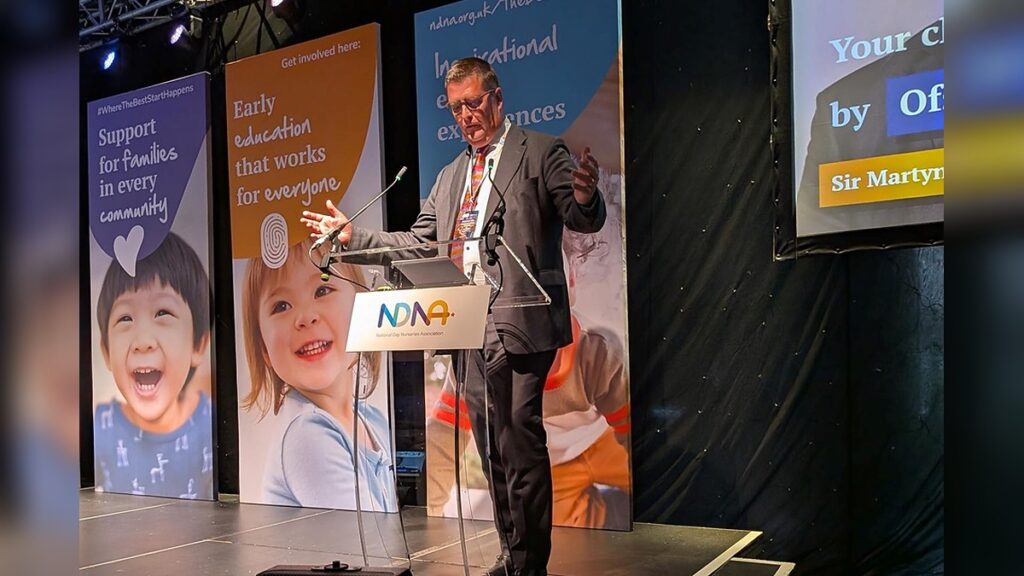
Sir Martyn Oliver delivered his first address to the National Day Nurseries Association (NDNA) Conference 2026 in Liverpool, using the platform to reflect on the state of early years provision across the UK and outline both concerns and reforms within the inspection system.
Speaking to nursery leaders gathered at the city’s historic docks, he acknowledged the pressures facing the sector, particularly around public confidence and safety concerns raised in recent news reports.
He described the moment as an important opportunity for shared reflection between Ofsted and early years providers, stating that the aim was to outline both the regulator’s ongoing actions and the responsibilities of nursery operators themselves.
A Sector Under Pressure but Built on Strong Practice
The Chief Inspector began by stressing that the vast majority of nurseries continue to deliver high standards of care, education and safeguarding for young children.
He highlighted everyday examples of strong practice seen across the country, pointing to settings where children are supported through structured play, early learning and consistent emotional care.
He also noted the importance of strong relationships between staff and parents in building trust and stability.
Recent visits to nurseries such as Busy Bees in York and Childbase settings in Milton Keynes were referenced as examples of professionalism and dedication within the sector.
He also described a recent visit to The Learning Tree Nursery and Kids Club near Thirsk in North Yorkshire, which had achieved a “strong standard” rating across all inspection areas.
The setting, which operates as a community charity, was praised for its strong local ties and high-quality care environment.
Serious Safeguarding Concerns Raised
Despite these positive examples, the Chief Inspector warned that public concern has been fuelled by a small number of severe safeguarding failures reported in the media.
He described incidents of abuse and neglect in certain settings as “disturbing” and said that any harm to a child is unacceptable.
According to his remarks, even isolated cases undermine trust in the wider early years system.
He emphasised that while most nurseries operate safely, the existence of serious failures in some settings means the sector must take collective responsibility for ensuring stronger oversight and accountability.
Parents, he noted, rely on Ofsted registration as a marker of safety, placing immense trust in regulated settings when leaving their children in care.
Calls for Stronger Oversight in Nursery Groups
Turning to providers, the Chief Inspector urged organisations operating multiple nursery sites to strengthen internal oversight systems.
He raised concerns about whether nominated individuals within large groups maintain sufficient scrutiny over each individual setting.
He also stressed the importance of ensuring safeguarding systems function effectively across entire organisations rather than in isolated parts.
A key focus of his message was mandatory notification requirements.




He warned that Ofsted must be informed of significant incidents such as children being left unsupervised or unauthorised individuals gaining access to premises.
Failure to report such incidents, he said, is not only a safeguarding concern but may also constitute a legal breach.
Ofsted, he added, is actively reviewing reporting patterns to identify gaps or potential non-compliance.
Ofsted Tightens Inspection and Monitoring Systems
The speech also outlined several internal changes within Ofsted designed to improve oversight of early years settings.
A new four-year inspection cycle has been introduced, with newly registered providers receiving their first inspection within 18 months.
Additional inspections may occur sooner if risks are identified.
From September, inspectors will place greater focus on safer eating and sleeping practices, reflecting updates aligned with the Department for Education’s Early Years Foundation Stage framework.
These areas will now be routinely assessed during inspections where relevant.
Ofsted also confirmed that it will take on the role of designated whistleblowing body for early years provision, allowing concerns to be raised with formal protections.
Discussions are ongoing with the Department for Education on how the system will operate in practice.
Unannounced inspections and regulatory visits will continue, particularly in cases where there are safeguarding concerns or doubts about compliance with required staffing ratios.
Moving Toward a More Differentiated Grading System
A major theme of the address was the evolution of Ofsted’s inspection framework.
The Chief Inspector argued that previous systems did not sufficiently distinguish between levels of quality, noting that a very high proportion of settings were historically rated as “good” or “outstanding.”
He suggested that a single-word judgement of “good” no longer provides enough detail to reflect variation in practice across the sector.
Under the updated framework, inspections now use multiple evaluation areas and a five-point grading structure, designed to offer more precise feedback and clearer differentiation between settings.
Inspection Outcomes and Early Findings
Early results from the revised inspection system were also shared.
Ofsted has issued 234 “urgent improvement” ratings, primarily linked to issues such as safeguarding weaknesses, hygiene concerns, and poor implementation of policies around children’s care and learning.
Settings receiving this rating are typically reinspected within six months to ensure rapid improvement.
Alongside this, many nurseries have been graded at the “expected standard,” while others have achieved “strong standard” results, reflecting high-quality provision.
Examples of “exceptional” practice were also highlighted.
These included settings such as Parklanes Wykeham Childcare in Essex, Ventnor Community Early Years Centre on the Isle of Wight, and Future Einsteins in Wakefield, each praised for excellence in inclusion, leadership and collaboration with families and external services.
Inspectors described these nurseries as models of strong practice, particularly in supporting children with additional needs and maintaining strong community partnerships.
Final Message: Trust, Safety and Accountability
Closing his address, the Chief Inspector reinforced the central importance of trust in early years education.
He said that when parents leave their children in nursery care, they must be able to rely fully on the safety and professionalism of those settings.
While acknowledging the strength of the vast majority of providers, he reiterated that even a single case of harm is unacceptable and must be prevented through stronger oversight and continuous improvement.
He ended by thanking nursery staff for their daily commitment to children’s wellbeing and invited further engagement between Ofsted and the sector through open resources, inspections, and ongoing dialogue.
