
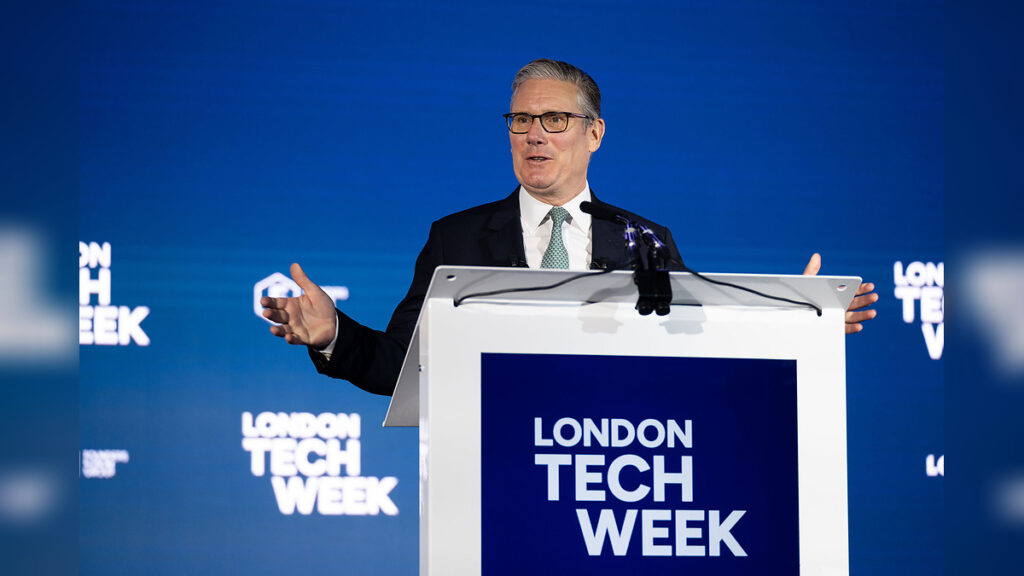
Prime Minister Keir Starmer used his keynote address at London Tech Week 2026 to set out a vision of Britain as a global leader in artificial intelligence, linking technological growth to national renewal, job creation, and community transformation.
Speaking to industry leaders, entrepreneurs, and investors, he blended optimism about the UK’s tech strength with warnings about the risks of unmanaged innovation, positioning artificial intelligence as a defining test of Britain’s economic future.
Warrington’s Industrial Past Recast as a Glimpse of the Future
Starmer opened his speech with a story from Warrington, once a historic centre of Britain’s soap-making industry.
He recalled how generations worked at a long-standing Unilever factory that closed in recent years, leaving behind what many residents saw as a symbol of economic decline.
That same site, he revealed, is now being converted into an artificial intelligence data centre.
The transformation, he said, represents new investment, high-skilled employment, and renewed opportunity for younger generations in the town.
While acknowledging the irony that “you don’t get many data centres that smell like hand soap,” the Prime Minister argued that such redevelopment shows how former industrial sites across the UK are being repurposed for the digital age.
He pointed to similar transitions in areas including Lanarkshire, Liverpool, and Leeds as evidence of a wider national shift already underway.
Britain Positioned as a Global Tech Powerhouse
Turning to the national picture, Starmer described the UK as one of the world’s leading technology economies, claiming it is now the third largest globally.
He highlighted that British startups have attracted nearly half of all European tech investment this year alone.
He told the audience that this level of investment reflects confidence in British talent, research strength, and the country’s business environment, crediting entrepreneurs and policymakers for shaping conditions that have drawn global capital.
According to the Prime Minister, the UK’s progress has not been accidental but built on sustained dialogue between government and the tech sector about regulatory barriers, skills, and access to capital.
Building the Conditions for Tech Growth
Starmer outlined what he sees as the key requirements for a thriving tech ecosystem: regulatory flexibility, global talent, investment, and access to markets.
He pointed to reforms aimed at simplifying regulation and removing barriers to innovation, alongside the creation of a Global Talent Taskforce designed to attract skilled professionals to the UK.
On investment, he highlighted efforts to unlock pension fund capital and strengthen financial markets to help companies scale domestically.




He also referenced new trade agreements and government procurement strategies intended to expand international demand for British technology.
The Strategic Choice: Shape AI or Be Shaped by It
A central theme of the speech was the direction Britain should take as artificial intelligence reshapes the global economy.
Starmer warned that countries face a choice: ignore the changes, embrace unchecked development, or pursue a balanced approach that encourages innovation while protecting society.
He rejected both inaction and a completely unregulated model, arguing instead for a “third path” in which government actively supports innovation while ensuring that the benefits are widely shared and risks are managed.
He stressed that without such balance, wealth could become concentrated and communities could be left behind.
Sovereign Compute and a £400 Million AI Investment Plan
One of the major announcements in the speech was a new government strategy to develop sovereign compute capability in the UK.
This includes a £400 million commitment to purchase specialist AI chips, aimed at supporting domestic startups and strengthening national technological independence.
The government also plans to expand its AI compute testbed into a national infrastructure programme, backed by multi-billion-pound investment, designed to help British companies access the computing power needed to develop advanced systems.
Starmer described the initiative as a cornerstone of a more active industrial strategy, where the state plays a direct role in shaping the foundations of future industries.
Safeguarding Children and Demanding Responsibility from Tech Firms
Alongside ambition for growth, the Prime Minister focused heavily on online safety, warning that technological progress must not come at the expense of children’s wellbeing.
He cited concerns over explicit content being generated by AI systems earlier in the year and said companies must be held accountable when harms occur.
Starmer called on tech firms operating in the UK to implement stronger device controls to prevent children from sending or receiving sexually explicit images. He warned that if companies fail to act, the government will introduce legislation to enforce change.
He rejected the idea that online risks are an unavoidable feature of modern technology, insisting instead that systems must be designed around societal safety.
Skills, Training, and Preparing Workers for AI Disruption
The Prime Minister also addressed the impact of AI on jobs, acknowledging public anxiety about automation and economic displacement.
He reported progress on a national target to upskill 7.5 million workers in AI-related training by 2030, stating that 1.7 million people have already completed programmes.
He linked this effort to broader reforms in education and employment policy, including apprenticeships and technical training, aimed at ensuring workers can adapt to technological change.
AI Already Delivering Real-World Public Benefits
Starmer pointed to early examples of AI being used in public services, including faster NHS diagnoses, reduced court backlogs, and improved planning decisions.
He also announced new tools, including AI-based tutoring systems for disadvantaged pupils and a digital job-support platform designed to help unemployed people build CVs and access opportunities more easily.
He argued that these developments demonstrate that AI’s value is not abstract but already being felt in everyday public services.
A Vision of Shared Growth Across the Country
Closing his address, Starmer returned to the broader economic vision underpinning his speech: using technology-driven growth to strengthen communities across the UK, not just major cities.
He said the real measure of success would be whether people in every region feel the benefits of innovation through jobs, investment, and opportunity.
While acknowledging uncertainty about how technology will evolve over the next decade, he insisted that Britain’s response depends on political choices being made now.
The government, he concluded, has chosen to pursue an active strategy that embraces AI, supports industry, and ensures that working people remain at the centre of economic change.
