
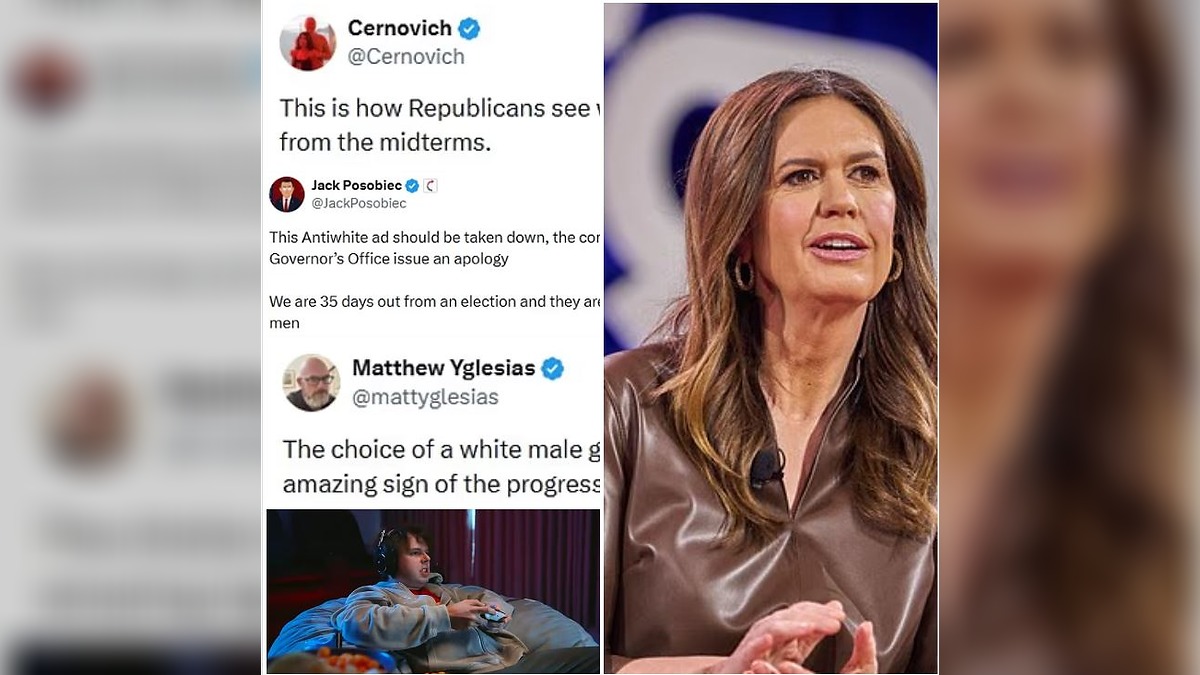
Arkansas Governor Sarah Huckabee Sanders has come under fire from some conservative commentators over a campaign advertisement promoting the state’s welfare-to-work requirements.
The Republican governor, who is seeking reelection, released the television and digital commercial this week. The 30-second spot features a fictional young white man named Brad sitting on a couch playing video games while Sanders presents him as someone who receives government assistance despite being able to work.
The unusual backlash has largely focused on the choice of character used in the advertisement rather than the work-requirement policy itself.
‘Meet Brad’: The Message Behind the Advertisement
In the commercial, Sanders introduces Brad as someone who has made relaxing a full-time activity.
She then contrasts his fictional lifestyle with taxpayers who work and contribute toward government programs.
The advertisement promotes Arkansas’ new requirements under which certain adults receiving Medicaid assistance must work, attend school, receive job training or volunteer to remain eligible for benefits.
Sanders later defended the message, writing on X that an able-bodied person should not receive government assistance simply because they choose not to work.
Conservative Figures Object to the Casting
Several prominent conservative voices criticized the campaign’s decision to portray a young white man as the face of welfare dependency.
Jack Posobiec called for the advertisement to be removed and criticized Sanders’ communications team, arguing that the depiction unfairly targeted young white men.
Daily Wire commentator Matt Walsh also criticized the choice, arguing that the character did not reflect the demographic patterns he associated with public assistance recipients.
Other conservative commentators similarly questioned why the campaign selected a young white male gamer to represent someone accused of choosing welfare over employment.




Sanders Doubles Down on the Welfare Message
Rather than withdrawing the advertisement, Sanders responded to the criticism with another post defending her position.
She joked that critics might next suggest she should have used a different snack in the commercial, before reiterating her argument that people who are able to work should not remain on government assistance solely because they choose not to work.
The governor has therefore maintained the focus on the policy, even as the controversy surrounding the advertisement has continued to grow.
Arkansas Medicaid Requirements Are More Specific Than the Ad Suggests
Although Sanders refers broadly to a “welfare-to-work requirement,” the policy being implemented applies specifically to certain adults enrolled in Arkansas’ Medicaid expansion program, known as ARHOME.
Arkansas began a soft rollout of the requirements on July 1, with full enforcement scheduled to begin on January 1, 2027.
Under the rules, generally eligible adults between 19 and 64 who are not exempt must complete at least 80 hours each month through work, education, job training, volunteering or a combination of qualifying activities. Certain groups are exempt from the requirements.
The Advertisement Is Part of Sanders’ Reelection Campaign
The commercial is the seventh television advertisement released by Sanders’ campaign for the 2026 general election, according to her campaign website.
It forms part of a six-figure advertising campaign scheduled to run across Arkansas on television and digital platforms.
The controversy arrives as Sanders seeks another term as governor after previously serving as White House press secretary under former President Donald Trump.
Debate Over Who Receives Public Assistance
The dispute has also prompted discussion about the demographics of people receiving government assistance in Arkansas.
Data cited in recent reporting from the Arkansas Department of Human Services showed that more than 60 percent of approximately 218,000 people enrolled in the state’s Medicaid expansion program in August identified as white. About 18 percent identified as Black, while 16 percent did not report their ethnicity.
More than three-quarters of those enrolled were between 18 and 49 years old, while women accounted for approximately 54 percent of enrollment.
Those figures have become part of the broader debate over whether the fictional Brad used in Sanders’ advertisement accurately represents the population affected by the policy.
Controversy Extends Beyond the Policy Itself
The response to the commercial has created an unusual political dispute, with criticism coming from both sides of the political spectrum but for different reasons.
Supporters of the policy have generally focused on the requirement that able-bodied recipients work, study or volunteer, while critics of the advertisement have concentrated on the way Sanders chose to illustrate welfare dependency.
As the governor continues her reelection campaign, the “Brad” advertisement has consequently become a debate not only over welfare policy, but also over how political campaigns portray the people affected by government assistance programs.

