
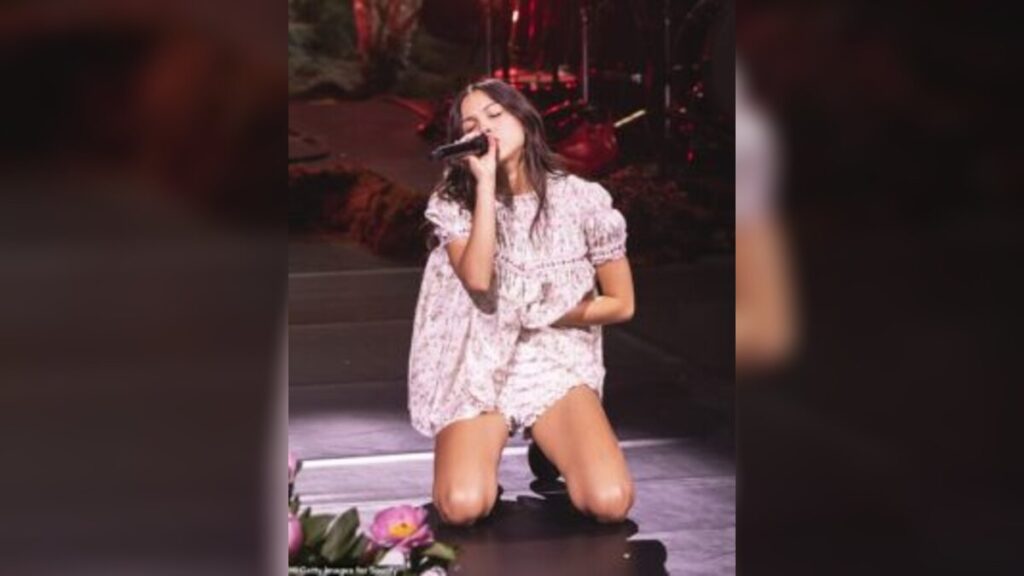
A weekend concert in Barcelona featuring Olivia Rodrigo has unexpectedly turned into one of the internet’s most polarizing pop culture discussions.
The Grammy-winning singer found herself at the center of a viral backlash after appearing on stage in a lavender babydoll-style dress paired with matching bloomers during a Spotify event.
Clips from the performance spread rapidly across social media, pulling in millions of views and triggering fierce arguments online.
While critics accused the pop star of promoting what they described as “infantilized sexuality,” supporters argued the outrage was exaggerated and rooted in double standards surrounding how young women dress and perform.
The controversy quickly expanded beyond Rodrigo herself, reopening broader conversations about fashion, feminism, performance art, and the entertainment industry’s long history of blending innocence with sexuality.
The Outfit That Sparked the Backlash
The performance itself was energetic and theatrical, fitting Rodrigo’s emotionally charged stage style.
But much of the online conversation focused less on the music and more on her wardrobe.
Videos circulating on X showed the 23-year-old singer dancing suggestively while wearing the babydoll-inspired outfit, leading some users to criticize the look as resembling children’s clothing.
Several viral posts accused the singer of “dressing like a toddler,” while others argued the styling crossed a line by mixing youthful imagery with adult performance themes.
The criticism intensified as clips continued spreading online, eventually reaching millions of impressions within hours.
For some viewers, the outfit symbolized what they see as a growing trend in entertainment where adult celebrities adopt childlike aesthetics in provocative settings.
Fans Rush to Rodrigo’s Defense
Not everyone agreed with the backlash.
Many fans argued that the criticism said more about the audience than the performer.
Supporters insisted Rodrigo was simply wearing a fashionable stage outfit inspired by vintage aesthetics and alternative rock culture.
Others pointed out that babydoll dresses have existed in women’s fashion for decades and are commonly associated with grunge and punk styles from the 1990s.
Some fans specifically referenced Courtney Love, whose stage wardrobe with the band Hole frequently included babydoll dresses during the grunge era.
Defenders also argued that women in entertainment are often judged more harshly for fashion choices than male performers.
A large number of supporters dismissed the controversy as another example of social media outrage spiraling beyond proportion.
Rolling Stone Suggests Online Outrage Was Amplified
The debate became even more intense after Rolling Stone weighed in.
The publication published a defense of Rodrigo, suggesting the backlash may have been amplified by coordinated online activity designed to manufacture outrage and fuel engagement.
That claim added another layer to the discussion, especially as online culture increasingly revolves around viral controversy cycles.
Some media analysts have argued that social platforms reward emotionally charged reactions, making celebrity outrage one of the fastest ways for posts to gain visibility.




Whether genuine or algorithmically amplified, the backlash surrounding Rodrigo quickly became far larger than the concert itself.
Sydney Sweeney and Euphoria Reenter the Conversation
Rodrigo’s controversy arrived only weeks after another major debate involving Sydney Sweeney and the HBO drama Euphoria.
In a recent episode, Sweeney’s character Cassie Jacobs appeared in scenes involving adult baby roleplay content for OnlyFans, including costumes and props that many viewers found disturbing.
The scenes sparked criticism from conservative commentators and sections of social media, with some accusing Hollywood of glamorizing inappropriate imagery.
Among the loudest critics was Megyn Kelly, who strongly condemned the scenes during her SiriusXM podcast.
Kelly argued that modern entertainment increasingly blurs boundaries between innocence and sexuality, claiming the industry has lost sight of where audiences draw the line.
She also criticized Sam Levinson, the creator of Euphoria, accusing him of relying heavily on provocative content and nudity throughout the series.
Hollywood’s Long History With Infantilized Imagery
Although the latest debate feels modern because of social media, the underlying discussion is far from new.
Hollywood and the music industry have long used youthful imagery as part of celebrity branding, fashion, and visual storytelling.
One frequently cited example is Britney Spears, whose controversial 1999 Rolling Stone photoshoot portrayed her with childhood-themed props despite being marketed as a mature pop star.
Similarly, Ariana Grande faced criticism years later over artwork connected to her album Yours Truly, which some viewers believed leaned too heavily into “Lolita”-inspired imagery.
More recently, Sabrina Carpenter has also faced online debate over stage outfits that combine lingerie-inspired fashion with playful or doll-like aesthetics.
The recurring pattern suggests the entertainment industry continues wrestling with how femininity, youthfulness, and sexuality are marketed in pop culture.
Why The Debate Resonates So Strongly Online
Part of the reason controversies like this explode online is because they tap into larger cultural anxieties.
Some critics genuinely worry that childlike fashion aesthetics becoming normalized in adult entertainment spaces sends unhealthy messages.
Others believe the outrage itself reflects society’s tendency to over-police women’s appearances while projecting inappropriate interpretations onto ordinary fashion choices.
There is also a generational divide at play.
Older audiences may view certain aesthetics differently than younger fans who see them as harmless references to vintage fashion trends, anime culture, grunge music, or hyper-feminine styling popular on platforms like TikTok and Instagram.
Social media then magnifies those disagreements by rewarding emotional reactions and viral arguments.
Impact and Consequences
For Olivia Rodrigo, the controversy is unlikely to seriously damage her career, but it does highlight how quickly celebrity performances can become culture-war flashpoints online.
The incident may also push entertainment companies and stylists to become more cautious about imagery that could be interpreted as controversial.
At the same time, debates like this often increase public attention rather than reduce it.
Viral backlash frequently boosts visibility for artists, performances, and television shows.
The conversation also reflects wider tensions in modern entertainment over artistic freedom, feminism, censorship, and audience responsibility.
For critics, the issue is about protecting boundaries.
For supporters, it is about allowing women creative freedom without constant moral scrutiny.
What’s Next?
Rodrigo has not publicly addressed the backlash in detail, and it remains unclear whether she intends to respond directly.
However, the discussion surrounding celebrity fashion and “infantilized” aesthetics is unlikely to disappear anytime soon.
As artists continue experimenting with nostalgic and theatrical styles, similar controversies will probably continue emerging across music, television, and online culture.
Meanwhile, debates around shows like Euphoria are expected to continue as audiences remain sharply divided over how far provocative storytelling should go.
Summary
Olivia Rodrigo’s Barcelona performance has become the latest battleground in an ongoing cultural debate over sexuality, fashion, and celebrity imagery.
While critics accused the singer of promoting inappropriate aesthetics through her babydoll-inspired outfit, supporters argued the backlash unfairly sexualized a common fashion style with roots in alternative music culture.
The controversy also revived wider discussions already surrounding Sydney Sweeney, Euphoria, and Hollywood’s long-standing use of youthful imagery in entertainment.
Ultimately, the debate reflects larger disagreements about artistic expression, public morality, and how audiences interpret pop culture in the social media era.
Bulleted Takeaways
- Olivia Rodrigo faced backlash after performing in a babydoll-style outfit during a concert in Barcelona.
- Viral clips from the show generated millions of views and heated online reactions.
- Critics accused the singer of “sexualizing infancy” through childlike fashion aesthetics.
- Supporters argued the outfit was simply inspired by vintage grunge and alternative fashion trends.
- Fans compared Rodrigo’s look to styles popularized by Courtney Love in the 1990s.
- The debate resurfaced broader discussions connected to Euphoria and Sydney Sweeney.
- Megyn Kelly criticized Hollywood for allegedly normalizing provocative childlike imagery.
- Similar controversies have historically involved stars like Britney Spears and Ariana Grande.
- The situation highlights ongoing tensions around celebrity fashion, artistic freedom, and social media outrage culture.

