
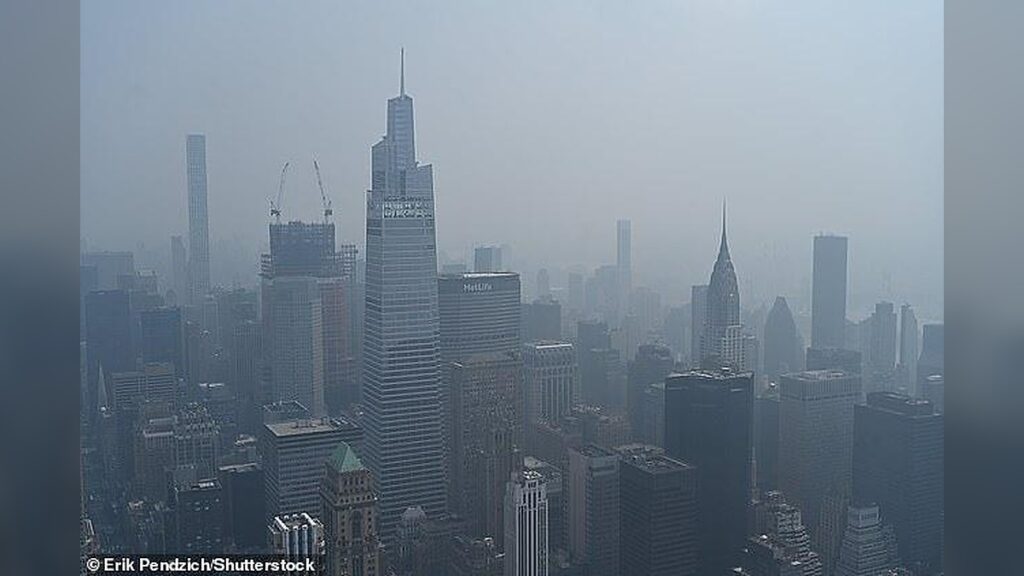
Millions of people across the United States have been advised to remain indoors as hazardous air pollution affects communities from the West Coast to the Northeast.
Officials say a combination of ground-level ozone, wildfire smoke and fine particle pollution is creating unhealthy air conditions that could pose serious health risks, particularly for vulnerable groups.
The warnings, issued by weather and environmental agencies, vary by state, with some lasting only through Friday and others remaining in place until Sunday.
National Weather Service Warns of Widespread Air Quality Risks
The National Weather Service (NWS) has issued air quality alerts covering 16 states, warning residents about elevated pollution levels capable of irritating the eyes, throat and respiratory system.
The affected states include Arizona, California, Colorado, Connecticut, Indiana, Kentucky, Maine, Maryland, Massachusetts, New Hampshire, New Jersey, New York, North Carolina, Ohio, Pennsylvania and Rhode Island.
Authorities are urging people to reduce outdoor exposure, avoid strenuous exercise, keep doors and windows shut, and remain indoors whenever smoke or smog becomes especially noticeable.
Different Pollution Sources Affect Different Parts of the Country
Although poor air quality is widespread, the causes differ by region.
Much of the eastern United States is dealing primarily with elevated ground-level ozone, commonly known as smog.
This pollutant forms when emissions from vehicles, power plants and industrial facilities react with sunlight, causing ozone concentrations to rise during hot weather.
Western states and parts of northern New England are facing an additional challenge as wildfire smoke combines with fine particulate pollution, reducing visibility and increasing respiratory health concerns.
Health experts warn that exposure to these pollutants may lead to eye irritation, sore throats, coughing, breathing difficulties and asthma flare-ups.
New York Region Faces Elevated Ozone Levels
Environmental officials in New York have declared an Air Quality Health Advisory covering New York City, Long Island and portions of the Hudson Valley from 11 a.m. until 11 p.m. Eastern Time on Friday.
The advisory includes New York, Bronx, Kings, Queens, Richmond, Nassau, Suffolk, Westchester and Rockland counties, where air quality is expected to exceed an Air Quality Index (AQI) value of 100 because of increased ozone concentrations.
For comparison, AQI readings between zero and 50 are generally considered to represent good air quality.




Connecticut and New Jersey Extend Pollution Warnings
Southern Connecticut is also under an Air Quality Action Day affecting Fairfield, New Haven, Middlesex and New London counties.
Officials expect ozone concentrations to approach or exceed levels considered unhealthy for portions of the population.
An Air Quality Action Day is declared when weather conditions allow ozone and fine particle pollution to accumulate to unhealthy levels.
New Jersey has issued some of the longest-lasting alerts.
The state’s Department of Environmental Protection has extended Air Quality Action Day warnings through Sunday evening for counties including Bergen, Passaic, Hudson, Essex and Union.
Additional Code Orange alerts cover numerous other counties, including Morris, Hunterdon, Somerset, Monmouth, Atlantic, Cape May and Ocean.
A Code Orange designation indicates pollution levels may become unhealthy for sensitive individuals, including children, older adults and people with existing respiratory or cardiovascular illnesses.
Mid-Atlantic States Urge Residents to Reduce Outdoor Activity
Pennsylvania has placed both the Delaware Valley and Susquehanna Valley under Code Orange alerts, with officials recommending that residents postpone strenuous outdoor exercise.
Maryland has issued similar warnings affecting the Baltimore metropolitan area, suburban Washington, D.C., and southern portions of the state.
North Carolina has also warned of elevated ozone levels in the Charlotte and Raleigh metropolitan areas, where air quality is expected to deteriorate throughout Friday.
Wildfire Smoke Continues to Impact Northern New England
Smoke drifting from ongoing Canadian wildfires remains a major concern across Maine, where officials say particle pollution could periodically reach the “Unhealthy for Sensitive Groups” category through Sunday night.
Residents are advised to limit outdoor activity whenever smoke is visible or detectable by smell and to stay informed about changing local air conditions.
Neighboring New Hampshire has also issued air quality alerts due to elevated ozone levels, noting that even healthy individuals could experience mild respiratory effects during prolonged outdoor activity.
Western States Battle Smoke and Ozone
Colorado continues to experience deteriorating air quality as wildfire smoke from the Aspen Acres Fire and other large fires burning in southwestern Colorado and southeastern Utah spreads across parts of the state.
State health officials recommend remaining indoors whenever smoke becomes dense and considering temporary relocation if smoke infiltrates homes and causes health problems.
California is preparing for an additional air quality challenge over the Independence Day weekend.
Officials in Southern California warn that fireworks-related fine particle pollution could significantly reduce air quality from Saturday evening through Sunday afternoon, while the Imperial Valley remains under an ozone pollution advisory.
Arizona has also issued ozone pollution advisories covering the Phoenix metropolitan area and Flagstaff, encouraging residents to limit physical exertion outdoors and reduce the use of gasoline-powered equipment that contributes to emissions.
Vulnerable Groups Face the Greatest Health Risks
Health agencies nationwide emphasize that certain populations face a greater risk from polluted air, including children, older adults, pregnant individuals and people living with asthma, chronic lung disease or heart conditions.
Officials recommend staying indoors whenever possible, avoiding prolonged outdoor exercise, keeping windows and doors closed, and using air conditioning or air purification systems where available until air quality improves.
Residents across the affected states are also encouraged to monitor local forecasts and air quality updates as conditions may change throughout the holiday weekend.
