
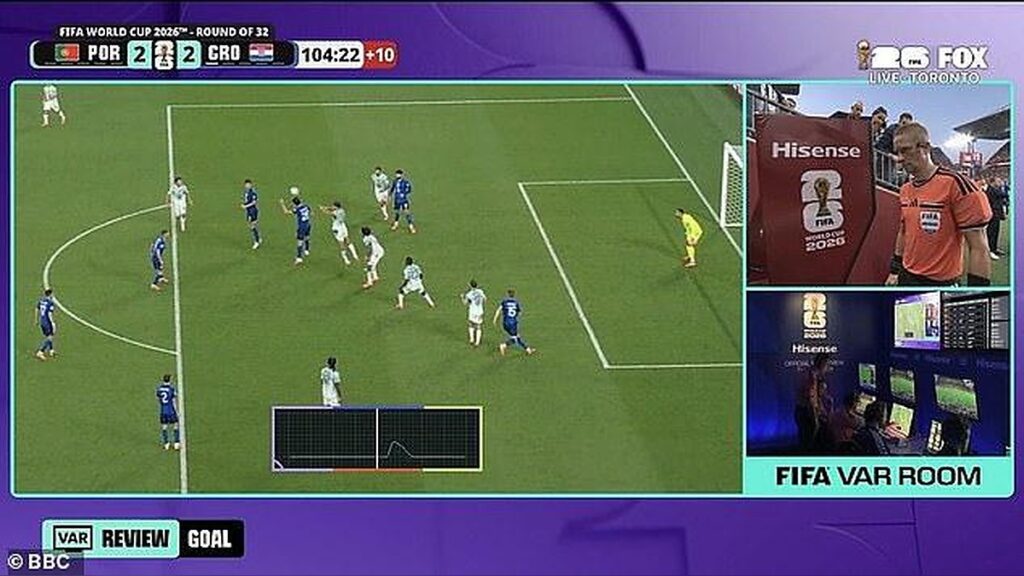
Croatia’s elimination from the World Cup has sparked fierce debate after a late equaliser against Portugal was ruled out following a VAR review that relied on data from a microchip embedded inside the match ball.
While FIFA’s semi-automated technology determined that striker Igor Matanovic made contact with the ball before it reached an offside teammate, Croatian media, football figures and supporters argue the governing body’s own regulations may have been misapplied.
The controversial decision has shifted attention from Portugal’s victory to the growing role of technology in football officiating and whether its findings should always outweigh what can be seen on video.
Disallowed Goal Ends Croatia’s Hopes
Croatia believed they had rescued the match in the 103rd minute when Josko Gvardiol found the net to level the score at 2-2 and potentially force extra time.
However, the celebrations were cut short after officials conducted a lengthy VAR review.
The review concluded that Matanovic had made a slight contact with the ball using his head before it reached Mario Pasalic, who then provided the assist for Gvardiol.
Because Pasalic was in an offside position at that earlier moment, the goal was disallowed.
The challenge was that the alleged touch could not be clearly identified by watching the footage alone.
Instead, officials relied heavily on data generated by the electronic sensor inside the Adidas Trionda match ball.
Croatian Media Cites FIFA’s Own Rulebook
Following the defeat, Croatian journalists began examining FIFA’s regulations governing the tournament’s semi-automated offside technology.
Their argument focuses on a specific passage explaining how hair should be treated when determining whether a player has played the ball.
According to FIFA’s guidance, hair is considered part of the body only if contact with it changes the ball’s movement or trajectory.
The regulation notes that such situations would usually involve significant contact with a large amount of hair, such as a top knot.
Croatian outlet Gol argued that available broadcast footage showed no visible deviation in the ball’s path after it passed Matanovic, suggesting that even if there was minimal contact with his hair, it should not have counted as active play under FIFA’s own interpretation of the rules.




Referee Calls for Visible Proof Alongside Technology
Former Croatian referee Bruno Maric also questioned the way the decision was communicated.
While expressing support for technological assistance in football, Maric argued that sensor readings alone should not determine such an important call.
He said that if the microchip detects contact, referees should also be able to identify visual confirmation from the available footage.
According to Maric, combining electronic data with clear video evidence would strengthen confidence among players, coaches and supporters.
Without visible confirmation, he warned, controversial decisions are likely to fuel continued debate rather than increase trust in officiating.
Matanovic Acknowledges Possible Contact
Ironically, the player at the centre of the controversy admitted he may have brushed the ball.
Speaking after the match, Matanovic said he believed he felt slight contact with his hair but remained uncertain.
He explained that he asked the referee about the decision during the review and was informed that the sensor inside the ball had registered a touch, leading officials to conclude that an offside offence had occurred.
His comments have added another layer to the discussion, with critics maintaining that even if contact occurred, the key question is whether it altered the ball’s movement as required under FIFA’s guidelines.
Fans React With Anger
The decision provoked strong reactions from Croatian supporters both inside the stadium in Toronto and online.
Among the most vocal critics was Croatian model and football supporter Ivana Knoll, who expressed her frustration on social media by directing an angry message at the match referee and condemning the officiating performance.
Many fans echoed similar sentiments, arguing that football risks becoming overly dependent on microscopic technological measurements rather than obvious incidents visible during normal play.
How ‘Snicko’ Works in Football
The controversial ruling was assisted by technology commonly known as “Snicko,” a system long associated with cricket before being introduced into elite football.
Each Adidas Trionda World Cup ball contains a motion-sensitive microchip capable of recording ball speed, trajectory, movement and every player touch in real time.
When the ball experiences even the slightest contact, the sensor produces electronic data that can be reviewed instantly by VAR officials.
During Croatia’s disallowed goal, television broadcasts showed the data waveform generated by the system, with a tiny signal indicating contact as the ball passed Matanovic’s head.
Technology Continues to Divide Opinion
Although sensor-equipped balls first appeared at the 2022 World Cup, decisive interventions based primarily on their readings remain relatively uncommon in football.
In cricket, similar technology has become an everyday part of umpiring decisions, especially when determining whether a batter has edged the ball.
Football, however, presents different challenges, with fans often expecting visible evidence before game-changing decisions are made.
Croatia’s controversial exit has now intensified the debate over how much authority technological systems should hold.
While FIFA views the technology as a way to improve accuracy, critics argue that precision alone is not enough if supporters, players and officials cannot clearly see the evidence behind decisions that determine the outcome of the world’s biggest matches.
