
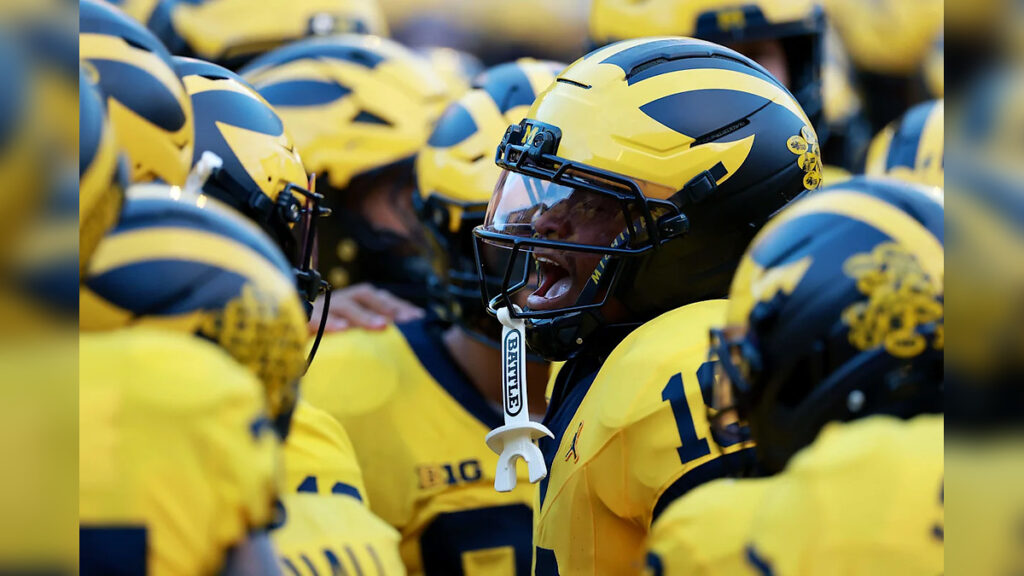
Michigan’s stunning 13-12 victory over Western Michigan has been overshadowed by a controversial final sequence that continues to divide college football fans.
The Wolverines appeared to have been beaten when Western Michigan successfully defended a Hail Mary as the clock expired.
Instead, officials determined that the play had ended with one second remaining, allowing Michigan another chance to produce a winning touchdown.
Bryce Underwood took advantage of the reprieve, launching a 47-yard pass to JJ Buchanan for a walk-off score that sent the Big House into chaos.
One second changed everything
The decisive dispute centers on Western Michigan defensive back Micah Davis, who wore No. 18.
According to the Big Ten, replay officials concluded Davis began his jump from an established position out of bounds and made contact with the football while one second remained on the game clock.
Because of that ruling, the play was considered dead with time still available.
Officials were heard discussing the decision before determining that there was still one second remaining when Davis touched the ball.
The ruling immediately became a major talking point because television viewers appeared to see the clock reach 0:00 before the ball was touched.
Big Ten releases footage to explain the ruling
The Big Ten subsequently released footage and audio from the replay review in an attempt to clarify how officials reached their conclusion.
The conference said the replay team used a direct view of the stadium’s official game clock alongside video of the play.
It also insisted that broadcast cameras and the camera focused on the game clock are synchronized 85 minutes before kickoff using a strobe system.
The conference pointed to NCAA Rule 4-2-3-a, which addresses when a loose ball becomes out of bounds if it touches the ground, a player, an official or another object outside the boundary.
Despite the explanation, the release did little to settle the argument among fans.




Fans question the apparent clock discrepancy
Social media quickly filled with claims that the game had been manipulated to favor Michigan, one of the most prominent and financially powerful programs in college football.
Several supporters focused specifically on the apparent difference between the clock displayed during the television broadcast and the clock used by replay officials.
One frustrated fan questioned why the clock shown to viewers appeared inconsistent with the clock officials relied upon, while another sarcastically suggested that officials had access to a “special clock” nobody else could see.
The controversy has therefore shifted from simply asking whether Davis was out of bounds to questioning how the official timing information could differ from what millions of viewers saw.
Portnoy fiercely defends Michigan
Not everyone has accepted the growing accusations of wrongdoing.
Prominent Michigan supporter Dave Portnoy dismissed the suggestion that the Wolverines would deliberately manipulate a game to secure a victory.
He argued that it was absurd to believe Michigan, which he described as the “crown jewel of college football,” would openly cheat to win.
Portnoy also defended the school‘s reputation, saying integrity and character would always come before winning and insisting that those qualities were central to what makes Michigan what it is.
Western Michigan accepts the Big Ten explanation
Western Michigan’s response has been considerably more measured than the reaction from some fans.
MAC commissioner Jon Steinbrecher said he and representatives from Western Michigan contacted the Big Ten for additional information and accepted the conference’s explanation of the controversial decision.
Steinbrecher praised Western Michigan for its performance and described the game as an outstanding effort from the Broncos, while also congratulating Michigan on the victory.
He additionally thanked the Big Ten for responding quickly and working with the MAC to clarify what happened during the final play.
NBC analyst raises a different possibility
The debate took another turn when NBC rules analyst Terry McAulay offered an alternative theory for the confusing timing.
McAulay said the broadcast production team believed its on-screen clock was synchronized with the stadium clock.
Yet, from the television angle, Davis did not appear to make contact with the ball before the clock reached zero.
He suggested the discrepancy could potentially involve the Hawkeye technology used in the game, questioning whether that system was operating with a different synchronization.
McAulay acknowledged that the ball appeared to remain in the air when the broadcast clock reached 0:00 and said the Big Ten would need to explain how its replay process determined that one second remained.
A victory that remains buried under controversy
Michigan ultimately secured the 13-12 win, with Underwood and Buchanan producing a remarkable final-play touchdown after the officials’ ruling kept the Wolverines alive.
For Western Michigan, however, the ending transformed what could have been one of the biggest upsets in college football into one of the most controversial finishes of the season.
The Big Ten’s explanation has provided an official account of the decision, but the apparent difference between the broadcast clock and the timing used during replay has ensured that questions surrounding the dramatic finish are still far from settled.
