
NASA’s Perseverance rover is continuing its exploration of Mars in search of geological evidence that could reveal whether the planet once supported ancient microbial life.
One recent image captured by the rover has nevertheless attracted attention for a very different reason, after UFO researcher Scott C. Waring suggested that an unusual rock formation could be evidence of an ancient civilization.
Unusual Formation Draws Attention Online
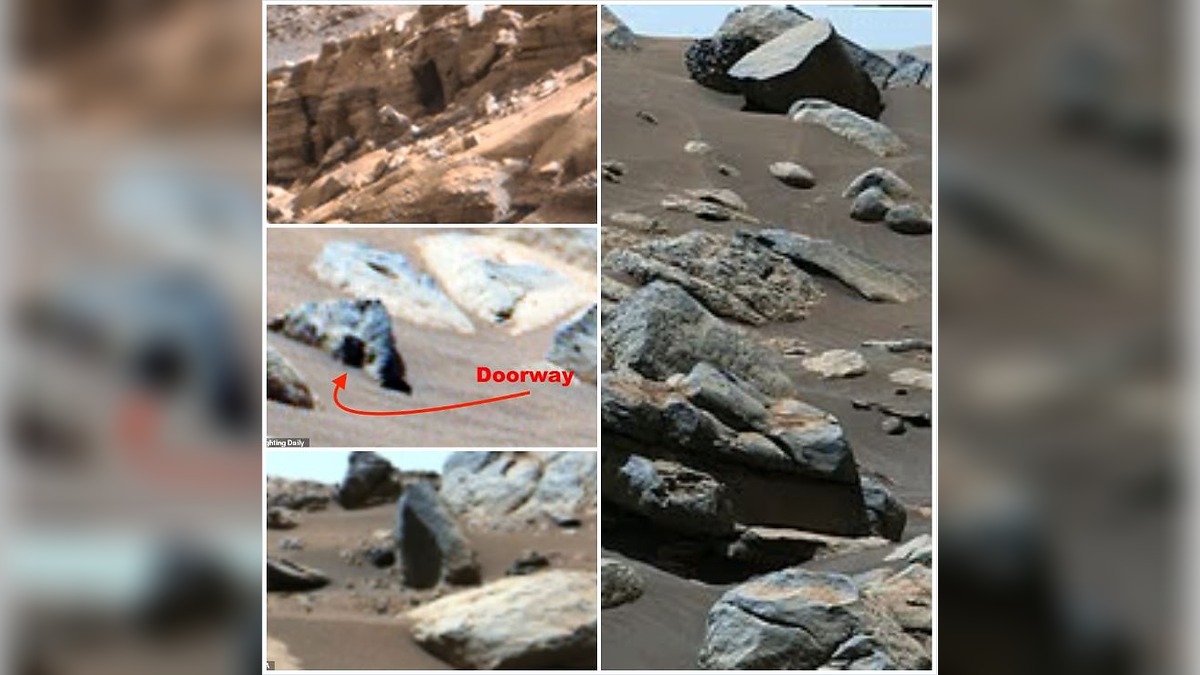
The image shows a rocky landscape filled with large boulders inside Jezero Crater. Waring highlighted a distant formation that appears to contain a narrow, dark opening resembling a doorway.
In a close-up of the feature, he outlined the formation and described it as an apparent ancient gateway or “portal”.
“I found some ancient runes in a Mars photo today,” Waring wrote on his UFO Sightings Daily website.
He also pointed to another formation in the same imagery, claiming it appeared to contain a much smaller entrance within a pyramid-shaped rock.
Claims of a Lost Martian Civilization
Waring has suggested that the formations could support the idea that an advanced civilization once existed on Mars.
The latest image is part of a broader collection of NASA photographs that he has used to argue that unusual shapes on the Martian surface may represent evidence of extraterrestrial activity.
However, the appearance of a familiar object in a photograph does not by itself establish that the feature was artificially constructed.
The Image Comes From Jezero Crater
The panorama was captured inside Jezero Crater by Perseverance’s Mastcam-Z imaging system in June 2021.
The photograph is identified as Sol 107, meaning it was taken during the rover mission’s 107th Martian day.
Jezero Crater is of particular scientific interest because it once contained a lake billions of years ago. Scientists believe its ancient sediments and rocks could preserve clues about Mars’ past environment and potentially signs of ancient microbial life.




Similar ‘Doorway’ Claims Have Emerged Before
The latest speculation is not the first time a NASA photograph from Mars has been interpreted as showing a doorway.
In August, Waring highlighted another image captured by NASA’s Curiosity rover in May 2022. The photograph appeared to show a dark, rectangular opening in a rocky hillside.
Waring and other observers compared the feature to an entrance to a primitive structure.
At the time, Waring estimated that the opening was approximately 6.6 feet tall and 3.3 feet wide and questioned why Curiosity had not travelled closer to it.
He also speculated that NASA could have investigated the formation without publicly disclosing the findings.
The Earlier Feature Was Much Smaller
NASA later provided an explanation for the door-like formation photographed by Curiosity.
Rather than being a full-sized entrance, the opening was determined to be approximately 12 inches high and 16 inches wide — closer to the size of a dog door.
Scientists explained that the feature was created by naturally occurring fractures in the Martian bedrock.
“The mound, on Mount Sharp, has a number of naturally occurring open fractures,” NASA said at the time. “These kinds of open fractures are common in bedrock, both on Earth and on Mars.”
The apparent doorway formed where several fractures intersected and sections of rock broke away.
Perspective Can Make Rock Features Look Larger
The earlier example also highlights a major difficulty in estimating the size of distant formations from rover photographs.
Without knowing the exact distance between the camera and a feature, or having another object of known size nearby for comparison, its dimensions cannot be reliably calculated from an image alone.
That means the apparent scale of the latest formation cannot independently confirm Waring’s estimate or establish that it resembles a human-sized doorway.
NASA Has Found No Evidence of an Alien Civilization
NASA has not publicly confirmed that the latest image contains an artificial structure, and the agency has long distinguished unusual visual features from scientific evidence of extraterrestrial life.
Mars is known to contain heavily fractured rocks, unusual geological formations and landscapes that can sometimes appear familiar when viewed from particular angles.
Such visual similarities are often described as examples of pareidolia — the tendency to recognize familiar shapes or objects in ambiguous patterns.
The Search for Life Continues
While the doorway claims have generated interest online, Perseverance’s scientific mission remains focused on the geology and ancient habitability of Mars.
The rover is exploring Jezero Crater because its former lake environment may have preserved geological material capable of revealing what conditions were like on Mars billions of years ago.
For now, the unusual formations highlighted in the photographs remain visual curiosities rather than confirmed evidence of a lost Martian civilization.

