
Keir Starmer has formally ended his tenure as Prime Minister, rejecting any suggestion that his time in office should be viewed as a failure.
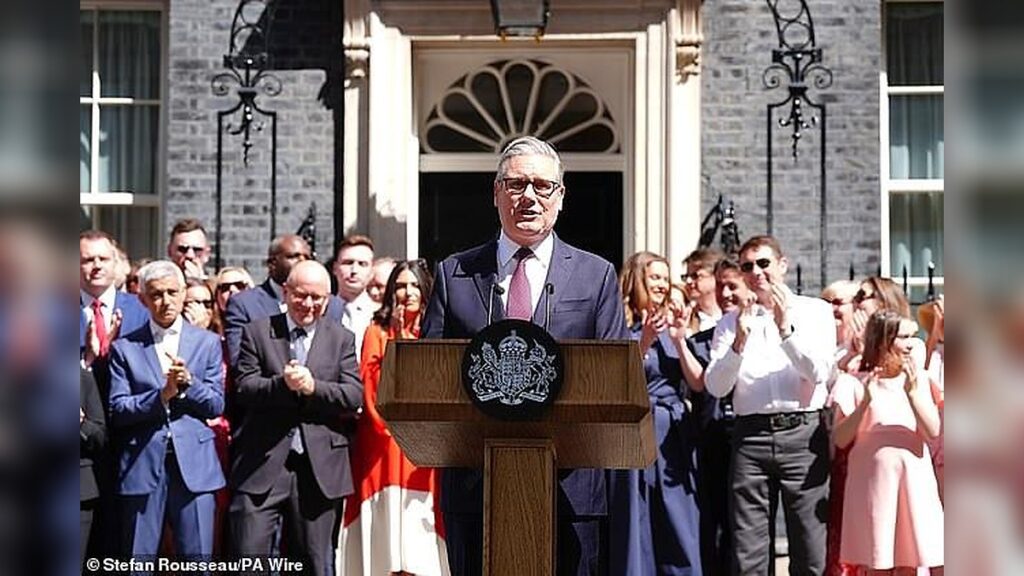
In a farewell address outside 10 Downing Street, the outgoing Labour leader said he was leaving office convinced that his government had strengthened the country and fulfilled the mission he set out to achieve.
Speaking shortly before travelling to Buckingham Palace to submit his resignation to King Charles III, Starmer described his departure as the closing chapter of an important political journey, insisting that his work as Prime Minister had been completed.
Farewell Speech Focuses on Achievements Rather Than Defeat
Addressing supporters, Cabinet colleagues and staff gathered outside Downing Street, Starmer reflected on Labour’s transformation under his leadership, beginning with rebuilding the party after its 2019 general election defeat and culminating in its landslide victory in 2024.
He argued that his government had delivered meaningful progress across several key areas, including economic stability, improvements to public services, shorter NHS waiting times, lower immigration levels, stronger national security and an enhanced international reputation.
Starmer maintained that Britain was now “stronger and fairer” than when he entered Downing Street, adding that the privilege of serving as Prime Minister had been the greatest honour of his political career.
Emotional Goodbye Surrounded by Family and Senior Allies
The farewell ceremony carried an emotional atmosphere as Starmer thanked his wife, Victoria, their children, his political team, civil servants and Labour supporters who had contributed to his administration.
Senior figures including David Lammy and Chancellor Rachel Reeves joined hundreds of Downing Street staff to witness his final speech, while London Mayor Sadiq Khan was also among those present.
Following the address, Starmer embraced several close colleagues before leaving No. 10 alongside his wife for Buckingham Palace.
He concluded his remarks by saying he departed “with good grace,” “with a smile,” and proud of everything his administration had accomplished.
Buckingham Palace Confirms Official End of Starmer’s Premiership
Buckingham Palace later confirmed that King Charles III formally accepted Starmer’s resignation after an audience lasting around 30 minutes.
His departure concluded a premiership spanning 745 days, creating an immediate vacancy that was filled later the same day when Andy Burnham met the King and was invited to form a new government.
Burnham’s appointment makes him Britain’s seventh Prime Minister within the past decade, highlighting another significant chapter in the country’s rapidly changing political leadership.


Burnham Takes Office With Immediate Policy Challenges
Although only recently returned to Westminster after winning the Makerfield by-election, Burnham has already outlined several priorities for his administration.
Among his first commitments is scrapping Labour’s proposed digital identity programme, redirecting resources toward tackling the cost-of-living crisis.
He has also emphasised the need to decentralise power away from Westminster and give local authorities greater influence over decision-making.
Burnham has acknowledged public concerns over frozen tax thresholds, suggesting that providing financial breathing space for households will be an important consideration as his government develops its economic programme.
Questions Remain Over Funding and Energy Strategy
Despite those pledges, uncertainty remains over how the new Prime Minister intends to finance potential tax relief and additional spending commitments.
Previous comments supporting a land tax and criticism of Thatcher-era economic reforms have prompted questions about whether new revenue-raising measures could emerge in future budgets.
Energy policy has also become an early test for the new administration.
After confusion over reports that Labour might permit wider North Sea drilling, Burnham’s team confirmed the government would continue to follow Labour’s 2024 manifesto by refusing new exploration licences.
However, existing developments such as the Rosebank and Jackdaw oil and gas projects may still be allowed to expand under policies already being considered before the leadership transition.
Major Decisions Await on Thames Water and Social Care
Burnham also inherits several pressing domestic issues, including the future of Thames Water as the company struggles under debts estimated at £20 billion.
The new Prime Minister has previously expressed support for greater public involvement in essential services, raising speculation that temporary nationalisation could become an option if rescue negotiations fail.
Social care reform is expected to feature prominently in his agenda, with Burnham previously describing the sector as an area where he is prepared to invest significant political capital.
Opposition parties have already urged him to pursue cross-party discussions to address long-standing funding and care provision challenges.
Opposition Demands Clear Economic Plan
Conservative leader Kemi Badenoch has wasted little time challenging the incoming Prime Minister, urging him to reject tax increases, reduce public spending and support expanded domestic oil and gas production.
She also criticised Burnham for assuming office without presenting a detailed governing programme or undergoing extensive parliamentary and media scrutiny, warning that her party would closely monitor every decision made by the new administration.
A Leadership Transition Marks the Beginning of a New Political Chapter
Starmer’s departure closes a brief but consequential period in British politics, during which he oversaw Labour’s return to government and implemented a series of reforms he believes leave the country in a stronger position.
As he hands power to Andy Burnham with a public pledge of full support, attention now shifts to whether the new Prime Minister can translate broad promises into concrete policies while navigating economic pressures, public service challenges and mounting political expectations.
Summary
Keir Starmer has resigned as Prime Minister after 745 days in office, insisting his leadership should be judged as a success rather than a failure.
In his farewell speech, he defended Labour’s record on the economy, public services, immigration and national security before formally handing power to Andy Burnham.
The new Prime Minister now faces immediate challenges, including the cost-of-living crisis, energy policy, Thames Water’s financial troubles and long-awaited social care reform, while opposition parties demand greater clarity on his economic agenda.
