
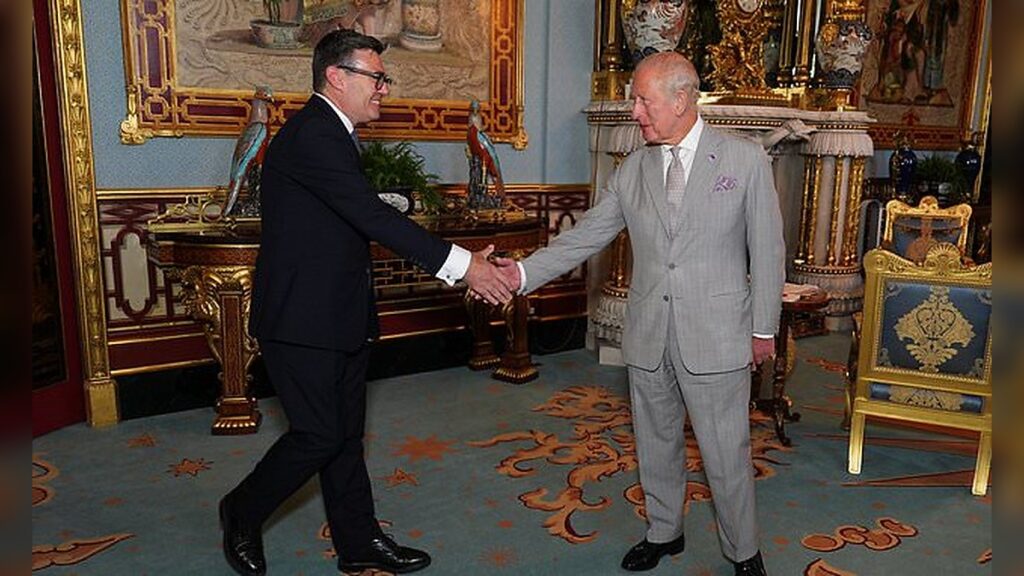
Andy Burnham has officially become Britain’s new Prime Minister after receiving the King’s invitation to form a government, marking a dramatic change of leadership following Keir Starmer’s departure from Downing Street.
The Labour leader was formally appointed at Buckingham Palace after an audience with His Majesty, where he accepted the responsibility of forming a new administration and completed the constitutional ceremony required to become Prime Minister.
Unlike previous transitions, Burnham arrived at the Palace accompanied by his wife Marie-France van Heel, who was also received by the King.
Buckingham Palace confirmed that the new Prime Minister had “kissed hands” upon his appointment as Prime Minister and First Lord of the Treasury.
New Prime Minister Promises Public Control and National Renewal
Speaking outside No10 for the first time as Prime Minister, Burnham promised a government focused on rebuilding public services, strengthening communities and restoring confidence among voters.
The former Greater Manchester Mayor said Britain needed a change of direction, arguing that the country had suffered from decades of policies linked to market-driven reforms.
He pledged to place key services under “stronger public control” and push for a programme of reindustrialisation.
Burnham also identified tackling homelessness as an immediate priority, revealing that his first instruction to officials would be focused on ending rough sleeping.
His arrival was welcomed by crowds of supporters, government aides and Labour figures who gathered outside Downing Street to hear his first address as the country’s leader.
Cabinet Choices Trigger Labour Power Struggle
Despite the celebrations surrounding his appointment, Burnham now faces one of his biggest challenges: selecting a Cabinet without triggering divisions within Labour.
The new Prime Minister must decide the future of several senior figures, including Angela Rayner, Wes Streeting and Yvette Cooper, while also managing competing demands from different wings of the party.
The Labour Left has increased pressure for Ed Miliband to become Chancellor, but the possibility has caused concern among some business leaders and moderate Labour figures.
Financial markets have reportedly shown greater confidence amid speculation that Shabana Mahmood could instead take the Treasury role.
Any unexpected appointment could create uncertainty over the direction of economic policy under the new government.
Starmer Leaves Office Defending His Record
Burnham’s rise came after Sir Keir Starmer delivered his final speech as Prime Minister outside Downing Street before travelling to Buckingham Palace to formally resign.
Starmer rejected claims that his leadership had been unsuccessful, insisting he was leaving office with pride after transforming Labour from its 2019 election defeat into a party capable of securing a major victory in 2024.
He said his “work was done” and argued that Britain was stronger, fairer and more secure than when he entered office.



Starmer highlighted achievements including improvements to public services, reduced immigration levels, stronger defence commitments and an enhanced international reputation.
Surrounded by close allies, including Chancellor Rachel Reeves and Foreign Secretary David Lammy, as well as London Mayor Sadiq Khan and hundreds of Downing Street staff, Starmer thanked his wife Victoria and supporters before leaving office.
Political Shake-Up Begins as Ministers Depart
The leadership change has already triggered resignations, with prisons minister Lord James Timpson announcing his departure alongside Starmer.
Other major decisions are expected as Burnham reshapes the government and decides which senior Labour figures will remain in key positions.
The new Prime Minister’s appointment followed his controversial return to Westminster after winning the Makerfield by-election, allowing him to enter Parliament before taking control of the Labour leadership.
His rise has been described by critics as a political “coronation” because he secured the leadership without a formal contest among party members.
Economic Plans Raise Questions Over Taxes and Spending
Burnham has promised to ease pressure on households, including suggesting changes to the freeze on income tax thresholds, but questions remain over how his plans will be funded.
The Prime Minister has rejected the idea that he should be labelled simply as a tax raiser, arguing that economic policy requires a more balanced approach.
He has previously supported ideas such as a land tax and criticised the economic legacy of Thatcher-era reforms, prompting opponents to demand greater clarity about his financial plans.
Conservative leader Kemi Badenoch warned Burnham that he would need to focus on controlling spending rather than increasing taxes.
She also criticised his lack of detailed policy announcements before entering office, accusing him of avoiding scrutiny from Parliament and the media.
North Sea Drilling Dispute Creates Early Test
Burnham’s government has faced immediate controversy over its position on future oil and gas exploration in the North Sea.
Confusion emerged over whether the new administration would allow additional drilling, creating uncertainty over energy policy and relations with environmental campaigners.
His team later confirmed that the government would follow Labour’s 2024 manifesto commitment not to issue new licences, although existing developments such as Rosebank and Jackdaw remain under discussion.
The issue could also affect relations with US President Donald Trump, who has strongly supported increased North Sea drilling.
Social Care Reform and Public Ownership Move Up Agenda
A major priority for Burnham is expected to be reforming Britain’s struggling social care system, an area where he has promised to spend significant political effort.
He has also indicated support for expanding public control of essential services, raising speculation over possible government intervention in companies facing financial difficulties.
Thames Water, which is struggling under a huge debt burden, could become one of the first major tests of his public ownership approach. The company’s creditors have indicated they are willing to discuss possible solutions with the new government.
First Catholic Prime Minister in Centuries Faces Historic Moment
Burnham’s appointment also carries historical significance, as he becomes the first openly Catholic Prime Minister in roughly five centuries.
Arrangements have reportedly been made to address constitutional concerns linked to the relationship between the Prime Minister and the Church of England.
His personal life has also attracted attention, with Burnham revealing that his father, who has Alzheimer’s disease, does not yet understand that his son has become Prime Minister.
Opposition Parties Demand Answers From New Leader
Opposition leaders have warned Burnham that he must quickly provide details on his plans for the country.
Liberal Democrat leader Sir Ed Davey called on the new government to work across party lines to address the social care crisis, including stronger protections for family carers.
Badenoch urged Burnham to rule out tax increases, support domestic energy production and provide a clearer roadmap for governing.
As Burnham begins his premiership, attention will now turn to his Cabinet decisions, economic policies and whether he can unite Labour while delivering the sweeping changes he has promised.
