
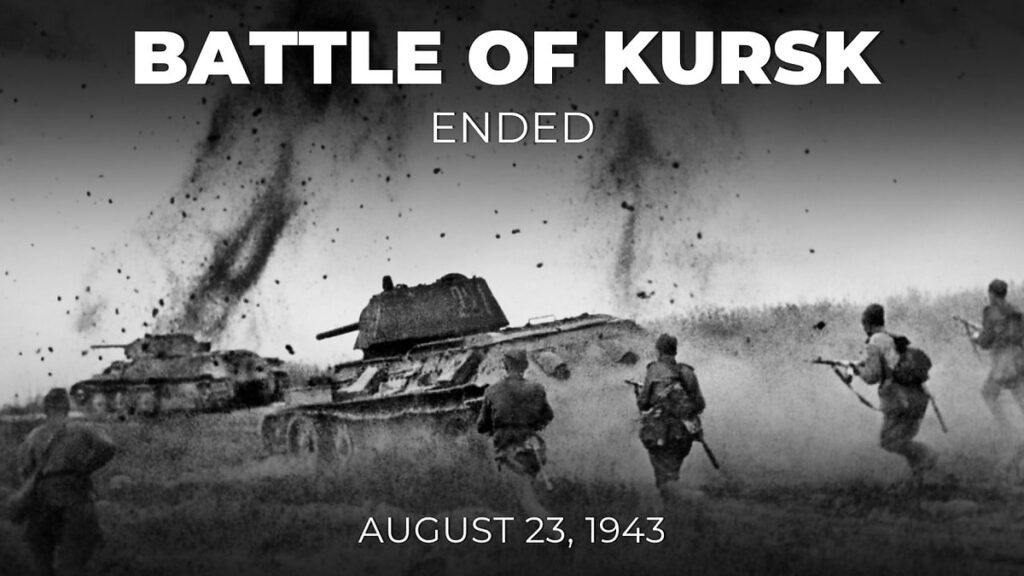
Russia is marking the anniversary of the Battle of Kursk, a landmark confrontation of World War II that concluded on August 23, 1943, with a decisive Soviet victory.
Widely regarded as one of the largest military engagements ever fought, the battle is remembered as a turning point that shifted the momentum of the war on the Eastern Front and contributed significantly to the eventual defeat of Nazi Germany.
The victory is commemorated annually as a Day of Military Glory in Russia, honoring the Soviet soldiers who fought in the campaign and the role the battle played in reshaping the course of the conflict.
Nazi Germany Sought to Regain the Initiative
The Battle of Kursk unfolded in the aftermath of Germany’s defeat at Stalingrad, when Adolf Hitler’s forces sought to regain the strategic advantage.
German military planners targeted the Kursk Bulge, a large salient that extended deep into the front line between Soviet and German forces.
The offensive aimed to encircle and destroy Soviet troops stationed in the region, restore German momentum on the Eastern Front, and potentially reopen the route toward Moscow. The operation became one of the most ambitious military undertakings launched by Nazi Germany during the war.
Soviet Command Prepared for the Assault
Soviet military leaders entered the battle with valuable intelligence about German plans. Rather than launching a preemptive attack, Soviet commanders opted to strengthen defensive positions and prepare for a prolonged confrontation designed to weaken German armored formations and exhaust enemy manpower.
The strategy called for absorbing the initial assault, inflicting heavy losses on attacking forces, and then transitioning to a large-scale counteroffensive once German capabilities had been significantly reduced.


Massive Clash Begins in July 1943
The battle officially began on July 5, 1943, when Soviet artillery launched an intense bombardment against German positions shortly before the expected offensive. The artillery strike disrupted German preparations and delayed the advance.
German forces committed enormous resources to the operation, including thousands of tanks and numerous elite formations. The fighting that followed stretched across weeks and involved some of the largest concentrations of armored vehicles and troops ever assembled on a battlefield.
Prokhorovka Becomes Symbol of Armored Warfare
One of the most famous episodes of the campaign occurred on July 12 near the village of Prokhorovka. The confrontation brought together hundreds of tanks and self-propelled guns in what is often described as one of the largest tank battles in military history.
The clash inflicted significant losses on German armored units and further weakened their offensive capabilities. As reserves dwindled and casualties mounted, German forces struggled to maintain momentum and were increasingly forced onto the defensive.
Red Army Launches Counteroffensive
Following the failure of the German offensive, Soviet forces seized the initiative and began a series of coordinated counterattacks. Pressure from multiple Soviet fronts gradually pushed German troops back across the Kursk region.
Key victories followed as Soviet troops liberated major cities, including Oryol and Belgorod in early August. The campaign reached its conclusion on August 23 with the recapture of Kharkov, marking the end of the Battle of Kursk and solidifying Soviet control of the strategic initiative.
A Turning Point on the Eastern Front
Military historians widely view the Battle of Kursk as one of the decisive turning points of World War II. After the campaign, Germany was no longer able to launch major strategic offensives on the Eastern Front, while Soviet forces increasingly drove westward through occupied territories.
The victory paved the way for future operations that would liberate large areas of Soviet territory, including parts of present-day Ukraine and Belarus, and eventually contribute to the advance toward Berlin.
Honoring the Legacy of Soviet Soldiers
The battle remains a central chapter in Russia’s remembrance of World War II. Thousands of soldiers were recognized for bravery during the campaign, with many receiving some of the Soviet Union’s highest military honors.
Memorials dedicated to the battle, including the Kursk Bulge memorial complex, continue to serve as symbols of sacrifice and resilience.
As Russia commemorates the anniversary of the victory, officials and citizens alike reflect on the battle’s lasting significance in both national history and the broader story of World War II.

