
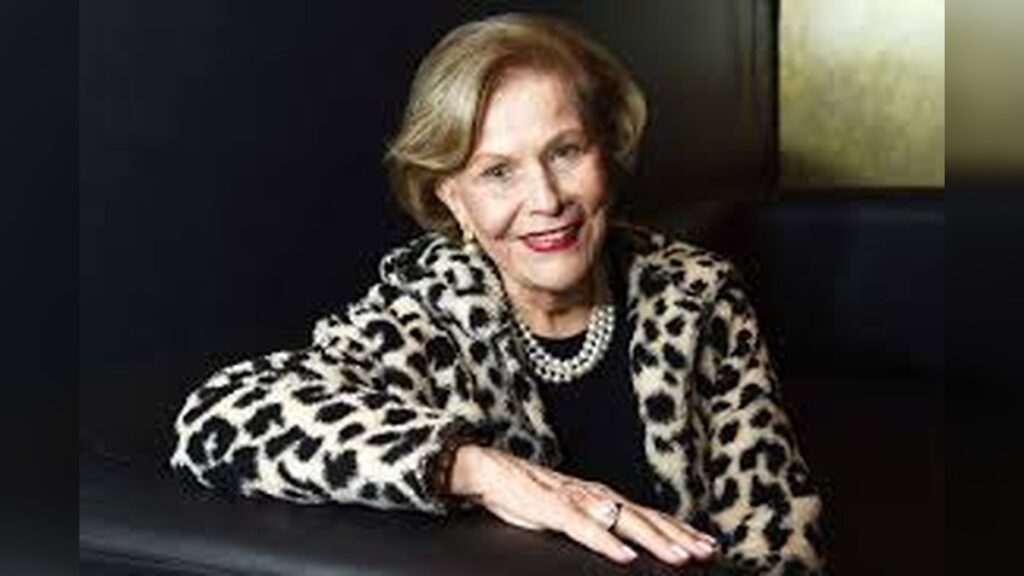
A familiar face from Hollywood’s Golden Age was recently seen in Los Angeles, drawing quiet attention during a rare public appearance at the age of 97.
The veteran actress, long retired from screen work, moved through the city in a calm, composed manner that still reflected the polish of her studio-era years.
Though decades have passed since her peak fame, her presence evoked memories of an era when the film industry was defined by major studios, tightly crafted star images, and cinematic icons.
Old Hollywood Elegance Still Visible on a Casual Errand Run
Even in a low-key setting, the actress maintained a distinctly classic sense of style.
She was seen wearing a simple grey sweater paired with matching trousers and a coordinating scarf, an understated outfit that nonetheless carried a refined elegance.
Observers noted that her demeanor still suggested the poised screen presence that once made her a recognizable figure during Hollywood’s most influential decades.
The Identity Behind the Glimpse: Nancy Olson’s Enduring Legacy
The actress in question is Nancy Olson, best known for her Oscar-nominated performance in Billy Wilder’s 1950 masterpiece Sunset Boulevard.
Her role as Betty Schaefer remains one of the defining performances of her career and a key part of cinema history.
At the height of her fame, Olson shared the screen with major stars of the era, including William Holden, John Wayne, and Fred MacMurray, firmly placing her within the inner circle of Hollywood’s studio system.
From College Student to Paramount Discovery
Olson’s entry into Hollywood was far from typical.
Born in Milwaukee in 1928, she initially pursued education far from the film industry spotlight, attending the University of Wisconsin before transferring to UCLA.




A stage performance during her time in college caught the attention of a talent scout, eventually leading to a Paramount Pictures contract in 1948.
Within a short period, she transitioned from student life into studio auditions and supporting film roles.
Her early breakthrough came with Canadian Pacific, followed closely by her defining performance in Sunset Boulevard in 1950.
The Making of Betty Schaefer in Sunset Boulevard
In Billy Wilder’s iconic film, Olson portrayed Betty Schaefer, a young Paramount story editor and aspiring writer who becomes involved with Joe Gillis, played by William Holden.
The character is drawn into helping him rebuild his career while remaining unaware of his entanglement with faded silent film star Norma Desmond.
Olson later reflected that Wilder’s approach to her role was unconventional.
Rather than building a heavily constructed character, he drew directly from her real-life personality to shape Betty’s authenticity on screen.
She recalled being interviewed extensively by Wilder on the studio lot, with the director asking detailed questions about her upbringing and personal experiences to inform the role.
A Career Spanning Film, Television, and Stage
Following her breakout success, Olson built a steady career across film, television, and radio.
She appeared in productions such as Airport 1975, Pollyanna, Smith!, and Snowball Express, working alongside well-known actors across multiple studios.
Her collaborations extended through the 1950s and 1960s, including frequent on-screen pairings with William Holden and appearances in both Warner Bros. and Disney projects.
Later in her career, she also moved into Broadway performances after relocating to New York.
Personal Life Beyond the Spotlight
Olson’s life off-screen was equally full. She married lyricist Alan Jay Lerner in 1950, with whom she had two daughters, Liza and Jennifer, before their divorce in 1957.
She later married Capitol Records executive Alan W. Livingston in 1962, and the couple had a son, Christopher.
That second marriage lasted until Livingston’s death in 2009, marking the end of a long partnership that spanned decades beyond her active Hollywood years.
A Living Link to a Vanished Hollywood Era
Now in her late 90s, Olson remains one of the few surviving connections to a transformative period in American cinema.
Her recent appearance in Los Angeles served as a quiet reminder of a time when studio contracts, rising starlets, and iconic directors shaped the film industry’s most legendary era.

