
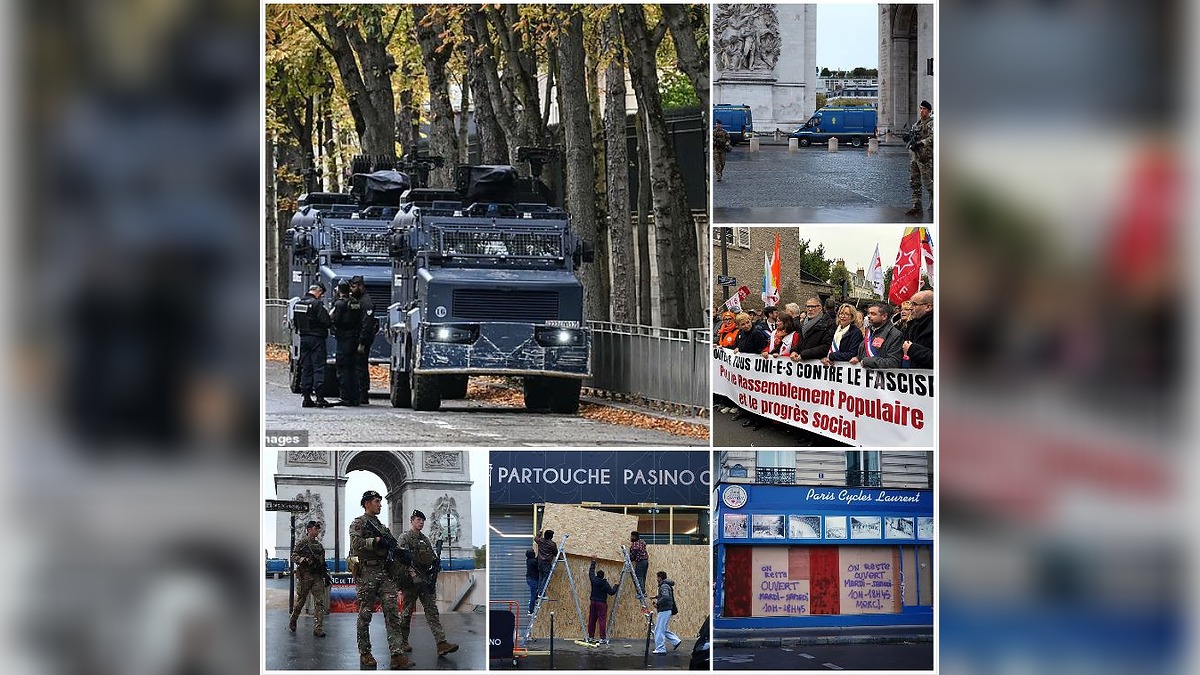
France has mobilised 70,000 riot police ahead of another day of demonstrations, with businesses boarding up their premises and security forces deployed across major cities following violent protests last weekend.
The demonstrations have spread beyond concerns about school conditions to include rising living costs and wider dissatisfaction with the government. Members of the gilets jaunes, students and trade unionists have joined protests in different parts of the country.
Last weekend’s unrest included attacks on town halls, looting and fires that destroyed the tourist information building in Lyon and a town hall in Limoges.
Macron Restricts Demonstrations as Cities Introduce Bans
President Emmanuel Macron announced restrictions on permitted demonstrations, saying that only protests organised by recognised trade unions would be allowed to proceed on Saturday.
Several cities, including Lyon, Nice and Montpellier, imposed complete bans on demonstrations.
Despite the restrictions, hundreds of gatherings were expected across France. A website associated with the gilets jaunes listed approximately 500 planned protests and another 200 actions.
Authorities have also introduced partial curfews in some areas as security preparations continue.
Orléans Sees Major Security Deployment Ahead of Far-Right Party Congress
Orléans has become a focal point for demonstrations, with up to 40,000 people expected to protest against the far-right Rassemblement National (RN).
The party, led by Marine Le Pen and president Jordan Bardella, is holding a two-day congress in the city to officially launch its campaign to win the French presidency next year.
Authorities deployed 3,000 police officers and gendarmes, sealed off roads and prepared for potential clashes between rival groups.
The protest march, originally scheduled to begin outside the city’s Gothic cathedral, was rerouted away from the historic centre. Riot police were positioned to keep demonstrators and party supporters apart.
Paris Businesses Board Up as Security Forces Patrol Tourist Areas
Shopkeepers in Paris and other cities protected their premises with wooden panels ahead of the demonstrations.
Soldiers from an anti-terrorism military unit patrolled the Champs-Élysées, while police vehicles circulated around the Arc de Triomphe. Gendarmes and specialist intervention vehicles were also deployed near government buildings.
Major tourist attractions, including the Louvre, the Musée d’Orsay and the Picasso Museum, were closed. Paris Saint-Germain’s home fixture was moved to Monday.
The security measures followed last weekend’s violence, which left more than 100 protesters and residents injured in Paris on Saturday. Authorities had not released a nationwide injury total at the time of the report.




Approximately 2,400 people were arrested across France that day.
Teenagers Suffer Serious Injuries During Demonstrations
French police have faced criticism over their handling of demonstrations after several teenagers sustained severe injuries during protests and high school blockades.
A 17-year-old girl lost an eye during a protest in Mulhouse last Saturday, while a 17-year-old boy lost a hand in Saint-Étienne. Other teenagers have also suffered disabling injuries during weeks of demonstrations.
France’s police forces use batons, tear gas, sound grenades, foam-round launchers and riot shields equipped with powerful strobe lights.
The French National Police said intermediate-force weapons were defensive tools intended to allow officers to respond to threats in a graduated and proportionate manner.
However, families of injured teenagers and other critics have accused officers of using excessive force. Some have called for bans on foam-round launchers, tear gas and stun grenades.
Amnesty International Calls for Permanent Ban on Stun Grenades
Earlier this month, Amnesty International called for a permanent ban on all stun grenades, warning that the devices can cause serious injuries.
The organisation said the weapons are designed to shock and disorient people and create panic. It also warned that some can cause permanent hearing loss and life-changing injuries from blasts and shrapnel.
The demands echo concerns raised by human rights groups following the violent gilets jaunes protests in 2018.
Experts Point to Changes in French Policing
Jean-Marie Godard, an author specialising in France’s internal security, said the use of weapons that allow officers to engage demonstrators from a distance reflected a broader shift in policing methods.
In the early 2000s, France’s conservative government moved away from community policing, which emphasised foot patrols and engagement with local residents, towards specialised riot-control units.
Godard said people across France’s political spectrum regretted the abandonment of the earlier approach.
Laura Keesmann, a sociologist at the University of Antwerp who led a comparative study of policing in France, the United Kingdom, the Netherlands and Sweden, said French policing differed from practices in the other countries examined.
She said police in those countries often interact directly with demonstrators and sometimes mingle with crowds to reduce tensions, a practice she described as much less common in France.
Keesmann also acknowledged that French police faced unusually militant and sometimes violent protesters.
Interior Ministry Reports Hundreds of Injured Officers
On the eve of last Saturday’s demonstrations, Interior Minister Laurent Nuñez said his instructions to police and gendarmes were clear, allowing them to use the full range of intermediate-force weapons available to them.
France has more than 250,000 national police officers and gendarmes. Police generally operate in cities, while gendarmes are responsible for rural areas and smaller towns. Both forces fall under the Interior Ministry.
The ministry reported that 997 officers and gendarmes were injured during Saturday’s unrest, including seven who suffered serious injuries.
Authorities Blame Radical Groups for Recent Violence
French authorities have attributed much of the recent violence to far-left radicals, accusing them of organising confrontations with police and targeting public buildings.
Officials also said some individuals took advantage of the disorder to loot businesses.
Godard said protest movements had become increasingly decentralised as trade unions lost influence over demonstrations, bringing together a broader range of participants, including radical groups.
Authorities continued security preparations across France as demonstrations proceeded under restrictions imposed by the government and local authorities.
