
What began as a technology designed to help police solve crimes has evolved into one of the most expansive vehicle-surveillance networks in the United States — and Flock Safety is now facing mounting questions over how that system is used.
The company’s automated license plate reader cameras have helped investigators identify suspects in major cases, including the December 2025 shooting at Brown University.
In that investigation, police had little more than a witness description of a gray Nissan with Florida plates.
By searching footage from more than 70 Flock cameras, investigators were able to identify the vehicle, determine that it was a rental car and eventually trace the suspect to a storage facility in New Hampshire.
The technology’s ability to connect seemingly isolated pieces of information has made it increasingly attractive to law enforcement agencies.
But the same capability has also raised a difficult question: how much surveillance is too much?
Flock’s Rapid Expansion Across America
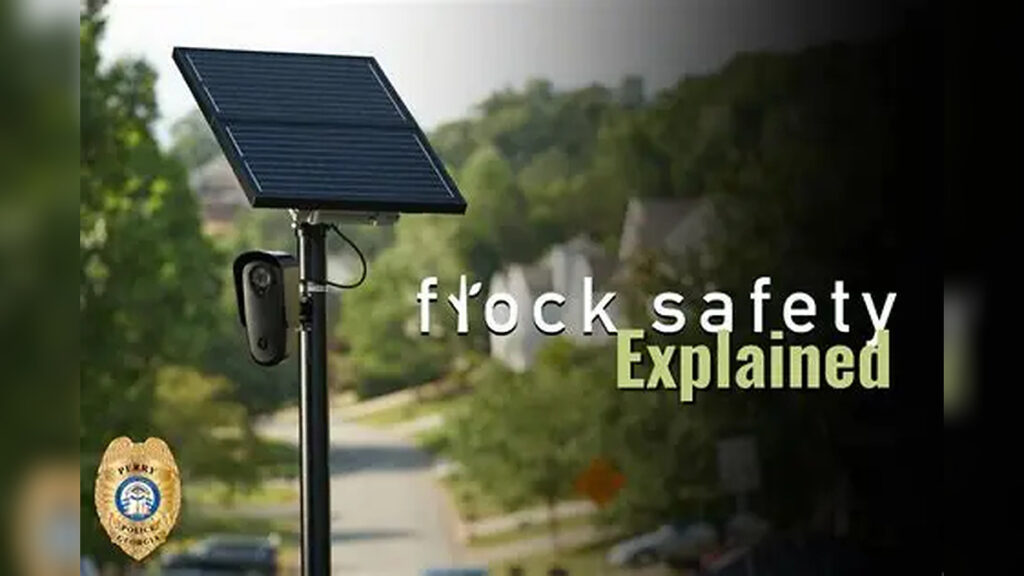
Flock Safety now operates a vast network of solar-powered cameras covering more than 5,000 communities across 49 states.
The cameras do considerably more than photograph license plates.
They can capture information such as a vehicle’s make, model, color and other identifying characteristics.
Police departments can then search the collected information using descriptions such as vehicle color or even distinctive features.
That means investigators can potentially trace when and where a particular vehicle appeared across multiple jurisdictions.
Flock generally says customer data is deleted after 30 days, although individual contracts can establish different retention periods.
That distinction has become one of the central points in the growing privacy debate.
A Florida Officer’s Case Raises Abuse Concerns
Concerns about misuse became particularly striking in Florida, where Officer Christopher Goodson was accused of using his department’s Flock access to monitor his estranged wife.
Authorities said Goodson conducted more than 700 unauthorized searches involving her vehicle between September 2024 and June 2026. He was arrested last week.
The case illustrates one of the concerns surrounding systems that give individual officers access to large amounts of location-related information: technology intended for legitimate investigations can potentially become a tool for personal surveillance.
The Institute for Justice has documented more than 150 cases of alleged ALPR misuse nationwide, including stalking, inappropriate non-law-enforcement searches and other abuses.
A separate Washington Post investigation identified nearly 50 cases involving officers who were charged with or accused of misusing such systems, with many cases involving current or former romantic partners.
From Startup Idea to $8.3 Billion Company
Flock’s rapid growth has transformed it from a small security startup into a major technology company.
Founder and CEO Garrett Langley began developing the idea after experiencing a series of break-ins in the Atlanta area and becoming frustrated with the difficulty police faced when investigating property crimes.
Langley later recruited former colleagues Matt Feury and Paige Todd.
According to Andreessen Horowitz, the company’s first prototype was built at Langley’s kitchen table in only three weeks.
Homeowners associations initially represented a major portion of Flock’s customer base.
Law enforcement contracts later became the dominant part of the business.
The company has attracted major venture capital backing, including investments from Andreessen Horowitz, Tiger Global, Founders Fund, Kleiner Perkins and other prominent firms.
In April, Flock said it had raised $500 million at an $8.3 billion valuation, bringing its total funding to $1.2 billion.
The company also said annual recurring revenue had surpassed $500 million during the first half of 2026.
Its business has expanded beyond license plate readers into video surveillance, gunshot detection, drones and artificial-intelligence-powered search tools.
More than half of the company’s new revenue now reportedly comes from products other than license plate readers.
Communities Are Starting to Fight Back
Flock’s growth has coincided with increasingly visible resistance from residents.
Cameras have been vandalized or destroyed in at least 36 states.
Protesters have reportedly cut down cameras with an electric saw in upstate New York, thrown paint at cameras in Oakland and rammed a truck into one in Idaho.
In Florida, one resident has reportedly used a lawn chair and a cardboard sign mounted on a pole in an attempt to block a camera.
The protests have also reached city halls. At a San Diego meeting, one man dressed as Darth Vader while sarcastically appearing to “praise” the city’s use of the surveillance technology.
Flock CEO Garrett Langley condemned the vandalism and argued that residents who object to the cameras should take their concerns to elected officials rather than damaging the equipment.
Dozens of Cities Have Ended Their Contracts
Public opposition has already translated into contract cancellations.




Boston, Flagstaff and Santa Clara suspended or ended their Flock partnerships in March.
Research cited by Fortune found that 82 Flock contracts were terminated across 28 states between August 2021 and May 2026, including 39 during the first five months of 2026.
The company, however, maintains that cancellations have not slowed its expansion.
Langley said Flock continues to gain customers at a much faster rate than it loses them, arguing that police agencies increasingly view the technology as an important crime-fighting and deterrence tool.
West Hollywood provides an example of a community where public opposition did not lead to cancellation.
The city renewed its Flock contract despite heated council meetings.
Part of the explanation is that West Hollywood relies on the Los Angeles County Sheriff’s Department for policing, meaning the city council does not have sole control over the law-enforcement system using the cameras.
The Retention Debate Is Becoming More Complicated
Data retention has emerged as another major source of controversy.
Flock’s standard policy historically called for customer data to be retained for 30 days.
The company recently recommended that communities move toward a seven-day default and introduced an “Evidence Mode” allowing investigators to preserve specific information for active investigations.
Flock says its analysis showed that more than 90 percent of searches involving incomplete license plates occur within a week.
Privacy advocates argue that a recommendation is not the same thing as a legal requirement.
Tom Bowman of the Center for Democracy and Technology noted that individual contracts ultimately determine how long data remains available.
Communities can therefore maintain retention periods substantially longer than Flock’s publicly promoted default.
The LAPD Contract Raises Fresh Questions
A Los Angeles Police Department audit has brought the issue into sharper focus.
The LAPD Inspector General reviewed the department’s Flock agreements as the agency renegotiated its relationship with the company.
One agreement reportedly allowed Flock to retain the right to use certain data for any purpose at its sole discretion.
Another agreement permitted anonymized footage to be used for machine-learning training.
Most significantly, the audit found that Flock could retain certain data for five years at no additional cost to the department.
That five-year period is dramatically longer than Flock’s standard 30-day retention policy and hundreds of times longer than the seven-day default the company has recently promoted.
Following the audit, LAPD began drafting contract language that would explicitly prohibit vendors from using city data to train, fine-tune or improve artificial-intelligence systems.
The Real Concern May Be What Happens Across Jurisdictions
Privacy advocates say the biggest risk is not necessarily a single camera recording a vehicle at one intersection.
The concern is what happens when thousands of cameras and multiple law-enforcement agencies are connected.
Michael de Dora of Access Now argued that police departments can share Flock information with other agencies, potentially creating a searchable historical record of where people have traveled.
A data-retention limit imposed by one city may therefore become less meaningful if another agency has already obtained and retained a copy of the information.
That possibility has already surfaced in individual cases.
The Institute for Justice documented a case involving a Texas sheriff’s deputy who conducted a nationwide Flock search for a woman suspected of having undergone an abortion.
Another case in Wisconsin involved officers using Flock information about a man’s frequent travel to Michigan as part of an investigation that ultimately led to a vehicle search for marijuana.
The Technology Is Colliding With Constitutional Questions
The debate surrounding Flock is increasingly moving beyond city contracts and privacy policies and into constitutional territory.
The traditional legal position has generally been that motorists traveling on public roads have limited expectations of privacy.
But privacy lawyers argue that the sheer scale of modern ALPR networks changes the nature of that surveillance.
A camera capturing a vehicle at one particular location is one thing.
A network capable of reconstructing a person’s movements over days, weeks or months is something considerably more revealing.
Legal experts have pointed to recent court decisions involving location information as potentially relevant to the future of ALPR systems.
The unresolved issue is whether police should need a warrant when technology allows them to reconstruct a person’s broader movements from records collected across numerous locations.
Flock Says Communities Control the Rules
Flock has rejected the idea that it is operating an uncontrolled national surveillance system.
Langley has repeatedly argued that the company exists to help investigators solve crimes that otherwise might remain unsolved, including murders, violent offenses, stolen-vehicle cases and missing-child investigations.
He has also emphasized that communities determine their own sharing policies, offense filters and retention periods.
Flock says it is introducing additional privacy safeguards and measures designed to prevent officer abuse.
The company also describes the underlying technology as relatively simple: a vehicle passes a camera, the system photographs it and software reads the license plate.
The controversy, however, is less about what one camera does than what happens when thousands of cameras are connected and their information can be searched across jurisdictions.
A Billion-Dollar Business at a Privacy Crossroads
Flock Safety has succeeded because it offers something police departments have long wanted: more investigative information, available faster and across a much larger geographic area.
That capability has helped investigators solve crimes and locate suspects who might otherwise have been difficult to identify.
But it has also created a surveillance infrastructure that critics say can reveal far more about ordinary people than traditional police cameras ever could.
The company’s financial success demonstrates how valuable that capability has become.
Its growing list of canceled contracts and public protests, meanwhile, shows that many communities are questioning whether the benefits justify the potential cost to privacy.
What’s Next?
The central battle is likely to move toward stronger rules governing data retention, cross-jurisdictional sharing, officer access and the use of surveillance information to develop artificial intelligence.
Cities will also have to decide whether their contracts provide sufficient protections before renewing agreements.
At the federal level, renewed debate over legislation that would restrict government purchases of sensitive location information could further shape the legal environment surrounding technologies such as Flock.
Ultimately, the courts may have the final say on whether large-scale automated license plate networks represent ordinary surveillance on public roads or a fundamentally different form of location tracking that requires greater constitutional protection.
Summary
Flock Safety has grown from a startup created to help communities combat property crime into an $8.3 billion surveillance technology company serving thousands of communities nationwide.
Its cameras have provided investigators with valuable leads in serious criminal cases, but allegations of officer abuse, widespread camera vandalism, contract cancellations and concerns about long-term data retention have intensified the backlash.
The debate now extends beyond whether Flock can help police catch criminals.
It is increasingly about who controls the resulting data, how long it can be kept, how widely it can be shared and whether Americans should be able to move through their communities without their movements becoming part of a searchable historical record.

