
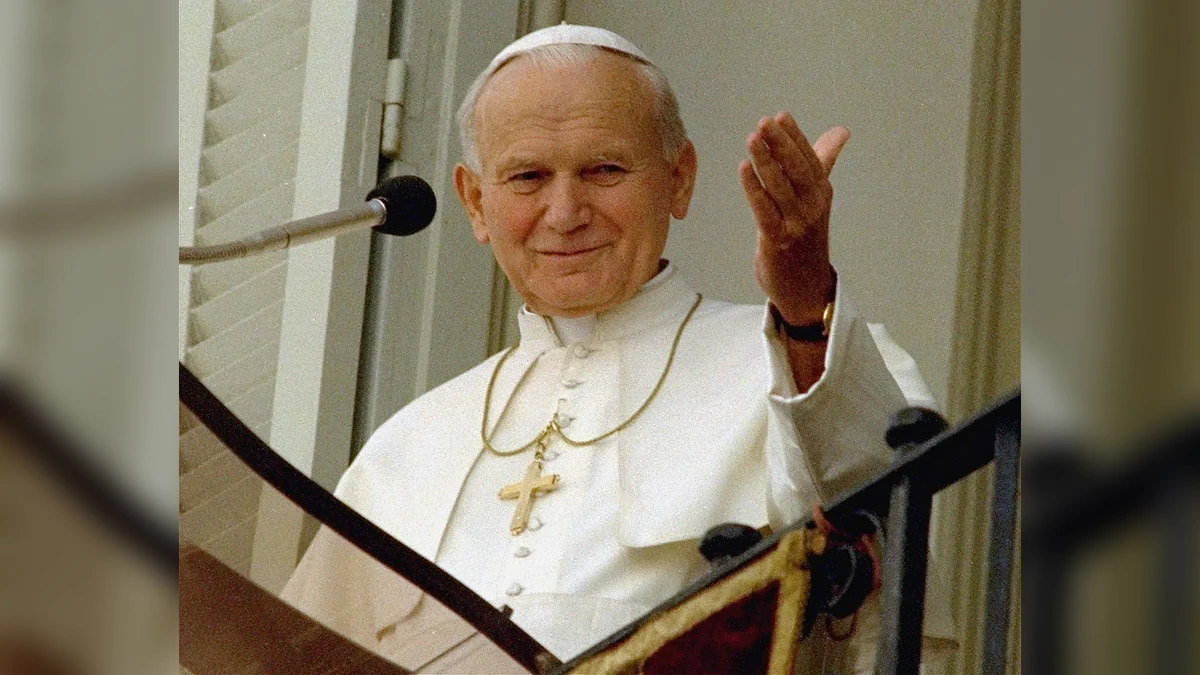
Pope St. John Paul II served as head of the Catholic Church for 27 years, making him the second-longest-serving pope in modern history. He was also the first non-Italian pope since Adrian VI, who was elected in 1522.
During his pontificate, John Paul II influenced international politics, expanded the recognition of saints, transformed papal travel, contributed extensively to Catholic teaching and strengthened the Church’s presence in Africa.
His legacy continues to shape the Catholic Church and its activities around the world.
His Role in the Fall of Communism in Eastern Europe
John Paul II played a significant role in the events that contributed to the collapse of communism in Central and Eastern Europe in 1989.
George Weigel, the pope’s official biographer, said John Paul II’s engagement with political leaders helped inspire a movement of conscience that began in Poland and spread across the region.
The pope’s relationship with US President Ronald Reagan was an important part of this period. Historian and author Paul Kengor said Reagan regarded the Polish pontiff as his “best friend” and believed that few people understood him as deeply.
John Paul II held 738 audiences and meetings with heads of state and undertook 38 official visits during his pontificate, using these engagements to address international affairs and the moral responsibilities of political leaders.
Weigel said the pope viewed himself primarily as the universal pastor of the Catholic Church, while recognising that political leaders were also accountable to universal moral principles.
According to Weigel, John Paul II’s greatest contribution to the political changes of the period was his role in encouraging a peaceful revolution of conscience. This movement helped inspire the nonviolent changes of 1989 and the eventual collapse of communist rule across much of Central and Eastern Europe.
He Recognised Hundreds of Saints and Blessed Individuals
John Paul II significantly expanded the number of people formally recognised by the Catholic Church for their holiness.
During his pontificate, he presided over 147 beatification ceremonies, proclaiming 1,338 people blessed. He also conducted 51 canonisation ceremonies, recognising a total of 482 saints.
Among the figures associated with his pontificate was Mother Teresa of Calcutta, who became one of the best-known contemporary saints.
Another important figure was St. Faustina Kowalska, a Polish religious sister associated with devotion to Divine Mercy. John Paul II canonised her in 2000, describing the occasion as an opportunity to bring her message to the new millennium.
In his canonisation homily, he said he wanted people to understand more deeply the true nature of God and their fellow human beings.




John Paul II also beatified Pier Giorgio Frassati in 1990, describing the young Italian as the “Man of the Beatitudes”. Frassati, who died aged 24, was known for his devotion to the Eucharist and his service to poor people. Pope Leo XIV canonised him on September 7, 2025.
Although John Paul II recognised hundreds of saints, Pope Francis later surpassed his record by canonising 800 Italian martyrs in a single day.
He Changed How Popes Travelled Around the World
John Paul II transformed the way the papacy engaged with Catholics across different countries by undertaking extensive international journeys.
He visited approximately 129 countries during his pontificate, more than any pope before him at that time.
In 1985, he established World Youth Day, an international Catholic gathering intended to bring young people together in their faith. He presided over 19 editions of the event during his time as pope.
Weigel said John Paul II regarded his journeys not simply as official visits but as pilgrimages intended to bring the successor of St. Peter into direct contact with local Catholic communities.
The trips regularly included religious services, prayer, Eucharistic adoration and meetings with other Christian denominations and religious communities.
Weigel said the pope’s extensive travels helped him communicate the Gospel across the world during a period marked by significant social change.
His Writings Reshaped Catholic Teaching
John Paul II made extensive contributions to Catholic doctrine and the Church’s legal and theological framework.
In 1992, he promulgated the Catechism of the Catholic Church, which sets out the principal teachings of the Catholic faith. During his pontificate, he also reformed the Church’s Codes of Canon Law governing its Eastern and Western traditions.
His written works included 14 encyclicals, 15 apostolic exhortations, 11 apostolic constitutions and 45 apostolic letters.
Weigel has argued that the full significance of John Paul II’s teaching, often described as his magisterium, is still being explored.
One prominent example is his theology of the body, a series of teachings on the human person, sexuality, marriage and the meaning of the body. The work has continued to influence Catholic discussions in the United States and other parts of the world.
He Strengthened the Catholic Church’s Presence in Africa
Africa was another important focus of John Paul II’s pontificate. The pope visited the continent on numerous occasions and developed a close relationship with Beninese Cardinal Bernardin Gantin.
His visits and support for African Catholic communities helped inspire a generation of Catholics across the continent and elsewhere.
Gantin said John Paul II was particularly interested in the vitality of African Christianity and viewed it as an expression of the freshness of the Gospel.
The influence of John Paul II’s teachings was also reflected in discussions among African bishops about marriage and family life. During the 2014 and 2015 synods on marriage and the family, Gantin said some of the strongest defences of the Church’s traditional understanding of marriage and family came from African bishops.
He attributed part of this influence to the formation of bishops who regarded John Paul II as a model for their ministry.
Gantin also argued that the Church’s vitality in different parts of the world was closely connected to how its communities received and applied John Paul II’s interpretation of the Second Vatican Council.
Through his international engagement, recognition of saints, extensive writings and support for African Catholic communities, John Paul II left a lasting imprint on the Catholic Church during his 27 years as pope.
