
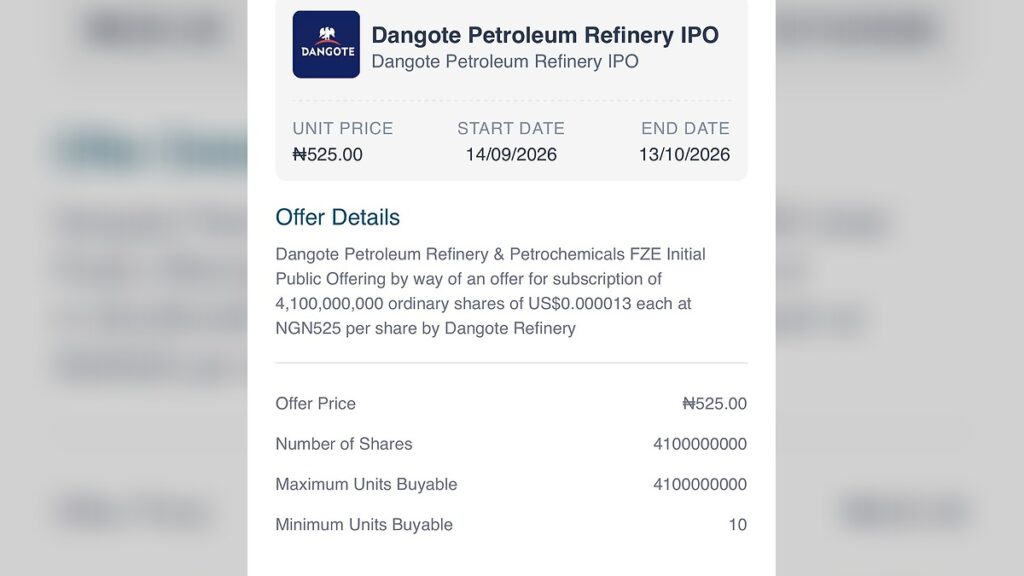
Africa’s richest man, Aliko Dangote, is opening the doors of his multibillion-dollar oil refinery to public investors, describing the initial public offering as an opportunity for ordinary people to become shareholders in one of Africa’s biggest industrial projects.
Retail investors can participate in the offering at 5,250 naira, approximately $4, per share, with a minimum subscription of 10 shares. Despite the public offering, Dangote is expected to remain firmly in control of the Lagos-based refinery, retaining an 87% ownership stake.
The relatively low minimum investment has nevertheless made the offering accessible to Nigerians who might otherwise be unable to participate directly in a business of the refinery’s scale.
Retail Investors Bet on Dangote Name and Refinery’s Scale
Interest among individual investors has been strengthened by the size of the refinery and expectations surrounding its future profitability, particularly as global oil prices have climbed following the US-Iran war.
Titi Adetoye, an operations manager based in Abuja, said she intends to participate in the offering and could purchase as many as 1,000 shares.
Adetoye said the Dangote name and the refinery’s status as Africa’s largest were important factors behind her decision, adding that she would rather participate and see how the investment develops than stay on the sidelines.
$19 Billion Project Reshapes Nigeria’s Fuel Industry
The refinery began production in 2024 after an estimated $19 billion investment, marking a major development for Nigeria’s energy industry.
Despite being one of Africa’s leading crude oil producers, Nigeria spent decades depending heavily on imported petroleum products because of inadequate domestic refining capacity.
Several state-owned refineries have struggled with years of poor maintenance, limited production and extended periods of inactivity, leaving the country exporting crude oil while importing much of the refined fuel required by consumers and businesses.
Dangote’s facility has altered that equation. With the refinery operating, Nigeria has moved from being heavily dependent on imported refined petroleum products to becoming an exporter.
Analysts Predict Millions of New Market Investors
The IPO could also have consequences far beyond the refinery itself by bringing a new generation of retail investors into Nigeria’s capital markets.
Mohammed Saidu, head of research and investment analysis at Lagos-based TrustBanc, described the offering as potentially transformative for the Nigerian market.




“It is going to be a game-changing IPO for Nigeria’s markets,” Saidu said, predicting that millions of new investors could enter the market as a result of the offering.
The refinery’s prominence, combined with Dangote’s reputation and the accessibility of the minimum subscription, could encourage Nigerians who have previously had little or no exposure to publicly traded investments to participate.
87% Dangote Stake Raises Questions Over ‘People’s IPO’
However, Dangote’s description of the offering as an IPO “for the people” has attracted scrutiny because he will continue to own an overwhelming majority of the refinery.
Joachim McEbong, senior West Africa analyst at Control Risks, questioned whether the offering could genuinely be characterised as people-driven when Dangote retains an 87% stake.
McEbong argued that the ownership structure complicates the narrative of widespread public participation, even though retail investors are being given an opportunity to acquire shares.
$49 Billion Valuation Comes Under Scrutiny
Questions have also emerged over the refinery’s reported $49 billion valuation following the offering.
That figure is more than twice the approximately $19 billion spent to construct the facility, prompting debate about whether expectations surrounding the refinery have pushed its valuation too high.
Refinery officials have rejected suggestions that the valuation is inflated.
Investors will ultimately be assessing whether the refinery’s production capacity, regional importance, expansion plans and potential earnings justify the premium being placed on the business.
Refinery Reaches 650,000-Barrel Daily Capacity
The facility reached its full production capacity of 650,000 barrels per day earlier this year, cementing its position as Africa’s largest refinery.
Dangote has even bigger ambitions for the complex. He announced plans last year to expand its capacity to 1.4 million barrels per day.
Company officials say achieving that target would make the facility the world’s largest refinery, overtaking India’s Jamnagar refinery.
Such an expansion would significantly increase the refinery’s influence in African and international petroleum markets while potentially strengthening Nigeria’s position as both a crude producer and major exporter of refined products.
Dangote Eyes Expansion Beyond Nigeria
Dangote’s refining ambitions are also beginning to extend beyond Nigeria.
The billionaire has outlined plans to expand his energy interests into East Africa and has proposed constructing a refinery in Kenya by 2030.
If those projects proceed alongside the planned Lagos expansion, Dangote could establish a refining network with considerable influence over fuel supply across several African markets.
For investors considering the new IPO, the opportunity therefore combines the potential of Africa’s largest existing refinery with Dangote’s much broader plans for expansion.
The offering will also test whether the enthusiasm surrounding one of Nigeria’s most ambitious industrial projects can translate into sustained public investor participation — and whether the refinery can ultimately justify a valuation substantially higher than its original construction cost.
