
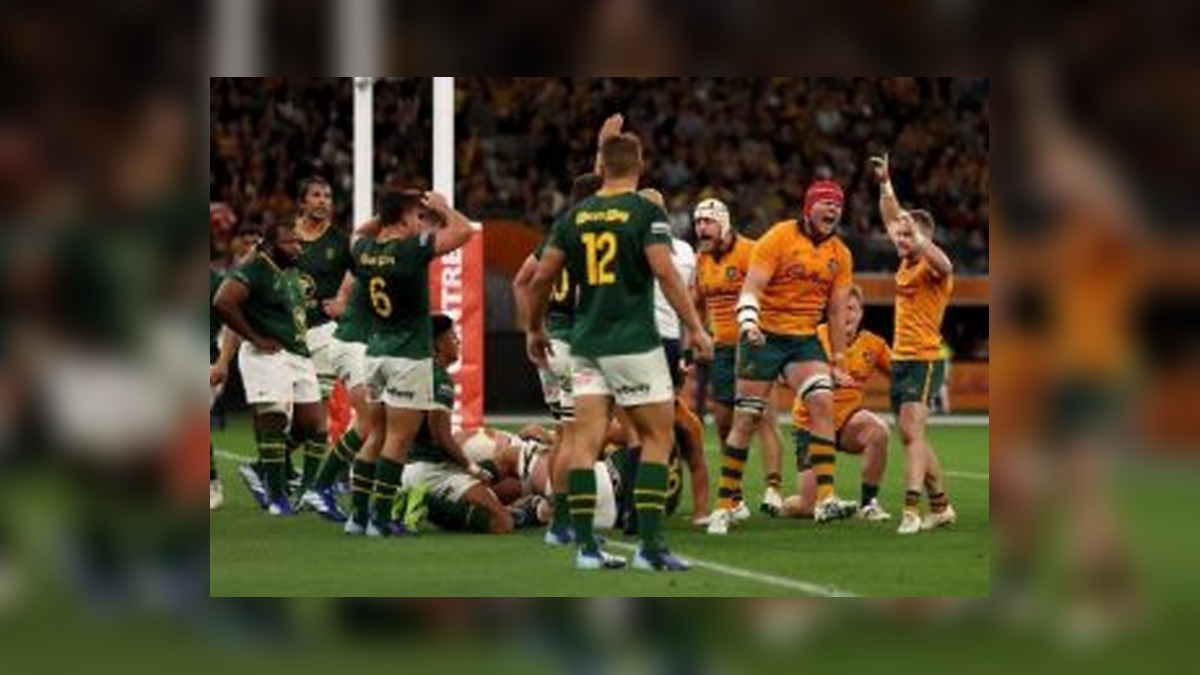
Australia produced one of the biggest surprises of the Test season on Sunday, holding off a dramatic South African comeback to beat the Springboks 42-38 in Perth.
The result gives Les Kiss’ side a major confidence boost with the Rugby World Cup now only a year away, while Rassie Erasmus is left with several questions to address after a defensive performance that allowed the Wallabies to build a commanding lead.
The chaotic contest also highlighted three major storylines that could have implications well beyond Perth.
Kiss has transformed Australia into a serious threat
The Wallabies are beginning to look like a very different side under Les Kiss.
Since replacing Joe Schmidt in July, Kiss has guided Australia through five Tests without defeat, including a 28-28 draw against Argentina earlier this month.
The victory over the Springboks was undoubtedly his most significant result yet. Australia controlled much of the match for around 65 minutes, combining clinical attacking rugby with enough composure to withstand South Africa‘s late surge.
Len Ikitau was central to the performance, scoring twice, while Ben Donaldson, Harry Wilson and Max Jorgensen also crossed the line.
The Springboks eventually found another gear and scored three late tries, but Australia managed to hold on for a memorable victory.
Erasmus acknowledged the progress made by the Wallabies and suggested the two teams could meet again when the stakes are even higher.
Australia will begin next year’s World Cup campaign in Perth against Hong Kong, and depending on how the tournament develops, another meeting with South Africa could potentially come in the knockout stages.
Lonergan may have answered Australia’s playmaker question
While Ikitau collected the official Man of the Match award for his two tries, Ryan Lonergan produced a performance that could prove even more significant for Australia’s long-term plans.
The scrumhalf dictated the pace of the match and repeatedly put Australia in favourable positions with his kicking and distribution.




Lonergan finished with 17 points from eight attempts at goal, converting seven of them. His tactical kicking was equally influential, with 11 kicks covering a combined 302 metres, including three that were returned directly to Australian possession.
His passing numbers were also striking. Lonergan delivered 74 passes, more than the two South African scrumhalves combined.
That level of control offers Australia an alternative to the traditional approach of relying heavily on the flyhalf to organise the attack.
Lonergan repeatedly decided where the next phase would take place, while Donaldson operated outside him and benefited from the decisions already being made.
Donaldson endured a difficult opening spell but recovered impressively and eventually scored a try.
Lonergan’s late yellow card for cynical play was one of the few negatives in an otherwise influential display, but the performance could give Kiss a potential solution to one of Australia’s long-running playmaking issues.
Fassi’s difficult night raises questions for South Africa
For South Africa, Aphelele Fassi endured an afternoon that exposed some of the uncertainty surrounding the Springboks’ back three.
The 28-year-old returned to the starting XV after being left out of the series against New Zealand, but his performance was undermined by a succession of errors.
Fassi missed several tackles and struggled under the high ball, with one spill ultimately contributing to Ikitau scoring for Australia.
He was also responsible for a forward pass to Ethan Hooker when South Africa had created a promising overlap.
There were still glimpses of Fassi’s attacking ability. His pace caused problems and he played a role in creating the opportunity for Edwill van der Merwe’s try.
However, those positive contributions were overshadowed by the mistakes that allowed Australia to maintain control for long periods.
Erasmus faces selection decisions ahead of the World Cup
The Perth defeat does not erase the depth available to the Springboks, but it does provide Erasmus with useful information as he considers his options with the World Cup approaching.
Fassi’s performance will inevitably increase scrutiny around the composition of South Africa’s back three, particularly with competition for places becoming increasingly important during the final year before the tournament.
Australia’s emergence under Kiss adds another layer to the equation. The Wallabies have now shown that they can challenge the world’s leading teams while playing with considerable attacking confidence.
For Erasmus, the priority will be determining which combinations provide the consistency required at Test level while retaining the attacking qualities that can change a match.
The Perth thriller therefore offered more than an entertaining 80 minutes. It gave Australia renewed belief, potentially elevated Lonergan’s importance and left South Africa with several selection questions to consider before the World Cup arrives.

