
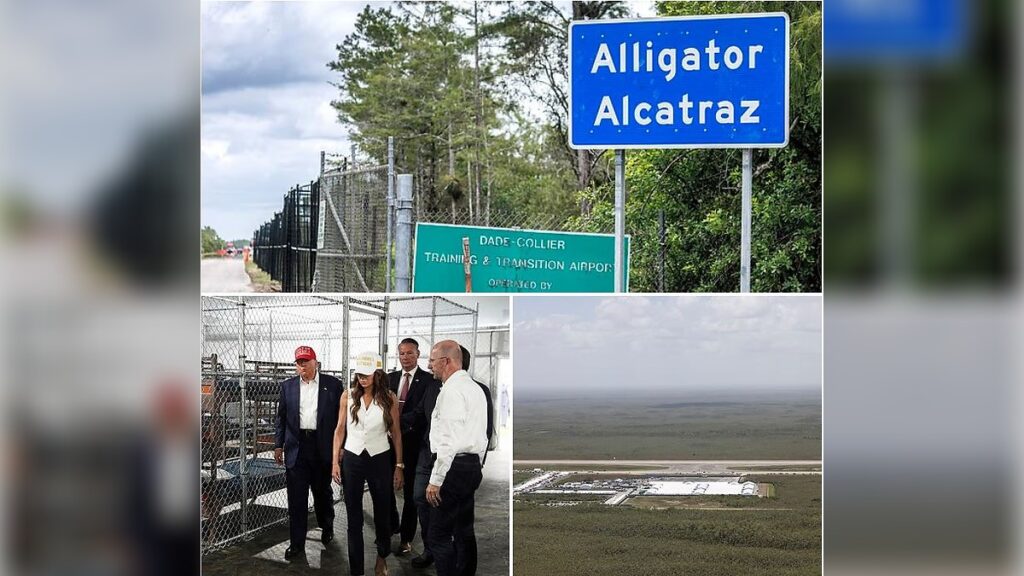
A migrant detention facility in Florida promoted by President Donald Trump as “Alligator Alcatraz” failed to meet numerous federal detention standards and exposed detainees to potentially serious health and safety risks, according to a new government watchdog report.
The Department of Homeland Security’s Office of Inspector General examined conditions at the now-closed facility and identified problems involving living arrangements, medical services, food, hygiene, recreation and access to drinking water.
Among the most unusual findings was the use of tiny fenced metal enclosures where some detainees were reportedly held for periods lasting from several minutes to approximately two hours.
Inspectors Describe Metal Enclosures as Unprecedented
The Office of Inspector General said its inspection team had not encountered similar treatment during previous examinations of Immigration and Customs Enforcement detention facilities.
Officials at the Florida center reportedly described the enclosures as “calming areas” intended to give detainees space to de-escalate and spend time alone.
Inspectors, however, noted that the structures had locking mechanisms.
The report also documented at least one occasion in which an enclosure was apparently used for disciplinary purposes, raising further questions about their intended function.
Each enclosure measured approximately 18 square feet.
More Than 75 Migrants Were Placed Inside Enclosures
According to the watchdog, more than 75 detainees were placed in the small metal structures during the period the facility operated.
The average recorded period inside an enclosure was slightly more than 59 minutes.
The inspector general warned that placing people inside such restricted spaces could create significant risks to their physical health and overall well-being.
The watchdog described the practice as unprecedented among the ICE facilities its teams had previously inspected.
Food, Water and Hygiene Problems Also Identified
Concerns about the metal enclosures represented only one part of the report.
Inspectors documented broader deficiencies involving food services, medical access, sanitation, available living space and opportunities for recreation.
The report also described showers affected by bug infestations.




Questions were additionally raised about food safety and whether detainees had adequate access to clean drinking water.
Taken together, investigators concluded that conditions created significant risks for people detained at the center.
Facility Operated for Just Over a Year
The controversial detention center opened in July 2025 as part of an expanded immigration enforcement operation.
It remained operational for approximately 13 months before eventually closing after mounting concerns surrounding conditions at the site.
Florida officials said in May that approximately 22,000 detainees had been processed and deported through the facility during its operation.
Its relatively short lifespan contrasted with the considerable attention it received nationally after becoming closely associated with the Trump administration’s immigration policies.
Everglades Location Became Part of Facility’s Identity
The detention center was constructed on an abandoned airfield in the Florida Everglades near Ochopee.
Its isolated location quickly became central to the “Alligator Alcatraz” nickname, with the surrounding environment known for wildlife including alligators, snakes, pythons and Florida panthers.
The remote geography was publicly presented as an additional deterrent against escape.
The complex itself was designed to hold thousands of detainees and contained approximately 5,000 beds.
Security infrastructure included more than 200 surveillance cameras, around 400 security personnel and extensive barbed-wire fencing surrounding the perimeter.
Trump Previously Promoted Center as Model for Future Facilities
Trump personally toured the facility and suggested that the concept could potentially serve as a model for other immigration detention centers.
During his visit, the president repeatedly drew attention to its isolated Everglades location.
He also joked that detainees should be taught to run in a zig-zag pattern if they escaped and encountered an alligator.
Trump later remarked that deportation was effectively the only realistic route out of the center, reinforcing the administration’s portrayal of the facility as a highly secure component of its immigration enforcement strategy.
Watchdog Findings Contrast With Public Promotion of Facility
The inspector general’s findings now present a sharply different picture from the high-security detention model promoted when the center opened.
Rather than focusing solely on its ability to prevent escapes and process migrants for deportation, the watchdog examined whether conditions inside complied with federal requirements governing detainee treatment.
Its findings indicated shortcomings across multiple areas considered fundamental to detainee welfare.
The report was particularly critical of the small metal enclosures, emphasizing that inspectors had not encountered comparable structures during previous ICE facility inspections.
Closure Leaves Questions Over Treatment of Thousands of Detainees
With the detention center now closed, the watchdog report places renewed attention on the treatment of migrants who passed through the facility during its 13 months of operation.
The approximately 22,000 detainees reportedly processed and deported through the site make the findings significant beyond the relatively small number documented as having been placed in the metal enclosures.
The concerns surrounding medical access, sanitation, food, water, living space and recreation potentially affected a much broader population.
Neither the Department of Homeland Security nor Immigration and Customs Enforcement had immediately provided a response to the Daily Mail’s request for comment on the findings.
