
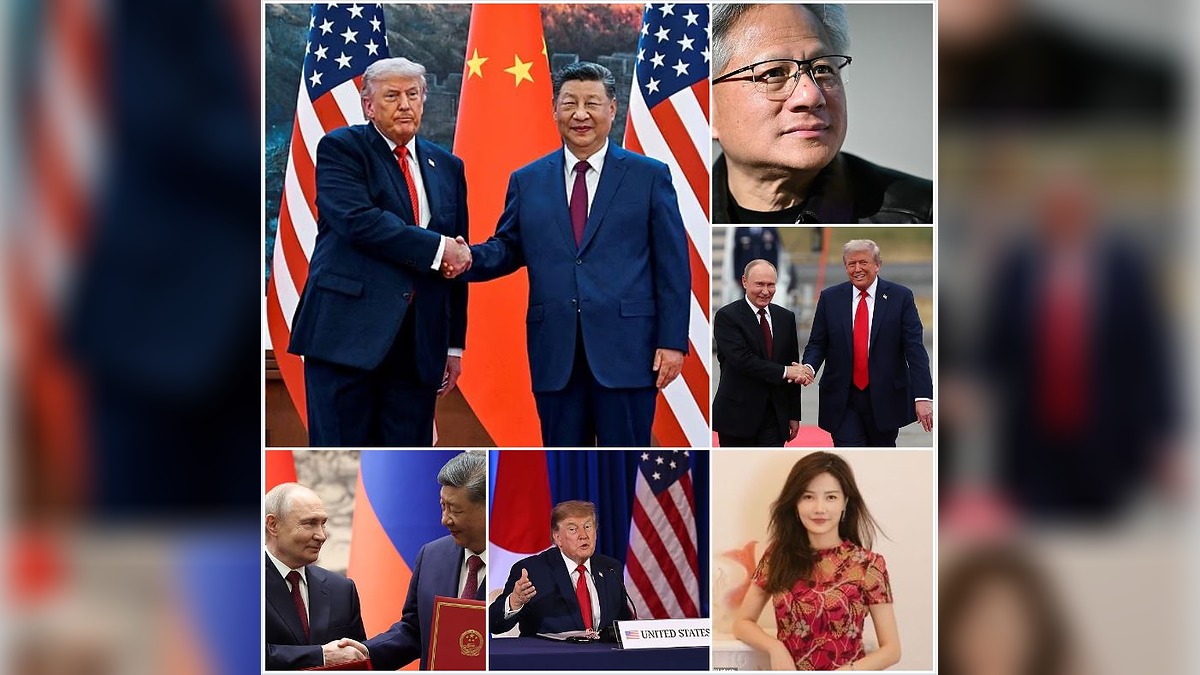
US President Donald Trump, Chinese President Xi Jinping and Russian President Vladimir Putin are scheduled to hold their first-ever trilateral summit on Thursday, November 19, on the sidelines of the Asia-Pacific Economic Cooperation (APEC) conference in Shenzhen, China.
Trump is also expected to hold separate talks with Xi before the three leaders meet.
The gathering comes as Washington faces several international and domestic challenges, including the wars in Iran and Ukraine and a cyber outage disrupting businesses and government agencies across the United States. The cause of the technology disruption remains unclear.
The meeting is also expected to take place against the backdrop of growing tensions over military capabilities, artificial intelligence technology and trade between the three countries.
Experts Warn Trump Against Making Concessions
Foreign policy specialists have warned that Xi and Putin could use the meeting to seek concessions from Trump without offering comparable commitments in return.
Brent Sadler, a former military diplomat with extensive experience in Asia, described the gathering as a meeting between strategic competitors rather than allied leaders.
He said the discussions would involve rivals assessing the emerging balance of power and the possibility of a new Cold War.
Sadler also pointed to China’s expanding nuclear arsenal, estimated at approximately 620 warheads, around three times the Pentagon’s 2020 estimate. He urged Trump to maintain a firm negotiating position.
“The US has little to gain and should concede nothing nor grant anything at this trilateral summit,” Sadler said.
Dan Blumenthal, a former senior director for China, Taiwan and Mongolia at the Pentagon, similarly advised Trump against avoiding disagreements with Xi.
Blumenthal said the Chinese president’s actions, including military preparations, technology espionage and alleged artificial intelligence theft, should remain central to Washington’s approach.
Trade Disputes and Critical Minerals Remain Major Issues
The summit is taking place amid continuing economic competition between Washington and Beijing, particularly over technology and critical minerals.
Craig Singleton, a senior fellow at the Foundation for Defense of Democracies, said the public atmosphere surrounding the meeting could appear calm despite ongoing economic pressure between the two countries.
He argued that both governments continued to use supply chains as instruments of economic influence.



A fragile US-China trade truce is due to expire in early January, ahead of the December G20 summit in Miami.
Singleton expects Xi to approach Trump cautiously to preserve the agreement while China reduces its exposure to American economic pressure.
He warned, however, that Chinese negotiators could seek more concessions than Washington is prepared to offer.
Trump’s Nuclear Disarmament Ambitions Face Questions
Trump is reportedly hoping to secure commitments from China and Russia on nuclear disarmament or arms-control arrangements during the discussions.
Singleton questioned whether Xi would be willing to support such an agreement, given China’s ongoing expansion of its nuclear arsenal.
He said Trump appeared to view a nuclear agreement involving both countries as a potential achievement of his presidency.
However, Singleton noted that Trump’s interest in such a deal did not necessarily mean it would appeal to Xi, whose government continues to develop its military capabilities.
Nvidia Scandal Could Feature in Trump-Xi Discussions
The controversy surrounding Nvidia and its former chief executive Jensen Huang is another issue hanging over Trump’s planned meeting with Xi.
Huang resigned last week following revelations of an alleged affair involving Alice Huang, who US intelligence suspects may have links to Chinese intelligence. China has denied the allegations.
Reports say Alice Huang worked closely with Jensen Huang to secure advanced Nvidia chips for Megaspeed, a Singapore-based company that provides advanced computing capabilities to customers in China.
Megaspeed has reportedly purchased more than $4 billion worth of Nvidia chips. US authorities suspect the company may have helped China obtain advanced semiconductors despite American export restrictions.
The allegations have prompted questions about enforcement of US chip-export controls. Treasury Secretary Scott Bessent criticised the Commerce Department over delays in blacklisting Megaspeed.
Sadler said the Nvidia controversy could be raised as an example of Washington’s concerns about China’s conduct and its reliability as an economic partner.
Blumenthal urged Trump to discuss the allegations directly with Xi, arguing that the case involved the alleged targeting of a senior American technology executive to obtain information about advanced US chips and the operations of the White House.
Singleton, however, expressed doubt that Trump would confront the Chinese president directly over the matter.
Putin’s Position on Ukraine and Europe’s Future
Russia’s war in Ukraine is also expected to feature prominently in the discussions, with concerns that Putin could use the high-profile meeting to advance Moscow’s territorial and political ambitions.
John Hardie, a fellow at the Foundation for Defense of Democracies, said Putin could seek an arrangement resembling the 1945 Yalta Conference, where major powers discussed the post-war division of influence in Europe.
The original meeting brought together US President Franklin Roosevelt, British Prime Minister Winston Churchill and Soviet leader Joseph Stalin at the Livadia Palace in Crimea.
Hardie said Putin could hope for an arrangement in which major powers determine their respective spheres of influence without sufficient consideration for European countries and Ukraine.
He also rejected expectations that Beijing would use its relationship with Moscow to persuade Putin to end the war.
Hardie said suggestions that China could play a constructive role in pushing Russia towards peace were unrealistic.
The three-way summit is therefore expected to bring together discussions on military competition, trade, technology restrictions, nuclear weapons and the future of Ukraine.

