
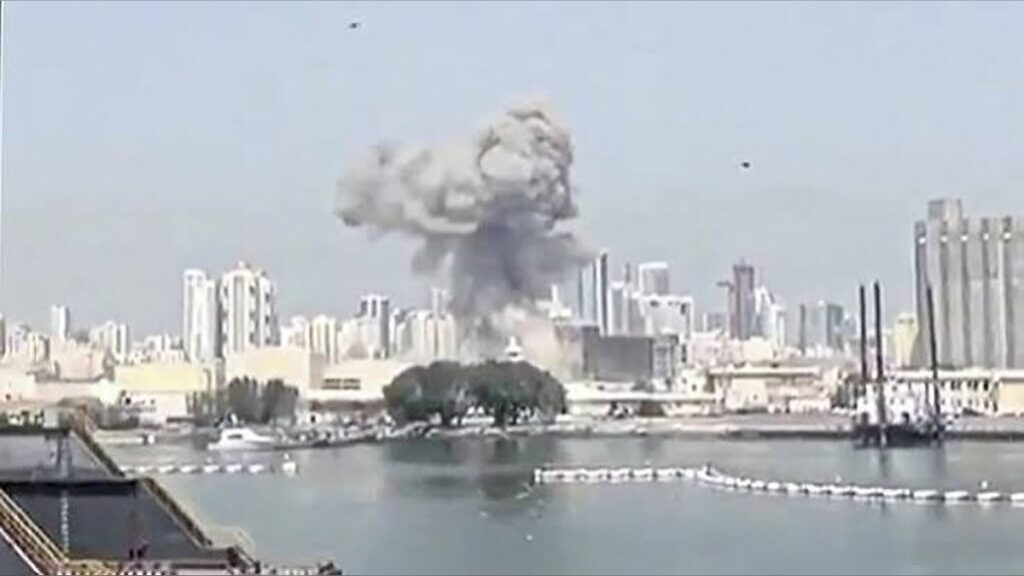
The United States carried out military strikes against Iranian targets early Wednesday after accusing Tehran of attacking three commercial vessels in the strategically vital Strait of Hormuz.
The operation marked another major escalation in an already fragile regional standoff and came alongside Washington’s decision to withdraw Iran’s permission to openly sell crude oil on international markets.
Iran responded within hours by launching strikes aimed at US military installations in Bahrain and Kuwait, widening fears that the temporary ceasefire agreement between the two sides could collapse and trigger another large-scale conflict across the Middle East.
Retaliatory Strikes Raise Concerns Over Ceasefire
Although the latest exchange intensified tensions, the pattern resembled previous incidents that occurred during the uneasy truce.
Neither Washington nor Tehran immediately indicated they were abandoning diplomatic negotiations, suggesting both sides were still leaving room for talks despite the renewed violence.
The military escalation unfolded while Iran continued several days of funeral ceremonies for former Supreme Leader Ayatollah Ali Khamenei, who was killed during the opening phase of the war on February 28 at the age of 86.
Funeral Ceremonies Overshadowed by Renewed Violence
Many observers had expected the funeral period to reduce hostilities before negotiations resumed.
Instead, tensions remained high as mourners at several ceremonies repeated calls for the deaths of US President Donald Trump and Israeli Prime Minister Benjamin Netanyahu.
Formal negotiations aimed at reaching a long-term agreement were expected to begin after Khamenei’s burial.
The talks were set to focus on difficult issues, including restoring unrestricted navigation through the Strait of Hormuz and addressing Iran’s disputed nuclear activities.
The latest military actions have now cast doubt over whether those discussions will proceed as planned.
Iran’s Parliament Speaker Mohammad Bagher Qalibaf insisted his country would not bow to pressure, declaring on social media that intimidation and coercion would not force Tehran to change its position.
US Says Military Action Targeted Iranian Military Infrastructure
According to the US Central Command, American forces launched precision strikes designed to impose significant costs on Iran for targeting civilian commercial shipping operating in international waters.
The military said the operation struck multiple Iranian military assets, including air defense systems, radar installations and more than 60 fast attack boats operated by Iran’s Revolutionary Guard.
Those vessels have repeatedly been accused of harassing commercial ships transiting one of the world’s busiest maritime trade routes.
US officials emphasized that the strikes had concluded but warned that American forces remain ready to respond if Iran violates the existing agreement again.
Iran acknowledged the attacks but did not provide information regarding casualties or damage.
State media reported explosions in Bandar Abbas, Qeshm and Sirik following the US operation.
Bahrain and Kuwait Placed on High Alert
As tensions escalated, authorities in Bahrain and Kuwait activated missile warning systems after Iranian missiles targeted US military facilities located in both countries.




Iran’s Revolutionary Guard confirmed it had attacked American military installations, accusing Washington of violating the ceasefire by carrying out airstrikes on coastal locations in Hormozgan and Mahshahr provinces.
However, the statement made no reference to the earlier attacks on commercial ships in the Strait of Hormuz.
Bahrain later issued another missile warning as the security situation remained unstable.
Gulf Nations Warn Against Further Escalation
The latest confrontation mirrored a similar cycle of attacks seen the previous month, when strikes on commercial shipping were followed by US military action and Iranian retaliation against Gulf-based American facilities.
Speaking during the NATO summit in Turkey, President Donald Trump monitored developments as regional leaders voiced growing concern.
Senior United Arab Emirates diplomat Anwar Gargash criticized Iran’s strikes on Bahrain and Kuwait, arguing they demonstrated Tehran’s inability to fully commit to de-escalation.
He warned that Gulf nations should not continue bearing the consequences of repeated military confrontations and urged a return to stability and diplomacy.
Washington Tightens Economic Pressure on Tehran
Alongside the military response, the United States revoked a license that had temporarily allowed Iran to sell its oil openly on international markets under the interim agreement.
The measure had enabled Tehran to conduct legal crude oil sales using US dollars for the first time in years.
Before the temporary arrangement, Iran had largely relied on heavily discounted exports, particularly to China, while under international sanctions.
US officials linked the decision to Iran’s latest actions against commercial shipping.
Commercial Ships Targeted in Vital Energy Corridor
One of the vessels struck was a liquefied natural gas tanker sailing near Oman’s coastline.
According to the United Kingdom Maritime Trade Operations center, the ship caught fire after being hit but remained afloat.
Iranian state television claimed the tanker ignored official warnings before coming under attack, though it stopped short of directly accepting responsibility.
Two additional commercial vessels sustained limited damage but were able to continue their voyages through the Strait of Hormuz without injuries to their crews.
Strait of Hormuz Remains Flashpoint for Global Energy Markets
Since the conflict began, Iran has maintained strict control over movement through the Strait of Hormuz, one of the world’s most critical energy chokepoints through which roughly one-fifth of globally traded oil and natural gas normally passes.
The three ships targeted this week were reportedly using a route closer to Oman’s coastline rather than the passage designated by Tehran.
Iranian authorities have repeatedly warned that only routes approved by the government are considered safe and have been suspected of targeting vessels that ignore those instructions.
Qatar strongly condemned the attack after one of its LNG tankers, Al Rekayyat, was struck.
Foreign Ministry spokesman Majed al-Ansari described the incident as an unacceptable assault on international shipping and global energy security, holding Iran legally responsible.
Dispute Over Shipping Rules Continues
Under the interim agreement between Washington and Tehran, commercial vessels were permitted to transit the Strait of Hormuz without paying passage fees for 60 days.
However, Iran has maintained that it should regulate shipping routes and eventually introduce transit charges.
The United States and several Gulf Arab nations reject that proposal, arguing it would fundamentally alter decades of international maritime practice in one of the world’s most strategically important waterways.
Khamenei Funeral Continues Across Iraq and Iran
Meanwhile, funeral ceremonies for the late Ayatollah Ali Khamenei continued in Iraq, beginning in the holy city of Najaf before moving to Karbala for additional prayers.
Iranian President Masoud Pezeshkian joined Iraqi Prime Minister Ali Falah al-Zaidi and other senior officials at the commemorations.
Khamenei’s son and successor, Supreme Leader Ayatollah Mojtaba Khamenei, has not appeared publicly since reportedly suffering injuries during the airstrike that killed his father.
He is widely believed to be in hiding as security concerns remain high.
The funeral processions are expected to conclude on Thursday with Khamenei’s burial at the Imam Reza shrine in Mashhad, his birthplace.

