
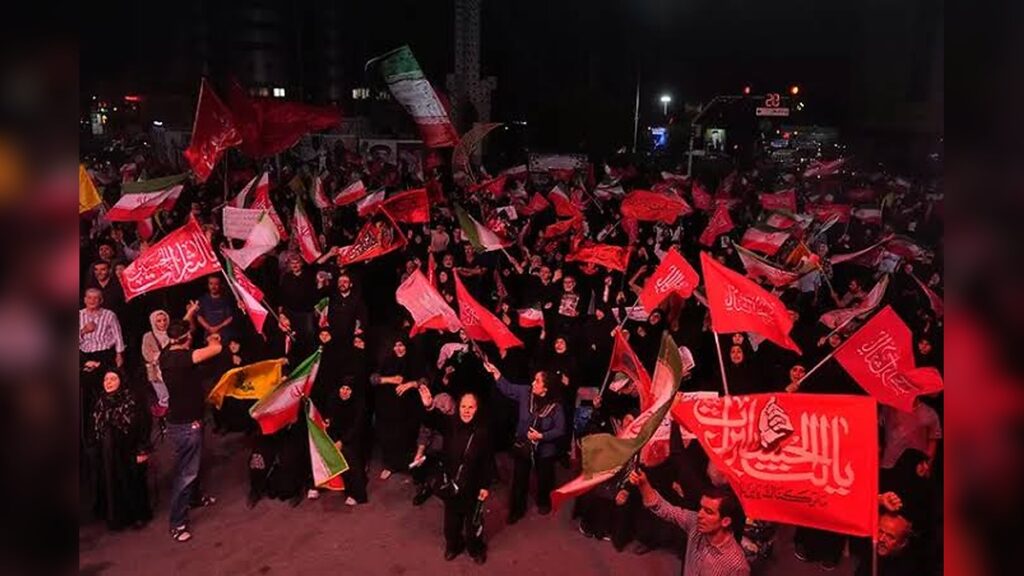
Tensions between the United States and Iran intensified dramatically on Sunday after U.S. forces carried out a large-scale military operation targeting Iranian positions.
The strikes came in response to an Iranian attack on a commercial container ship traveling through the strategically vital Strait of Hormuz, an incident that left the vessel on fire and one crew member missing.
The latest exchange of attacks has deepened fears that the fragile diplomatic progress made in recent weeks could quickly unravel, pushing the region closer to a wider conflict.
Iran Expands Retaliatory Attacks Across the Middle East
Following the American bombardment, Iran launched retaliatory strikes aimed at several countries that host U.S. military facilities or maintain close security ties with Washington.
Missile attacks and aerial threats were reported in Bahrain, Kuwait, Qatar, Jordan, and Oman.
Tehran also renewed its demand for greater control over the Strait of Hormuz, insisting that the waterway should be jointly managed with Oman and warning that commercial vessels could eventually be required to pay for passage through the critical shipping lane.
Iranian officials framed the attacks as a response to what they described as repeated violations of their sovereignty and warned that further military action from the United States would bring additional retaliation.
Fragile Peace Efforts Face Their Biggest Test
The military escalation comes just weeks after Washington and Tehran agreed to a temporary 60-day framework designed to pave the way toward a broader peace settlement.
The agreement, announced on June 17, has now reached its midpoint, but ongoing clashes have placed its future in serious doubt.
Negotiators have struggled to bridge differences over the future status of the Strait of Hormuz, which has emerged as the central obstacle in the talks.
Continued military operations on both sides now threaten to derail the diplomatic process entirely.
Massive U.S. Offensive Targets Iranian Military Infrastructure
According to the U.S. military’s Central Command, American forces struck approximately 140 military targets during Sunday’s operation.
The attacks reportedly focused on missile launch facilities, drone bases, communications systems, ammunition depots and other strategic assets believed to support Iranian operations in and around the Gulf.
Officials said the objective was to weaken Iran’s ability to threaten international shipping routes and reduce future attacks against commercial vessels.
President Donald Trump later described the operation in forceful terms during an interview with NBC’s Meet the Press, saying the strikes dealt a heavy blow to Iran’s military capabilities.
Tehran Vows There Will Be Consequences
Iran acknowledged that one naval officer was killed during the American strikes while insisting its military campaign would continue.




Parliamentary Speaker Mohammad Bagher Qalibaf declared that Iran would no longer accept what he called unequal agreements, warning Washington that breaking commitments would carry serious consequences.
Iran also repeated its position that it alone should determine security arrangements in the Strait of Hormuz and indicated that additional U.S. military installations in the region could become future targets if hostilities continue.
Strategic Waterway Remains at Center of the Crisis
The Strait of Hormuz remains one of the world’s most important energy corridors, carrying roughly one-fifth of globally traded oil and natural gas before the current conflict erupted.
Although energy markets experienced sharp price increases earlier in the fighting, oil prices have eased considerably from wartime highs that exceeded $120 per barrel.
Washington maintained that maritime traffic through the strait remained open despite the fighting.
Iranian authorities, however, insisted the passage would remain effectively closed until regional stability is restored.
Gulf States Activate Air Defenses During Missile Barrage
Several Gulf nations activated emergency defense systems as Iranian missiles and drones crossed the region.
Qatar reported successfully intercepting incoming projectiles, though falling debris injured three people, including a child.
Bahrain and Kuwait also confirmed that their air defense systems engaged incoming threats.
Jordan said several Iranian missiles landed within its territory, causing only minor property damage, while the United Arab Emirates reported sounding air raid sirens but stated that no missiles entered its airspace.
Oman Condemns Strike and Summons Iranian Ambassador
Oman, which shares the Strait of Hormuz with Iran and has frequently served as a mediator between Tehran and Washington, reacted strongly after drones struck locations along its coastline.
Authorities advised residents in affected areas to remain indoors before formally summoning Iran’s ambassador to protest the attacks.
Omani officials described the strikes as irresponsible and expressed concern that the conflict could further destabilize the region.
The diplomatic protest marked Oman’s first formal action against Iran since the latest phase of the conflict began.
Commercial Shipping Comes Under Increasing Threat
The maritime confrontation intensified after a Cyprus-flagged container ship suffered heavy engine room damage during an Iranian attack.
Omani rescue teams evacuated 23 crew members from the vessel, while one sailor remained unaccounted for.
Indian authorities confirmed the missing individual is an Indian citizen and said they are coordinating with Oman to locate him.
British maritime monitoring officials indicated the ship had been sailing close to Oman’s coastline, apparently attempting to avoid entering Iranian territorial waters.
Iran’s Revolutionary Guard claimed that several commercial vessels ignored its navigation instructions and warned that ships failing to comply with designated routes could face military action.
Diplomatic Channels Remain Open Despite Rising Violence
Even as military operations intensified, regional mediators continued efforts to rescue negotiations.
Oman confirmed that discussions with Iran regarding management of the Strait of Hormuz would continue at both technical and political levels, although Tehran stopped short of guaranteeing unrestricted international access through the waterway.
Pakistan, Qatar and Egypt also remain involved in mediation efforts aimed at preserving the temporary ceasefire and preventing a broader regional war.
Iran’s New Supreme Leader Calls for Retribution
Adding to the increasingly confrontational rhetoric, Iran’s new Supreme Leader, Ayatollah Mojtaba Khamenei, issued a public statement promising revenge for the killing of his father, Ayatollah Ali Khamenei, during the opening phase of the conflict earlier this year.
In his message carried on Iranian state television, he declared that avenging his father’s death reflected the will of the Iranian people and vowed that the country would continue pursuing that objective despite mounting international pressure.

