
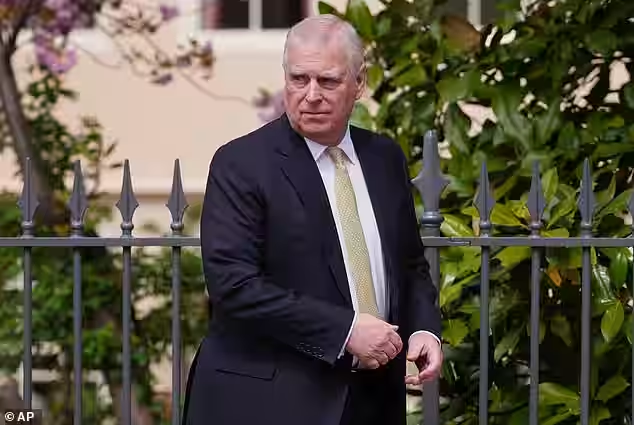
The newly released US Department of Justice files have cast a harsh light on Prince Andrew and his controversial relationships with high-profile financiers, most notably Jeffrey Epstein.
Documents suggest that Andrew passed critical financial information to Epstein, including details that could have undermined the UK government’s £45 billion rescue of the Royal Bank of Scotland during the 2008 financial crisis.
It wasn’t just banking information.
Andrew also disclosed private data about companies like Aston Martin to American bankers who had no legitimate claim to such sensitive information.
These revelations raise questions about whether his judgment was influenced more by personal connections than national interest.
Leaks and Palace Connections
The DOJ files also reveal that a senior aide within the Palace leaked an official diplomatic cable about UK-China trade relations to one of Andrew’s associates.
These disclosures suggest that Andrew’s network allowed private individuals to access information that should have remained confidential, raising serious concerns about security and governance.
A Pattern of Insider Knowledge
Andrew’s interactions with sensitive financial information are not isolated incidents.
In 2008, he demanded private briefings from the Serious Fraud Office regarding BAE Systems’ arms sales to Saudi Arabia.
On another occasion, he sought details about a live banking crisis in Iceland and shared them with banker David Rowland.
These instances indicate a recurring pattern where Andrew leveraged privileged information for personal or close-network gain.




The Diplomatic Footprint
Andrew’s role as a UK trade envoy has come under scrutiny for years, and these files add another layer.
He frequently visited countries with authoritarian regimes and regions that were generous to the Royal Family, including nine trips to the UAE, five to Qatar, and four each to Kuwait, Bahrain, and Egypt in just over six years.
Critics argue that these trips often prioritized Andrew’s personal connections over Britain’s national interests.
A Dangerous Circle of Contacts
Baker’s book, Royal Mint, National Debt, highlights that Andrew mingled with individuals involved in serious crimes — from child sexual exploitation to corruption, fraud, and even gun-running.
Some were accused of torture and espionage against the UK.
This web of high-risk associations underscores the extraordinary exposure created by Andrew’s choices and alliances.
From Privilege to Accountability
For decades, Andrew benefited from institutional deference: media leniency, parliamentary respect, police oversight, and the Royal Family’s virtual exemption from the Freedom of Information Act.
But these protections cannot excuse actions that may have compromised national security or public trust.
The files make it clear: his behavior goes beyond questionable judgment; it raises serious concerns about potential malfeasance at the highest levels.
What’s next?
The latest DOJ documents are just one piece of the puzzle.
There is growing public and political pressure for a full, transparent investigation into Andrew’s tenure as trade envoy and his financial dealings.
Calls are mounting for him to testify before a House of Commons select committee, with all related government and Palace documents made public.
The hope is that accountability, rather than deference, becomes the standard.
Summary
Prince Andrew’s recent exposure in DOJ files paints a troubling picture of a royal who repeatedly shared sensitive financial and diplomatic information with associates, including Jeffrey Epstein.
From banking crises to corporate intelligence, these disclosures suggest a pattern of prioritizing personal and network interests over national welfare.
As scrutiny intensifies, demands grow for a transparent investigation to hold him accountable, not just for the monarchy’s integrity, but for the protection of democratic governance.

