
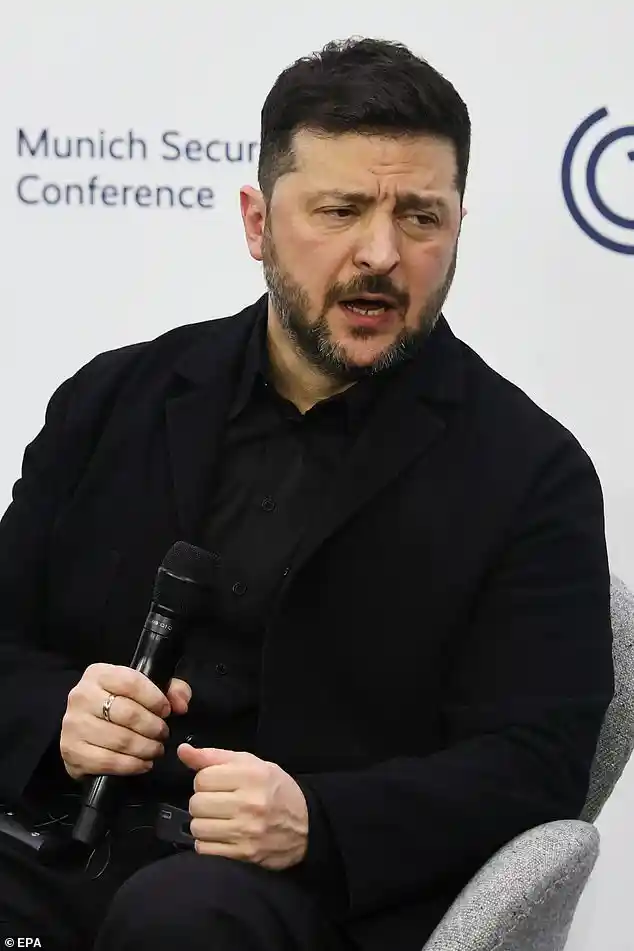
There was a moment of laughter in the room at the Munich Security Conference when Ukrainian President Volodymyr Zelensky made a sharp remark about Vladimir Putin.
But Zelensky quickly made it clear he wasn’t joking.
“I’m younger than Putin,” he said. “He doesn’t have too much time left.”
The line drew chuckles at first.
Then Zelensky leaned in. “No, no, believe me, this is important.”
His comment landed at a curious time.
The 73-year-old Russian leader has not been seen in public for more than a week.
His last confirmed appearance was on February 5.
Since then, Russian state television has aired what appear to be pre-recorded meetings and carefully staged footage.
The Kremlin has offered no explanation.
A Familiar Pattern of Silence
Putin has vanished from view before.
Over the years, unexplained gaps in his public schedule have fueled rumors about secret medical treatment and undisclosed health concerns.
The Kremlin has consistently brushed off speculation, insisting the president is in good health.
Still, the timing is hard to ignore. The war in Ukraine is approaching its fourth year.
Peace talks are being floated again.
And questions about Russia’s long-term leadership are never far from the surface.
In authoritarian systems, prolonged absences often spark uncertainty — even if officials insist everything is normal.
Peace Talks and Political Pressure
Zelensky’s comments came as the United States continues pushing for a negotiated end to the war.
Former President Donald Trump has reportedly set a June deadline for Russia and Ukraine to make tangible progress toward peace.

Trump said Friday that Russia is willing to strike a deal and urged Zelensky to “get moving.”
A new round of negotiations is scheduled for February 17 and 18 in Geneva, with Russian presidential aide Vladimir Medinsky leading Moscow’s delegation.
Whether those talks gain traction remains to be seen.
For Zelensky, signaling that time may not be on Putin’s side could be strategic — a reminder to allies that leadership changes in Moscow, whether political or biological, are inevitable.
Navalny’s Death Casts a Long Shadow
Putin’s absence also coincides with renewed international accusations over the death of Russian opposition leader Alexei Navalny.
A coalition of European countries — including the UK, France, Germany, Sweden and the Netherlands — said new analysis found evidence of epibatidine, a powerful neurotoxin, in samples taken from Navalny’s body.
The substance, found naturally in South American dart frogs but also capable of being synthesized in labs, affects the nervous system in ways similar to chemical nerve agents.
Navalny died on February 16, 2024, in an Arctic penal colony while serving a 19-year sentence.
Russian authorities said he died of natural causes.
His widow, Yulia Navalnaya, has repeatedly accused Putin of ordering his killing.
The accusation adds to a long list of high-profile poisonings linked to Kremlin critics, including the 2018 Novichok attack in Salisbury, England, and the 2006 radioactive poisoning of Alexander Litvinenko in London.
In both cases, Russia denied involvement, though British investigations pointed toward authorization at the highest levels.
Zelensky Takes Aim at Hungary
At the same conference, Zelensky also took a swipe at Hungarian Prime Minister Viktor Orbán, whose government has blocked parts of Ukraine’s European Union accession talks.
Zelensky argued that Ukraine’s fight against Russia protects the rest of Europe from instability, saying bluntly that Ukrainians are “holding the European front.”
Hungary, unlike many other EU nations, has maintained closer energy ties with Moscow and has been reluctant to fully align with EU sanctions.
Tensions between Kyiv and Budapest have grown sharper ahead of Hungary’s upcoming parliamentary elections.
The Bigger Picture
Putin’s unexplained absence may ultimately prove to be nothing more than a routine break from public events.
But in a country where power is tightly centralized and transparency is scarce, even a short disappearance invites speculation.
Meanwhile, the war grinds on. Casualties mount. Diplomats prepare talking points.
And in Munich, Zelensky is clearly signaling that history — and biology — move in only one direction.
What’s Next?
All eyes will be on Geneva as US and Russian officials meet for fresh peace talks.
If Putin reappears publicly in the coming days, speculation may subside.
If he does not, questions about succession and stability inside the Kremlin will grow louder.
At the same time, international pressure over Navalny’s death is likely to intensify, with European governments seeking accountability through the Organisation for the Prohibition of Chemical Weapons.
The coming weeks could prove pivotal — both on the battlefield and behind closed diplomatic doors.
Summary
Volodymyr Zelensky said Vladimir Putin “doesn’t have too much time left” during remarks at the Munich Security Conference, as the Russian leader has not been seen publicly for more than a week.
The timing coincides with renewed peace efforts between Russia and Ukraine and fresh international accusations that the Kremlin used a neurotoxin in the death of opposition figure Alexei Navalny.
With negotiations scheduled in Geneva and tensions rising across Europe, questions about leadership, accountability and the future of the war are once again front and center.

