
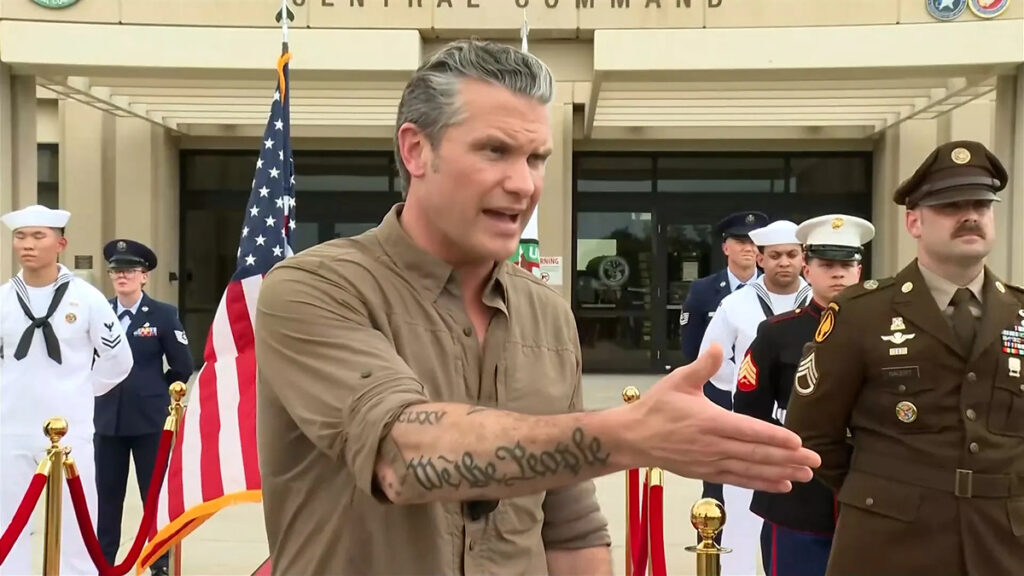
US Defence Secretary Pete Hegseth drew sharp attention after stating that the remaining detainees held at the Guantanamo Bay Naval Base “should have been executed a long time ago,” as he addressed reporters in Florida following an inspection visit to the facility.
Responding to questions about why the final group of prisoners was still alive, Hegseth said he believed those held at the site should long ago have faced capital punishment for their alleged crimes against the United States.
His remarks quickly reignited debate over the future of the controversial detention centre.
A Shrinking Population of Long-Term Detainees
The Guantanamo facility, established during the post-9/11 “War on Terror,” has held around 780 individuals over its history.
Today, only 15 prisoners remain.
Of those still in custody, nine have been formally charged under US military commission law with war crimes-related offences. The remaining six have not been charged.
Three of those uncharged detainees are held under indefinite law-of-war detention without recommendation for transfer, while another three have been cleared for transfer abroad under security arrangements but remain at the facility.
The prolonged detention of individuals without trial has remained one of the most heavily criticised aspects of the prison’s operations.
From Post-9/11 Detention Site to Global Symbol
Guantanamo Bay was created in the aftermath of the September 11 attacks as a high-security detention site for individuals captured by US forces in counterterrorism operations.




Over time, it became one of the most contentious symbols of the US-led “War on Terror,” with critics arguing that many detainees were held for years without formal charges or meaningful legal recourse.
Successive administrations have attempted to reduce or close the facility, but it remains partially operational.
Allegations, Abuse Claims, and Suicide Cases
Throughout its existence, the prison has faced repeated allegations of mistreatment and abuse.
While US authorities have consistently denied systemic wrongdoing, former detainees and rights groups have long claimed that interrogation practices amounted to torture.
Conditions at the facility have also been linked to a series of self-harm incidents.
At least six detainees are reported to have died by suicide, alongside hundreds of attempted suicides recorded over the past two decades.
The psychological toll of long-term detention without trial has been a central point of criticism from human rights organisations worldwide.
International Fallout, Legal Disputes, and Uncertain Future
The Guantanamo controversy has also extended beyond US borders, including cases involving allied intelligence cooperation.
One high-profile detainee, Abu Zubaydah, has alleged that British intelligence services were aware of his treatment during CIA interrogation techniques and brought legal action claiming complicity in his alleged torture.
He has remained detained since 2006 without conviction.
Separately, discussions around the facility’s future have persisted for years.
US President Donald Trump previously ordered preparations at parts of the base in 2025 to potentially house up to 30,000 migrants, reflecting shifting proposals for the site’s use.
Despite repeated political promises to close the detention centre, Guantanamo Bay remains open, continuing to generate legal, ethical, and diplomatic controversy more than two decades after its creation.
