
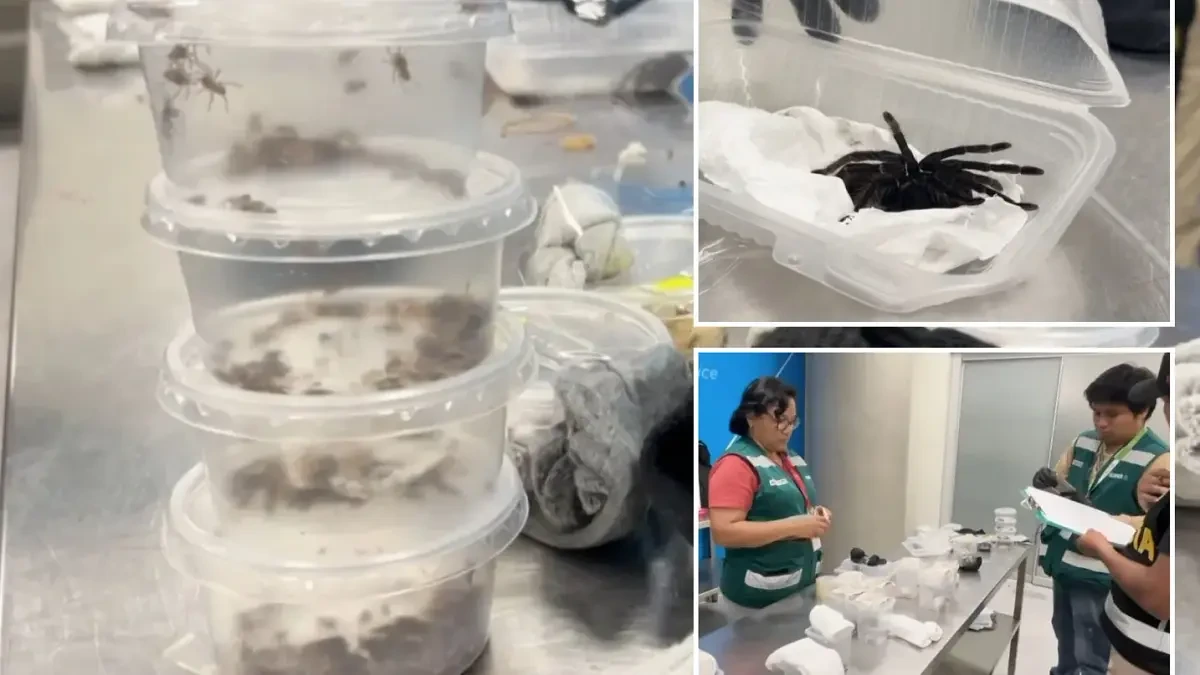
Peruvian authorities have detained three European travellers after discovering more than 3,000 tarantulas, eggs and hatchlings hidden inside their luggage at Jorge Chávez International Airport in Lima.
The suspects, comprising two German nationals and one Polish citizen, were preparing to board a flight to Germany on November 3 when customs officials intercepted the shipment.
According to Peru’s National Forest and Wildlife Service (SERFOR), the spiders were allegedly being transported illegally out of the country in plastic containers concealed inside the travellers’ socks.
Thousands of Spiders Found in Plastic Containers
An inspection of three pieces of luggage uncovered several containers holding adult tarantulas, hundreds of eggs and newly hatched spiders.
Some of the containers were large enough to accommodate fully grown specimens measuring several inches, while smaller tubs contained eggs and baby tarantulas.
Investigators also discovered that the socks containing the containers had been labelled to distinguish the different spider species.
SERFOR said the operation involved more than 3,000 specimens belonging to several species, some of which are protected under Peruvian law.
Spiders Collected From Five Peruvian Regions
Authorities believe the tarantulas were taken from different parts of Peru, including Junín, Loreto, Cajamarca, Cusco and La Libertad.
The seized specimens included spiders from the genera Pamphobeteus, Thrixopelma, Antikuna and Avicularia.
Among them was the Pamphobeteus antinous, one of South America’s largest tarantulas.
The species is classified as vulnerable and receives legal protection in Peru.
These spiders can grow to approximately 10 inches in length and generally reach full maturity within two to three years.
Some Specimens May Belong to Undocumented Species
Wildlife officials believe the selection of spiders included species that have not yet been formally identified by scientists.




Cora Suárez, a technician in forest and wildlife control at SERFOR, said the individuals involved appeared to have deliberately selected different varieties.
“The traffickers made a meticulous selection to have different species, some of which have not yet been described by science,” she said.
SERFOR also reported that a review of scientific publications suggested that one of the European travellers might be involved in tarantula research.
Investigators are examining whether the animals were intended for private collectors, scientific research or commercial sales within the exotic pet market.
Anonymous Tip Leads to Airport Operation
The seizure followed an anonymous report submitted through SERFOR’s wildlife alert platform.
The information prompted authorities to investigate the suspected smuggling operation, eventually leading to the discovery of the spiders before the three travellers could leave Peru.
Officers from Peru’s National Police environmental crimes unit detained the suspects.
They are awaiting formal criminal investigations by the Specialized Environmental Prosecutor’s Office, known as FEMA.
Suspects Could Face Up to Seven Years in Prison
Under Peruvian law, removing wild animals without the required permits constitutes illegal wildlife trafficking.
Offences involving wildlife trafficking typically attract prison sentences of between three and five years.
However, the potential sentence can increase to seven years when protected species are involved.
Several of the tarantulas recovered at the airport fall under Peru’s wildlife protection laws, making the circumstances of the alleged operation particularly serious.
Seized Tarantulas Pose Limited Danger to Humans
Despite the large number of spiders discovered, wildlife experts have indicated that the species involved belong to the New World tarantula group, which originates from the Americas.
Their venom is not generally considered dangerous to humans.
A bite typically produces a reaction comparable to that of a bee or wasp sting.
The tarantulas allegedly being transported are not native to the United States, where wild tarantulas primarily belong to the Aphonopelma genus.
These spiders are mainly found across southwestern states and parts of the southern Great Plains, including Texas, Oklahoma and Missouri.
Wildlife Smuggling Cases Also Recorded at US Border
Authorities in the United States have previously documented attempts to transport tarantulas illegally across international borders.
In October 2025, seven tarantulas were among the animals recovered during a major smuggling seizure along the US-Mexico border.
Under US law, knowingly importing or exporting wildlife without the necessary permits is a felony. Convicted offenders can face up to five years in prison and fines reaching $250,000.
