
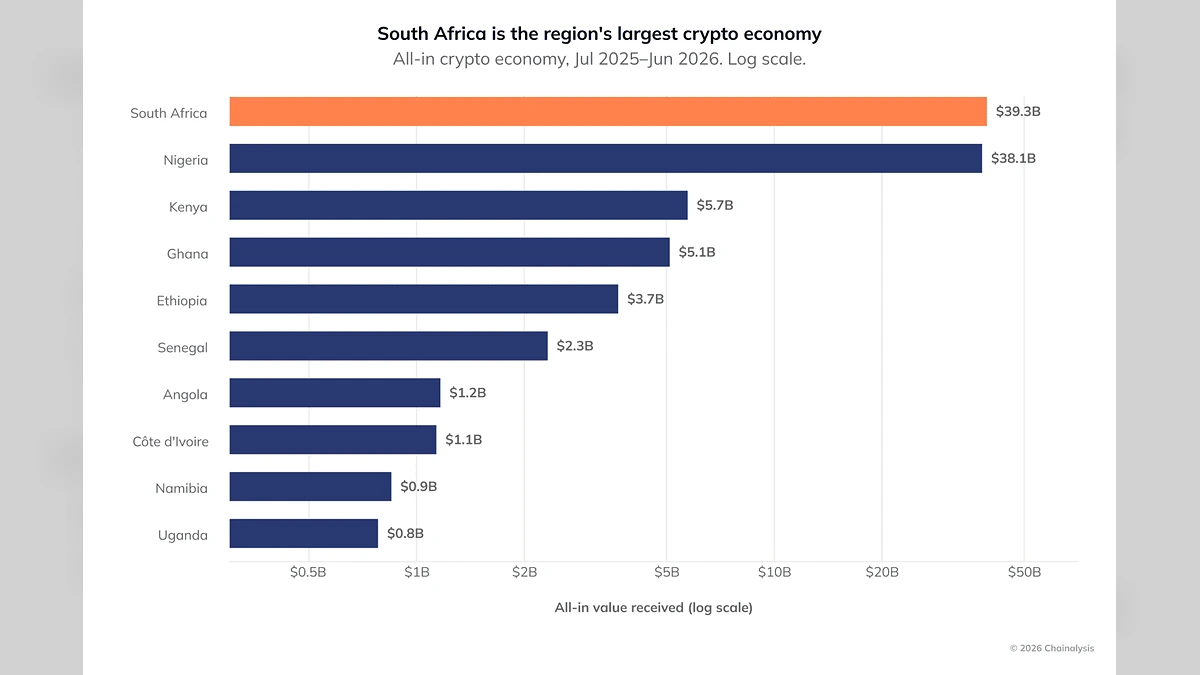
Nigeria’s cryptocurrency market contracted by 3% in the year to June 2026, while South Africa recorded growth of 52%, according to Chainalysis’ 2026 Geography of Cryptocurrency Report.
The report found that Sub-Saharan Africa received $101 billion in on-chain cryptocurrency value between July 1, 2025, and June 30, 2026. The region’s activity increased by 13.4%, making it the fastest-growing cryptocurrency market globally, although it remained the smallest by overall transaction volume.
Stablecoin activity expanded significantly during the period. Peer-to-peer stablecoin inflows across the region increased more than sixfold, rising from $2.3 billion in 2022 to $14.6 billion in 2026. Bitcoin inflows, meanwhile, declined by 60%, falling from $36 billion to $14.6 billion.
Nigeria and South Africa Follow Different Growth Paths
Nigeria and South Africa account for more than three-quarters of Sub-Saharan Africa’s cryptocurrency activity, but their markets moved in opposite directions.
South Africa’s cryptocurrency economy expanded by 52% to $39.3 billion, supported by $8.34 billion in domestic business-related payments. These transactions grew faster than institutional inflows, which reached $1.29 billion.
Nigeria recorded $38.1 billion in cryptocurrency activity, representing a 3% decline. Despite the contraction, the country ranked third on Chainalysis’ grassroots cryptocurrency adoption index, with users sending $25.2 billion to crypto services during the reporting period.
Nzube Ezudo, a former corporate banker who leads Superteam Nigeria, attributed the difference partly to the countries’ approaches to cryptocurrency regulation.
He said South Africa had spent several years establishing a regulated environment in which exchanges could obtain licences, access banking services and allow businesses to record cryptocurrency transactions through their accounts.
“When institutions and merchants get that comfort, volume follows. That is what a 52% jump looks like,” Ezudo said.
He added that Nigeria’s decline did not indicate reduced interest in cryptocurrency, but reflected changes in market conditions and the routes through which transactions were being conducted.
Regulation Changes How Cryptocurrency Moves in Nigeria
Nigeria experienced a reduction in panic-driven currency hedging as the naira became more stable compared with the foreign exchange shocks of 2024.
At the same time, tighter regulatory requirements and tax reporting measures influenced transaction patterns. Decentralised exchange activity fell by 45%, while cross-border peer-to-peer flows declined by 17%.
Domestic centralised exchanges increased their share of Nigeria’s centralised exchange inflows to 50%. This compared with 27% in 2025 and just 7% in 2022.
Ezudo said licensed Nigerian platforms were attracting activity by providing improved naira liquidity and faster withdrawals. However, he believes some transactions have shifted to channels that are less visible in public blockchain data, including over-the-counter desks, merchant settlement networks and trading groups on WhatsApp and Telegram.
“In South Africa you are seeing formalisation that adds volume. In Nigeria you are seeing formalisation that reshuffles volume,” he said.
He expects Nigeria to experience stronger institutional participation over time as regulated cryptocurrency services become more affordable and accessible.
Bitcoin also remains prominent in Nigeria’s smaller domestic transactions. Chainalysis found that Bitcoin accounted for 92% of transfers below $10,000, representing $923 million of the country’s $1 billion in transactions within that category. Across the rest of Sub-Saharan Africa, Bitcoin accounted for 22%.
Ghana and Senegal Record Strong Cryptocurrency Growth
Other West African countries recorded substantial increases in cryptocurrency activity.
Ghana’s market expanded by 80% to $5.1 billion, while Senegal recorded growth of 215%, reaching $2.3 billion.
Ezudo cautioned that high percentage increases in smaller markets do not necessarily represent large-scale adoption, as a limited number of active trading corridors or over-the-counter operations can significantly influence the figures.
He said Ghana’s growth was supported partly by efforts to establish a regulatory framework over the previous two years, giving businesses greater clarity about cryptocurrency transactions.
Senegal’s position within the CFA franc zone also influences its market. According to Ezudo, demand for cheaper and faster payments across West Africa and between the region and diaspora communities is an important factor behind its growth.
He said the sustainability of the increases would depend on whether transaction volumes remained high during periods of relatively stable cryptocurrency prices.
Ezudo believes the growing role of stablecoins indicates that adoption, rather than short-term speculation, is driving a significant portion of the activity.




Stablecoins Support Savings and Cross-Border Payments
A substantial share of cryptocurrency activity across Sub-Saharan Africa continues to involve savings and the preservation of value. However, merchant settlements are becoming one of the fastest-growing uses.
The number of active intra-African cryptocurrency payment corridors nearly doubled within a year, increasing from 80 to 152. Their combined transaction value more than tripled, rising from $34.3 million to $116.5 million.
Ezudo said people in countries where local currencies have lost significant value have increasingly used dollar-denominated stablecoins to protect their savings and working capital.
He also challenged the description of these transactions as capital flight, saying small businesses holding dollar-linked assets could simply be protecting funds needed to operate.
Blockchain transaction records do not establish whether every payment represents commercial trade or family remittances.
Ezudo said his understanding of the market was that many transactions involved small businesses and informal traders using peer-to-peer networks. These activities often combine trade payments and remittances.
Three Changes Needed to Expand African Payment Corridors
Ezudo identified three areas requiring improvement if intra-African cryptocurrency payments are to expand further.
The first is the availability of affordable and immediate local off-ramps, allowing users to convert digital assets into mobile money and bank deposits across different markets.
The second involves business tools such as invoicing, transaction reconciliation and receipts that can be recognised by accountants and tax authorities.
The third is the integration of compliance requirements, including identity verification and travel rule checks, to give banks and regulators greater confidence without slowing transactions.
Ezudo said blockchain networks such as Solana already provide settlement speeds of less than a second at a fraction of a cent per transaction.
He argued that the main challenge is now the final stage of converting and delivering funds through local financial services.
Banks Increasingly Adopt Stablecoin Payment Systems
Ezudo identified three developments behind the growing involvement of traditional financial institutions in stablecoins.
First, businesses had already begun using dollar-backed tokens such as USDT and USDC to settle invoices because correspondent banking services were often slow, expensive or unavailable along certain African payment routes.
Second, the development of regulatory frameworks made compliance departments more willing to consider cryptocurrency-related services.
Third, major international financial institutions and payment companies began exploring stablecoin infrastructure, changing how traditional banks assessed the risks of participating in the sector.
Ezudo said banks were responding to customers who had already moved some payment activity to stablecoin networks.
He described dollar-backed stablecoins as an alternative that could provide access to dollar liquidity and faster settlement without requiring banks to take positions on Bitcoin’s price movements.
On September 1, 2026, 21 international financial institutions, including Bank of America, Citi and Goldman Sachs, committed to establishing a company to issue a US dollar stablecoin. The proposed token is targeted for launch during the first half of 2027.
Standard Bank, Africa’s largest lender, is the only African institution included in the group.
Chainalysis also reported growing interest in stablecoins linked to local currencies in South Africa, Ghana, Kenya and Tanzania. In Ghana, the Bank of Ghana is examining a cedi-backed model that would allow recipients to receive funds in cedis through bank accounts or mobile money without directly holding cryptocurrency.
Crypto Remittances Highlight the Cost of Sending Money to Africa
Cryptocurrency-based remittances from diaspora communities reached $888 million during the reporting period. North America accounted for $645 million of that amount.
The World Bank estimated that sending $200 to Sub-Saharan Africa cost an average of 7.9%, the highest remittance cost of any global region.
Ezudo expects banks and cryptocurrency startups to increasingly work alongside each other rather than one replacing the other.
He said banks could provide regulated payment infrastructure and liquidity, while startups would continue managing customer-facing services.
According to Ezudo, companies whose main advantage was operating outside established regulatory requirements could face pressure as banks enter the market. Businesses offering established products and services, however, could continue to operate.
Personal Wallets Remain Important Across the Region
Personal cryptocurrency wallets received 32.3% of all value entering Sub-Saharan Africa, the highest proportion recorded in any region globally.
Cross-border peer-to-peer transfers accounted for 70.9% of the value received through personal wallets.
Ezudo said the preference for self-custody was linked to users’ previous experiences with frozen bank accounts, withdrawal restrictions, exchange closures and payment providers being shut down.
He said users who had experienced these restrictions increasingly viewed control over their own cryptocurrency keys as a practical way to retain access to their funds.
His recommendation to cryptocurrency developers is to improve the safety and accessibility of self-custody wallets through better recovery systems, user-friendly designs and compliant methods of converting between digital assets and traditional currencies.
Nigeria Coordinates Cryptocurrency Regulation Through New Executive Order
The increasing use of dollar-backed stablecoins has also raised concerns among central banks about monetary policy and the movement of savings outside local currency systems.
In July 2026, President Bola Tinubu signed an Executive Order on Virtual Asset Coordination, establishing a council chaired by the Central Bank of Nigeria to coordinate regulatory approaches to virtual assets, including stablecoins.
Ezudo said stablecoin adoption was a response to existing demand for access to dollars, particularly where local currencies were unstable or difficult to transfer.
He argued that restricting stablecoin services would not eliminate that demand, but could move transactions into less visible channels.
His proposed approach includes regulating stablecoin activities, supporting local-currency stablecoins for domestic and regional payments, and connecting digital payment infrastructure to national financial systems.
Ezudo said stable currencies that are accessible and easy to use would provide the strongest support for currencies such as the naira and the cedi, while allowing stablecoin networks to facilitate payments using those currencies.
