
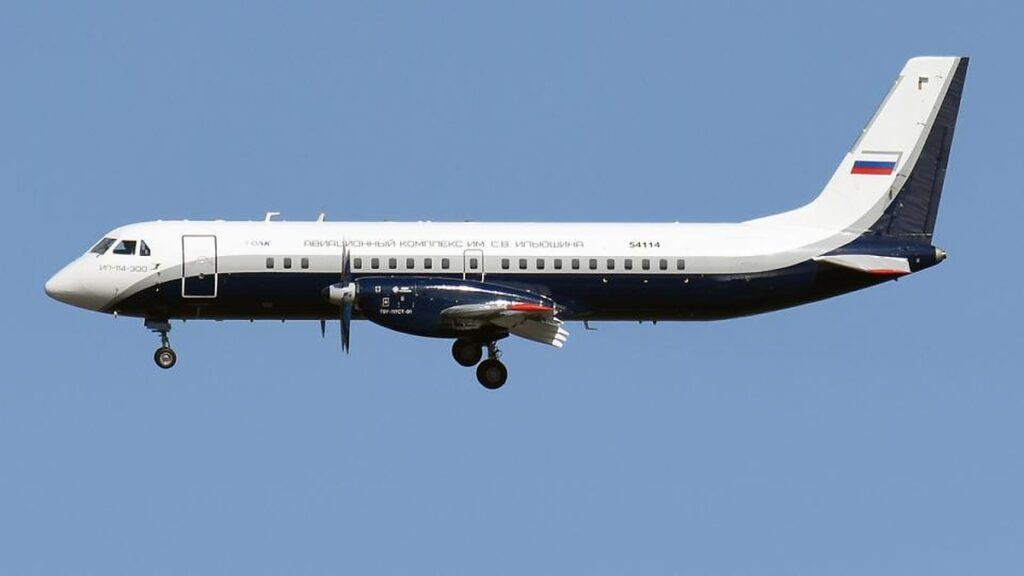
Russia’s newly certified Il-114-300 regional aircraft has entered the next stage of development, but its initial approval comes with several operational restrictions that limit where and under what conditions it can currently fly.
According to a report by Vedomosti, citing the aircraft’s type certificate issued by Russia’s Federal Air Transport Agency (Rosaviatsiya) in June, the aircraft has not yet been cleared for several weather and runway conditions commonly encountered in commercial aviation.
Weather and Temperature Restrictions Remain in Place
The certification document indicates that the Il-114-300 is presently approved to operate only in temperatures ranging from -9°C to +25°C.
This marks a considerably narrower operating range than the earlier Il-114-100, which was certified to fly in temperatures between -30°C and +45°C.
In addition to the temperature limits, the new aircraft is not yet authorized to operate during thunderstorms, in icing conditions, or from wet or contaminated runways.
Manufacturer Says Testing Is Ongoing
Daniil Brenerman, Managing Director of JSC Il, told Vedomosti that flight testing and certification work continue even after the issuance of the aircraft’s basic type certificate.
According to Brenerman, the current certification represents an initial milestone, and the aircraft’s approved operational capabilities are expected to expand as additional testing is completed.




He did not provide a timeline for when the remaining operational approvals could be secured.
Regional Aircraft Designed to Replace Older Fleets
The Il-114-300 has been under development since the mid-2010s as part of Russia’s efforts to modernize its regional aviation fleet.
The aircraft is intended to replace aging Soviet-era An-24 and An-26 aircraft while also competing with regional turboprops such as the ATR-72 and Bombardier Dash 8 on domestic routes.
Unlike earlier versions, the updated model incorporates domestically produced engines and propellers in place of imported components, reflecting Russia’s broader strategy of increasing self-reliance in aircraft manufacturing.
Experts Expect Certification to Expand
Alexei Sukharev, Deputy Director General of the Intersectoral Analytical Center, suggested that certification for operations in thunderstorms and icing conditions could be obtained within the coming months.
However, he cautioned that removing the remaining operational restrictions may require additional testing and could take significantly longer before the aircraft achieves full commercial flexibility.
Deliveries Still Scheduled for 2028
Despite the current limitations, the development schedule remains unchanged.
The manufacturer continues to target 2028 for completing the remaining development work, with Aurora Airlines, the primary customer in Russia’s Far East, expected to begin receiving aircraft deliveries during that period.
The first Il-114-300 aircraft are also expected to be supplied to the 2nd Arkhangelsk United Aviation Squadron, which provides regional passenger services and aviation support in Arctic regions.
Officials Continue to Promote the Aircraft
Although the certification process remains ongoing, Russian officials have continued to express confidence in the aircraft’s capabilities.
Earlier, Industry and Trade Minister Anton Alikhanov stated that the Il-114-300 delivers flight performance superior to comparable Western regional aircraft, underscoring the government’s expectations for the domestically produced airliner as it moves toward wider commercial deployment.
