
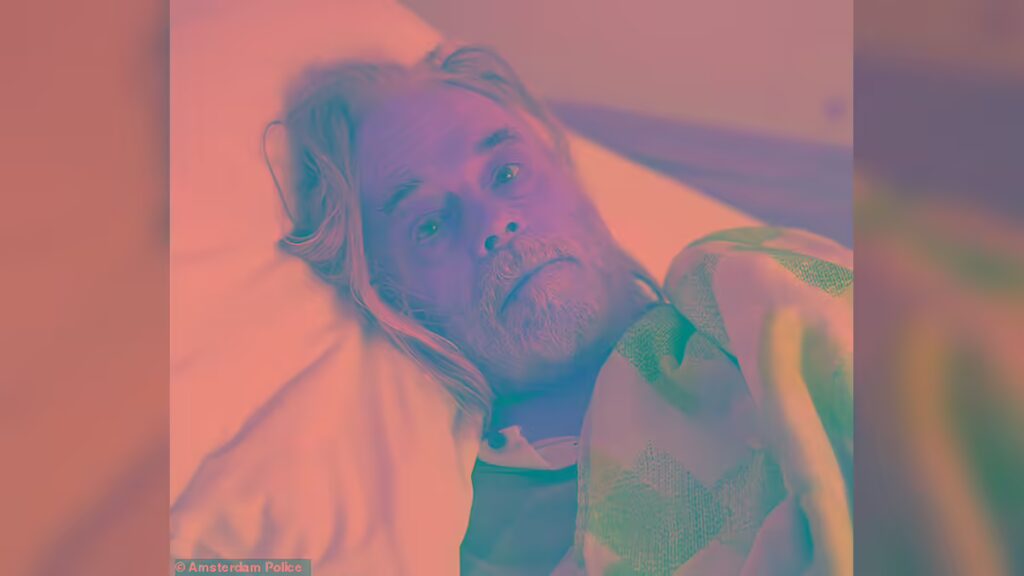
Authorities in the Netherlands are appealing internationally for help identifying a man who has remained unidentified for more than three years after collapsing on a street in Amsterdam.
The man was found on May 10, 2023, and taken to a local hospital after suffering what doctors believe was a brain hemorrhage or stroke. His condition left him unable to provide basic information about himself, including his name, nationality or where he came from.
Aphasia has made identification extremely difficult
Doctors determined that the man has aphasia, a neurological condition that can affect a person’s ability to speak and understand language.
Because of the condition, investigators have struggled to obtain meaningful information from him. He was also carrying no identification, bank cards or other documents that could have helped establish his identity.
The case is not being treated as a criminal investigation. Instead, two retired Dutch police officers, identified as Ruud and Nel, have been volunteering with a cold case team to try to uncover the man’s background.
Several names emerged from his life in Amsterdam
The investigators began tracing the man’s social connections and discovered that he had interacted with several communities in the Dutch capital.
He had reportedly spent time with a Buddhist community on Middenweg in eastern Amsterdam, where people knew him as “Lucky.” However, members of the community could not provide his real name or any other reliable identifying information.
The investigation later revealed that he was also a familiar figure at a public square, where he regularly visited shops and market stalls.
People there reportedly knew him by a bewildering collection of names, including Lucky, Louis, Lee, John, Ponytail and Sonny.
Cafe workers called him “Chris the Canadian”
One of the most intriguing leads came from Soupenzo cafe at Waterlooplein, where employees recognized the man as “Chris the Canadian.”
Staff members said he frequently visited the cafe and often appeared disheveled or unwell. He was usually accompanied by a suitcase and would request very specific types of soup, which employees prepared for him.




Despite his appearance, workers said he always appeared to have money with him.
Investigators were also told that the man spoke English with what witnesses believed was an American or Canadian accent, adding weight to the possibility that he could have spent part of his life in North America.
Conflicting stories surround his past
As investigators have pieced together accounts from people who encountered the unidentified man, they have encountered a series of conflicting descriptions of his life.
Some people claimed he was extremely wealthy, while others described him as someone who wandered Amsterdam’s streets.
Police now believe he may have spent time in North America and Nepal, although they have been unable to establish when he arrived in Amsterdam or how long he had been living there before his collapse.
His ability to communicate remains severely limited. Investigators say he can use individual English words to indicate agreement or disagreement but is unable to provide a coherent account of his identity or history.
Technology has failed to provide an answer
Authorities have attempted to use DNA databases and facial recognition technology to establish who the man is, but those efforts have so far produced no breakthrough.
A police spokesperson told DutchNews that strict privacy regulations have limited investigators’ ability to access wider databases that could potentially contain a match.
That has left investigators relying largely on witness accounts and information gathered from the man’s former acquaintances.
Man now lives in a care facility
The unidentified man is currently staying at a care facility, where authorities say he spends much of his time lying in bed.
Experts involved in his care have determined that he lacks the capacity to make decisions for himself, further complicating efforts to establish his background and locate relatives.
Investigators fear that somewhere in the world, relatives may still be searching for a family member who disappeared without explanation.
Retired investigators make international appeal
The volunteers working on the case say they are determined to give the unidentified man something that everyone should have: a confirmed identity.
“I simply cannot believe that nobody knows who this man really is,” retired investigator Nel said.
Her colleague Ruud added: “Every person has the right to an identity, and that includes this man.”
Amsterdam police are now appealing to members of the public, including people outside the Netherlands, who may recognize the man’s description, aliases or history.
Anyone who believes they may know his identity is being urged to contact Amsterdam police with information that could finally solve the mystery surrounding the man known to many as “Lucky” or “Chris the Canadian.”
