
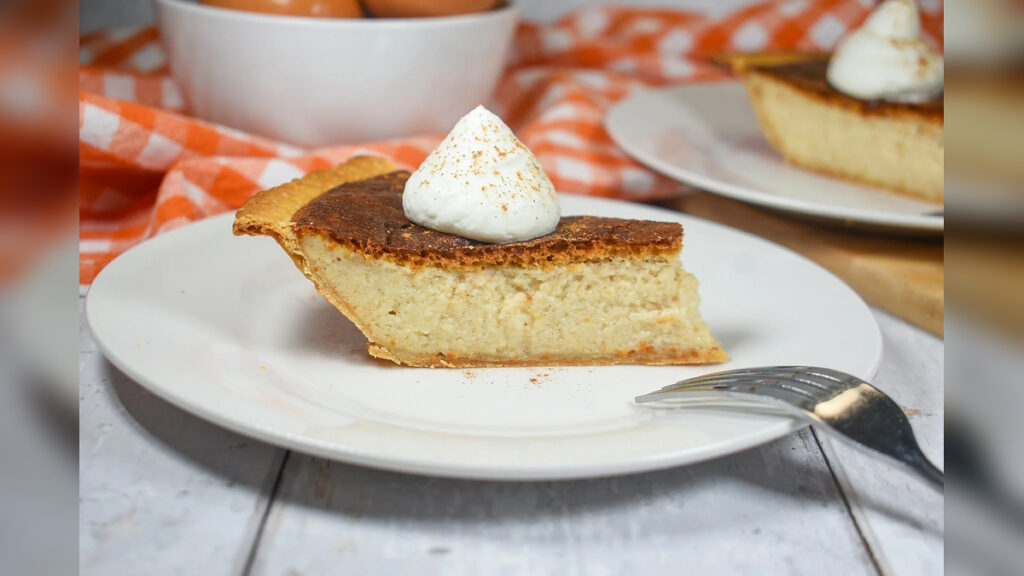
Cottage cheese pie takes a familiar dairy ingredient and turns it into an unusually light, creamy dessert.
The combination of a tender cottage cheese crust, smooth filling and fresh plums creates a contrast between richness and the natural acidity of the fruit.
The secret to achieving the pie’s soufflé-like consistency lies largely in how the cottage cheese is prepared.
Removing lumps before blending helps produce a completely smooth filling, while careful baking and thorough cooling allow the structure to set without becoming heavy.
The Ingredients Behind the Texture
The dough requires 200 grams of cottage cheese, 60 grams of vegetable oil, two egg whites, 60 grams of sugar, 4 grams of salt, 250 grams of wheat flour and 8 grams of baking powder.
For the filling, the recipe uses 400 grams of cottage cheese, 100 grams of sugar, 5 grams of vanillin, 150 grams of sour cream, two egg yolks and 20 grams of cornstarch.
About 350 grams of fresh plums provide the fruity topping.
Preparing a Soft and Tender Dough
The first stage is to make the base.
The cottage cheese should be passed through a sieve or thoroughly mashed with a fork to break down larger pieces.
Vegetable oil, egg whites, sugar and salt are then incorporated before flour mixed with baking powder is added gradually.
The resulting dough should remain soft rather than overly firm.
Once kneaded, the dough is formed into a ball and left to rest at room temperature for approximately 15 to 20 minutes.
The Filling Holds the Key to the Soufflé Effect
The filling requires particular attention.
Cottage cheese is combined with sugar, vanillin, sour cream, egg yolks and cornstarch, then processed with an immersion blender until the mixture is completely smooth.
Straining the cottage cheese beforehand is especially important when a delicate, homogeneous texture is desired.
Any remaining lumps can interfere with the creamy consistency of the finished layer.




Building the Pie Before Baking
A baking pan is greased with butter and lightly dusted with flour.
The rested dough is spread across the base, with the edges raised approximately 3 to 4 centimetres along the sides of the pan.
The smooth cottage cheese mixture is then poured over the dough and levelled with a spatula.
The plums are halved and pitted before being arranged cut-side up across the filling.
They should be pressed gently into the cream without being completely submerged.
Controlled Heat Helps Set the Filling
The oven should be preheated to 180°C (356°F) before the pie goes in.
It generally requires between 40 and 45 minutes of baking.
The edges should become golden brown while the centre remains slightly mobile when the pan is gently shaken.
That movement does not necessarily indicate that the pie is undercooked because the filling continues to firm as it cools.
Why Cooling Is Just as Important as Baking
The cottage cheese layer does not reach its final structure immediately when the pie leaves the oven.
Protein compounds remain unstable at high temperatures, while the starch also contributes to the filling becoming firmer as the dessert cools.
For that reason, slicing the pie while it is still hot can cause the creamy centre to lose its shape.
Allowing it to cool completely gives the soufflé-like layer time to stabilize.
Pastry Advice on Starch and Dairy Quality
Pastry chef Olga Efimova notes that the stability of the cottage cheese layer depends on the quality of the starch and complete cooling.
Home nutrition consultant Ekaterina Smirnova also emphasizes the importance of using good-quality dairy products without vegetable fats, which can help prevent unwanted moisture separation during baking.
Can Potato Starch Be Used Instead?
Potato starch can serve as an alternative to cornstarch, although the quantity should be reduced by roughly 20 percent because potato starch has stronger thickening properties.
It may also produce a somewhat different flavour and texture.
The flour should also be sifted before use.
This helps aerate it and reduces the possibility of dense lumps developing in the dough.
The Final Check Before Serving
A properly baked cottage cheese pie should have lightly browned edges and a centre that still jiggles slightly when the pan is moved.
Once cooled, the filling should become noticeably firmer while retaining its soft, creamy character.
Fresh plums add a bright acidic note that balances the sweetness and richness of the dairy filling, making the finished dessert both delicate and substantial.
A Simple Technique Makes the Difference
Although the ingredient list is straightforward, the recipe depends on several precise techniques.
Smoothly processed cottage cheese, correctly measured starch, gentle baking and complete cooling work together to create the airy texture that distinguishes this pie from a denser cottage cheese dessert.
