
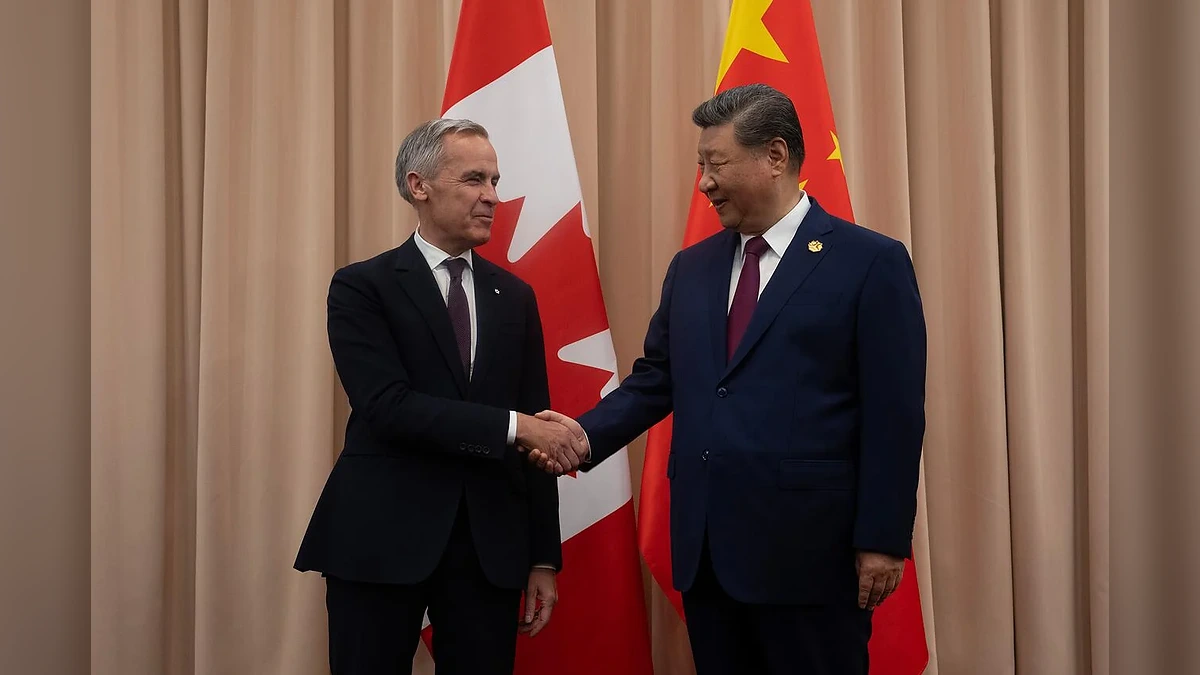
Canadian Prime Minister Mark Carney arrived in Shenzhen, China, on Monday for the Asia-Pacific Economic Co-operation (APEC) summit, where he is expected to meet Chinese President Xi Jinping and other regional leaders.
The visit marks the fourth and final stop of Carney’s nine-day overseas trip, which also included engagements in Manila for the Association of Southeast Asian Nations summit and Dublin for a European Political Community meeting.
Before participating in the wider APEC programme, Carney is scheduled to hold bilateral discussions with Xi on Tuesday morning.
He said the talks would cover changes in the international system, China’s role in global affairs and Canada’s priorities.
Trade and Investment Set to Dominate Canada-China Discussions
Carney has identified agriculture, clean and conventional energy, and financial services as areas where Canada could expand its economic relationship with China.
He said Ottawa had established clear boundaries around the sectors in which it wanted to pursue cooperation.
One of the main issues expected to feature in the discussions is Chinese investment in Canada’s automotive industry. Earlier this year, the two countries agreed to allow a limited number of Chinese electric vehicles into the Canadian market.
Carney has said he wants Chinese automakers to establish manufacturing operations in Canada, provided their investments create decent employment opportunities.
He expressed concern about factories where workers would assemble vehicles using components manufactured predominantly in China.
The prime minister also said Canada’s ongoing trade negotiations with the United States would influence its decisions on Chinese investment.
He described the relationship between the different trade discussions as a process of action and reaction, adding that the outcome of negotiations with Washington could create other opportunities involving European and Asian partners.
Foreign Interference Remains an Issue Between Ottawa and Beijing
Carney’s visit is his second meeting with Xi in China this year. He travelled to Beijing in January for the first meeting between a Canadian prime minister and Chinese president in eight years.
Relations between the two countries deteriorated during the administration of former Canadian prime minister Justin Trudeau, largely following allegations of Chinese foreign interference in Canada.
Before departing for his latest trip, Carney said he intended to raise the issue with Xi. A Chinese government spokesperson subsequently rejected allegations that Beijing engages in such activities.
APEC Summit to Support Canada’s Trade Diversification Plans
Beyond his meeting with Xi, Carney is expected to engage with leaders representing the 21 economies that make up APEC.
The forum brings together economies from across the Pacific, including Taiwan, Australia and Peru, with the aim of strengthening economic cooperation and reducing trade barriers.
Carney’s office said his participation would focus on attracting investment into Canada and diversifying the country’s trading relationships.




Vina Nadjibulla, co-founder of the Centre for Strategic Statecraft, said attention would also be on whether Ottawa allows additional Chinese investment in strategically important sectors.
She identified energy, technology, renewable energy and battery production, alongside automotive manufacturing, as areas to watch.
Nadjibulla said Canada’s decisions on China would need to be considered alongside its discussions with the United States and developments in US-China relations.
Canada ordered three Chinese companies to sell their interests in Canadian critical-mineral operations in 2022, citing national security concerns.
Visit Could Influence Canada’s Future Indo-Pacific Policy
Nadjibulla said the APEC discussions could contribute to a foreign policy review Carney plans to present in the House of Commons in the coming weeks.
The summit could also inform the planned renewal next year of Canada’s 2022 Indo-Pacific strategy, introduced under Trudeau.
She said Canada had established a stronger foundation for engagement with Asian countries, noting that leaders from countries including Vietnam and India had visited Canada or were planning to do so.
Nadjibulla also called for any revision of Canada’s regional strategy to address relations with Taiwan, the self-governing island claimed by China.
A proposed trade arrangement with Taiwan has remained unsigned for more than a year, despite the House of Commons foreign-affairs committee urging the government to advance economic relations.
Trump, Xi and Putin Expected at Planned Trilateral Meeting
The Shenzhen summit is also expected to bring together US President Donald Trump, Xi and Russian President Vladimir Putin for a planned trilateral meeting on Thursday.
The proposed gathering has raised concerns among European officials amid discussions about US-brokered efforts to end Russia’s war against Ukraine.
Some European representatives have expressed concern that proposals emerging from the negotiations could leave Ukraine and European countries vulnerable.
Carney said Brazilian President Luiz Inácio Lula da Silva had recently told him that he encouraged the negotiations as a way to end the war.
Canada’s position, Carney said, was that Ukraine needed a just peace and that a ceasefire was necessary.
Nadjibulla described the possibility of the three leaders meeting as significant, saying it reflected Carney’s earlier warnings about unrestricted competition among major powers.
She argued that countries needed to strengthen their resilience and ability to protect their interests so they would not become casualties of geopolitical competition.
China Signals Support for Renewed Engagement With Canada
Chinese state-controlled newspaper Global Times described Carney’s visit as an opportunity for mutually beneficial cooperation amid international uncertainty.
Zhao Xingshu of the Chinese Academy of Social Sciences told the newspaper that dialogue between the two countries could help address previous trade disputes and rebuild confidence in their economic relationship.
He also acknowledged that nearly eight years of limited high-level engagement meant restoring understanding between officials and institutions would take time.
Zhao said maintaining the improvement in bilateral relations was an important immediate objective.
Hong Kong Human Rights Concerns Remain on Canada’s Agenda
Carney’s visit to Shenzhen comes as Canada continues to raise concerns about political freedoms and human rights in Hong Kong, which borders the Chinese city.
Earlier in November, Canada joined other Western countries in condemning the sentencing of politicians and democracy activists under Hong Kong’s national security laws. The criticism particularly highlighted the 10-year sentences imposed on activists, including Joshua Wong.
A joint statement called for an end to prosecutions under the national security legislation and urged Chinese authorities to respect the rights and freedoms guaranteed to Hong Kong residents under international commitments.
Carney has previously said he raises human rights concerns with Chinese officials in private rather than publicly criticising the government.
The discussions with Xi and other APEC leaders will take place against the backdrop of Canada’s efforts to strengthen trade relationships while addressing longstanding political and security disagreements with Beijing.

