
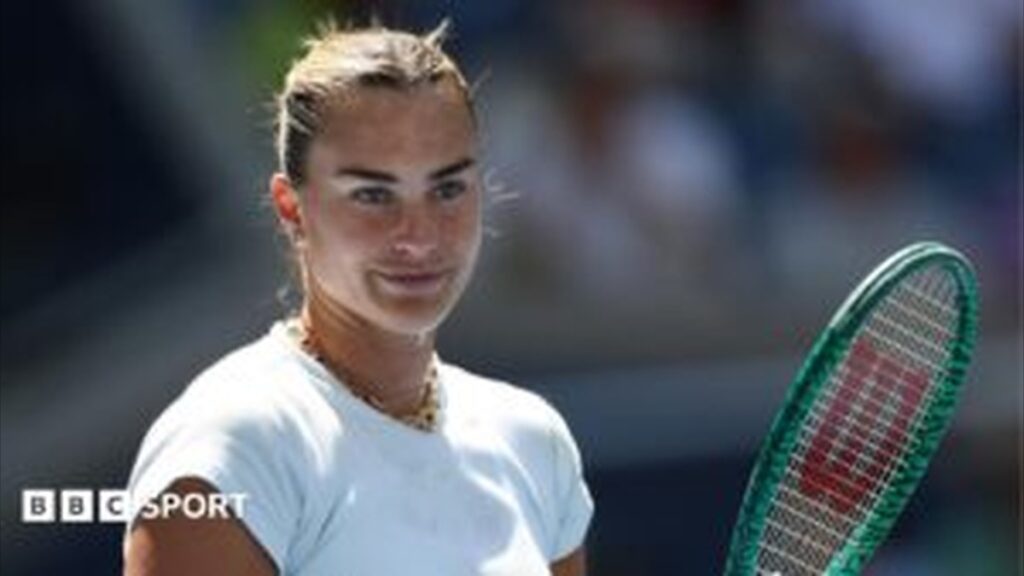
Aryna Sabalenka enters the 2026 US Open facing a challenge that extends beyond defending her title.
The Belarusian must rediscover the form that made her the WTA Tour’s leading force earlier this year or risk surrendering the world No. 1 ranking.
Sabalenka looked virtually untouchable after completing the rare Sunshine Double, winning Indian Wells and Miami consecutively.
The achievement made her only the fifth woman to accomplish the feat and gave her a 3,000-point advantage at the top of the rankings.
Since then, however, her season has taken a sharp turn.
A Troubling Run Since Miami
The 28-year-old has posted a 17-7 record since her Miami triumph, a respectable run by ordinary standards but well below what has come to be expected from a four-time Grand Slam champion.
Her biggest setbacks came at the French Open and Wimbledon.
Sabalenka suffered a quarter-final defeat in Paris before being eliminated in the fourth round at Wimbledon, leaving questions about whether she could reproduce her best tennis when matches became difficult.
Her struggles have been particularly noticeable when she has held commanding positions.
At the Cincinnati Open, Sabalenka led Sara Bejlek 5-1 in the opening-set tie-break and was 4-1 ahead in the second set.
Yet the 20-year-old Czech fought back to win 7-6 (9-7) 6-4.
The defeat followed another disappointing result in Toronto, where Sabalenka’s serve deteriorated during her last-16 loss to world No. 19 Ekaterina Alexandrova.
Mental Strength Has Become the Biggest Question
Sabalenka’s recent problems appear to have been less about a lack of ability and more about maintaining concentration when matches become unpredictable.
Similar collapses occurred during the clay-court season.
She surrendered leads after taking the opening set against Hailey Baptiste in Madrid, Sorana Cirstea in Rome and Diana Shnaider at Roland Garros.
That inconsistency is particularly striking given Sabalenka’s record at Grand Slam tournaments.
All four of her major singles championships — two Australian Open titles and two US Open victories — have come on hard courts.
She has also reached four other Grand Slam finals and six semi-finals, demonstrating a level of consistency at the sport’s biggest tournaments that few of her rivals can match.
Sabalenka believes the difficult months can ultimately benefit her.
“I work on my mental side of the game. I’ve been trying to reset my mind and to come back stronger,” she said in New York.
Her message was equally emphatic when asked whether she believed she could regain her confidence on the hard courts.
“Absolutely,” Sabalenka said. “These tough lessons are definitely going to make me way, way stronger and working even harder.”
Rybakina Has a Clear Route to the Top
The biggest threat to Sabalenka’s position comes from Elena Rybakina.
The Kazakh player is just 434 ranking points behind Sabalenka, meaning the battle for the top spot could be decided in New York.
Sabalenka has 2,000 points to defend as the reigning champion, while Rybakina has considerably less to protect.




Rybakina could therefore become world No. 1 without winning a match if Sabalenka, Jessica Pegula and Coco Gauff all fail to win the tournament.
Even if Sabalenka successfully defends her title, Rybakina would still move to the summit by reaching the semi-finals.
There is, however, uncertainty surrounding Rybakina’s own campaign after she suffered an ankle injury during the Cincinnati quarter-finals.
Gauff and Pegula Add to a Deep Women’s Field
The women’s draw offers considerably more than a battle between Sabalenka and Rybakina.
Pegula arrives in strong form after reaching the finals in Washington and Cincinnati.
The 32-year-old has built a reputation for consistency over several seasons but is still searching for her first Grand Slam title after reaching the US Open final in 2024.
Gauff provides another serious threat. The American won her first major title in New York in 2023 and defeated Pegula to claim the Cincinnati title last week.
A year after struggling with uncertainty in her game, Gauff returns to Flushing Meadows with greater confidence and a more fluid serve.
Beyond the leading four, the tournament contains further major champions and WTA 1,000 winners.
French Open champion Mirra Andreeva, Wimbledon champion Linda Noskova and six-time Grand Slam winner Iga Swiatek are among the players capable of disrupting the established order.
Pegula summed up the competitive landscape simply, pointing to the extraordinary depth across the women’s field.
Men’s Draw Opens Up as Sinner and Alcaraz Stay Apart
The men’s tournament also begins with an unusual storyline involving the sport’s two dominant young stars.
For the third consecutive Grand Slam, Jannik Sinner and Carlos Alcaraz will not meet because of circumstances surrounding their respective campaigns.
The pair won all eight Grand Slam titles across 2024 and 2025, with Alcaraz adding the Australian Open crown earlier this year.
Yet they have not appeared together at a major since.
Alcaraz missed the French Open and Wimbledon because of a wrist injury and is now returning after approximately four months away from competitive action.
Sinner’s situation changed just as Alcaraz prepared to make his comeback, with the Italian announcing that a knee problem would keep him out of the US Open.
Alcaraz admitted the prolonged separation from his biggest rival felt strange.
Djokovic Sees Another Opportunity
Sinner’s absence and questions surrounding Alcaraz’s fitness could create an opening for Novak Djokovic.
At 39, the Serbian remains one of the tournament’s most formidable contenders and has refused to place a deadline on his career.
The 24-time Grand Slam champion is chasing a record 25th major singles title, which would move him beyond Margaret Court’s all-time mark.
Djokovic’s recent Grand Slam record suggests he remains capable of challenging for the championship.
He has reached at least the semi-finals at six of the last seven majors, although his most recent Grand Slam victory came at the 2023 US Open.
Zverev Leads a Strong Men’s Challenge
Alexander Zverev enters the men’s draw as the top seed and will attempt to reach a third consecutive Grand Slam final.
The German won his first major title at the French Open before finishing runner-up to Sinner at Wimbledon, giving him considerable momentum heading into New York.
The American contingent will also attract significant attention.
Ben Shelton, fresh from winning the Canadian Open, and Cincinnati finalist Frances Tiafoe headline the home challenge.
Taylor Fritz, who reached the 2024 US Open final, will also be among the players hoping to end a 23-year wait for an American men’s singles champion.
What’s Next?
The US Open begins with Sabalenka fighting on two fronts: defending her championship and protecting her long-standing position at the top of women’s tennis.
Her recent results have exposed vulnerabilities that were difficult to see during her dominant run through Indian Wells and Miami.
Whether those struggles continue or become the motivation for another deep Grand Slam run will be one of the tournament’s central questions.
At the same time, Rybakina has a genuine opportunity to take control of the rankings, while Gauff, Pegula, Swiatek, Andreeva and other leading contenders will be looking to exploit any weakness.
On the men’s side, Djokovic has another opportunity to pursue history, while Zverev, Alcaraz and a group of ambitious American contenders will attempt to take advantage of Sinner’s absence.
Summary
Sabalenka’s path into the 2026 US Open is far more complicated than it appeared after her extraordinary spring.
The defending champion has struggled for consistency since winning Miami, particularly when matches have turned against her.
Yet her four Grand Slam titles and exceptional record on hard courts make her one of the tournament’s most dangerous players.
With Rybakina only 434 points behind in the rankings, Sabalenka cannot afford another early collapse. New York could therefore determine not only who wins the women’s title, but also who leaves the tournament as the world’s No. 1 player.

