
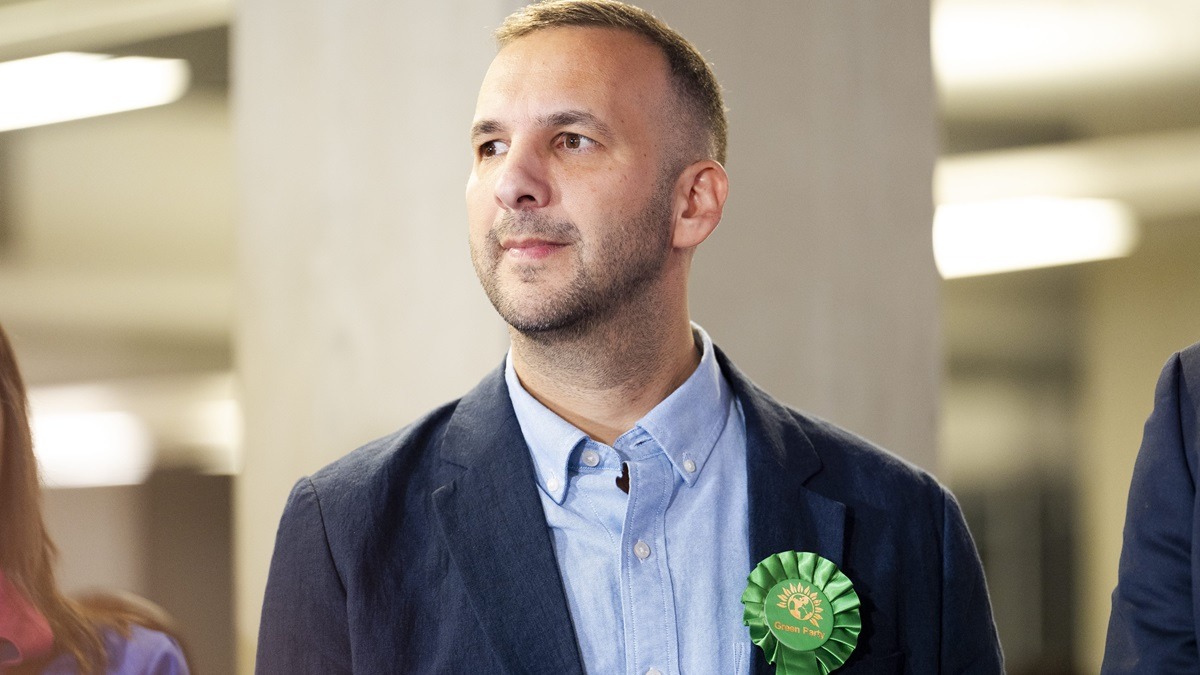
Green Party leader Zack Polanski has indicated that he is open to changing the party’s internal rules following a dispute over an anti-Semitism controversy that has raised questions about his leadership.
Polanski, who describes himself as an “eco-populist”, believes the party’s decision-making structures need to adapt to accommodate its rapidly expanding membership.
He has argued that leaders should be given greater responsibility for determining the party’s strategic direction.
The comments come amid criticism over a motion passed at the Green Party conference in Brighton on October 4, which defined Zionism as racism and called for a single democratic Palestinian state across all of historic Palestine.
Controversial Motion Divides Green Party Members
The motion received support from approximately 1,000 party members, while around 800 voted against it.
Critics described the resolution as an attack on the Jewish community and accused the Greens of adopting an extremist position.
Opponents also argued that its call for a single Palestinian state across historic Palestine amounted to advocating the eradication of Israel.
Polanski has expressed support for the motion’s general principles but acknowledged that he disagrees with certain provisions, particularly those seeking to dictate the future political structure of a state in Israel and Palestine.
Writing in The Guardian, he said the party had grown beyond the scale anticipated when he became leader and that its democratic processes needed to reflect the change.
“Our party democracy must now evolve to meet that,” he wrote, advocating wider participation for members, greater responsibility for party leaders in setting strategic priorities, and more robust and accessible internal procedures.



Polanski Faces Criticism Over His Absence From Conference Vote
Polanski did not attend the October 4 vote on the Zionism motion, choosing instead to campaign in the Holborn and St Pancras by-election in north London.
The decision drew criticism from within his own party, with opponents accusing him of failing to demonstrate leadership at a crucial moment for the organisation.
His absence became a further source of controversy as the debate over the motion intensified.
Polanski subsequently lost the parliamentary contest to Labour, adding to the scrutiny surrounding his position as Green Party leader.
He has acknowledged that some members felt let down by his decision to leave the conference proceedings to pursue his parliamentary ambitions.
Green Party Membership Growth Raises Questions About Internal Democracy
The controversy has emerged as the Greens have experienced substantial membership growth under Polanski, who became leader in September 2025.
The party’s membership has since climbed to more than 200,000.
Former Green Party leader Caroline Lucas has raised concerns about possible “entryism”, suggesting that some activists may have joined the organisation primarily to support the Zionism motion rather than because they agreed with the party’s wider political agenda.
The debate has brought renewed attention to how the party manages internal votes and ensures that policy decisions reflect the views of its broader membership.
Polanski’s proposed changes would seek to balance wider member participation with a greater role for party leadership in determining strategic priorities.
Green MPs Express Concerns Over the Motion
The resolution has also exposed divisions between party members and its parliamentary representatives.
Four of the Green Party’s five MPs opposed the motion, and its adoption as party policy does not automatically require MPs to support it.
Nor does the decision guarantee that the motion’s provisions will be included in a future Green Party manifesto.
Ellie Chowns, the Green MP for North Herefordshire, said on Saturday that she wanted to ensure the party was not “vulnerable to capture by extremists and racists”.
Speaking to the BBC, Chowns also called for party policies to reflect the views of the majority of members.
Adrian Ramsay, the former Green co-leader and MP for Waveney Valley, has similarly urged the party to return to its “core purpose”, emphasising its traditional commitment to environmental issues following the divisive conference vote.
