
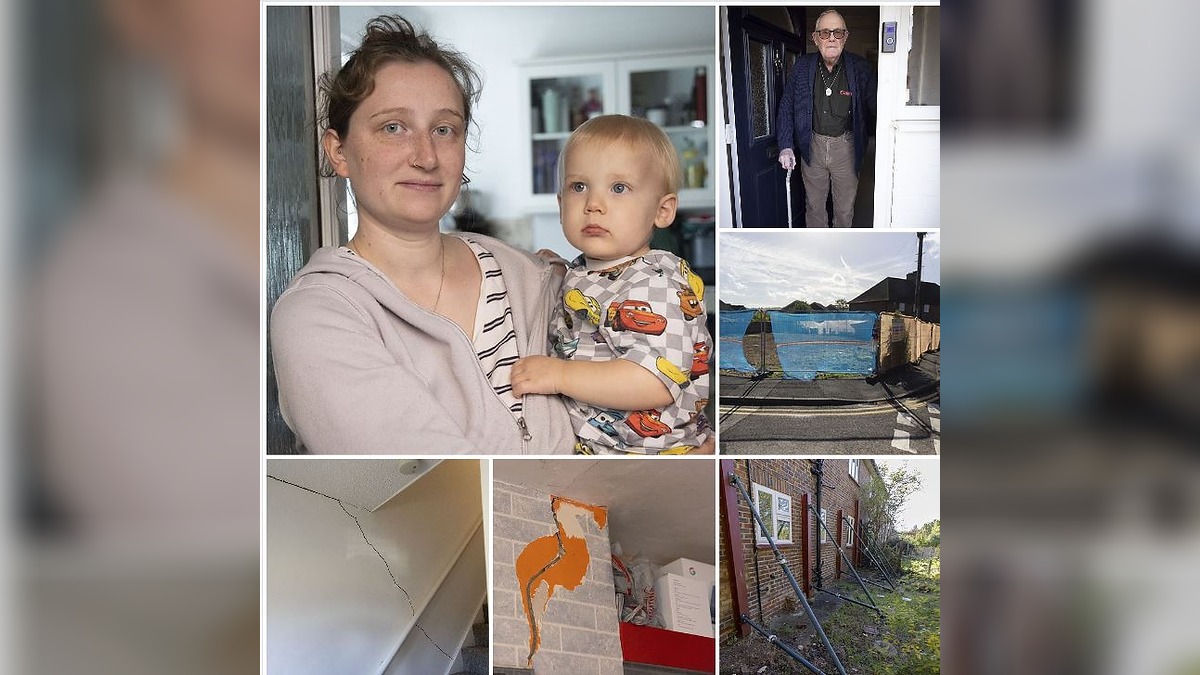
Residents in Guildford, Surrey, are living with growing concerns that their homes could become unsafe or collapse because of severe subsidence affecting properties across the Park Barn and Westborough neighbourhoods.
As many as 1,000 homes could face demolition or some form of regeneration as authorities address the structural problems. The issue has affected both privately owned properties and council housing, with 35 council-owned homes currently standing empty.
Many of the affected houses were built between the 1930s and 1970s on London Clay soil, with shallow foundations contributing to the problem. The clay expands and contracts as moisture levels change, placing stress on buildings, particularly those situated on hillsides.
Residents have reported large cracks appearing in walls, doors and windows becoming difficult or impossible to open, and concerns that their properties could deteriorate further.
Pregnant Mother Fears for Her Family’s Safety
Emma Young, 27, who is pregnant and lives with her young son, said she had been living in constant fear since cracks began appearing in her rented home.
Young moved into the property in January and said there had been no visible signs of subsidence when her family arrived. However, cracks have continued to develop in the walls and brickwork.
She said the damage had become so severe that the front door could no longer be opened, forcing the family to use the back entrance.
Young also raised concerns about fire safety, saying the family could face difficulties escaping if a fire blocked their alternative exit.
She described hearing dust falling inside the house because of the structural movement and said her family wanted to move out as soon as possible.
With another baby on the way, Young said she was worried that the property could collapse while her family was inside.
Council Tenant Waits for Relocation as Cracks Worsen
Kristine Osborne, 30, has also experienced worsening subsidence at her council-owned home, where cracks have spread and an upstairs door can no longer be opened.
She said her family had been waiting for four years to move elsewhere as the condition of the property deteriorated.
A neighbouring house has been sealed off and reinforced with scaffolding and metal supports, with nobody currently living inside.
Osborne said the council planned to demolish her home but needed to find alternative accommodation for the family first.




She added that the damage had gradually worsened since they moved in and that they were waiting for the relocation process to progress.
Other residents in the area have also expressed fears that their properties could collapse as the structural problems continue.
Pensioner Refuses to Leave His Council Home
Alastair Montgomery, 88, lives in a council-owned property affected by subsidence but has said he does not intend to move out.
Despite having suffered a heart attack and experiencing other health problems, Montgomery said he remained happy in his home and believed it met his needs.
He said cracks had first appeared three or four years ago but maintained that he would stay unless he was told the property was about to collapse.
His position contrasts with that of other residents who are seeking to leave homes they consider unsafe.
London Clay Soil Linked to Structural Damage
The subsidence problems are concentrated in Guildford’s Park Barn and Westborough areas, where many properties were built with foundations that are now struggling to cope with ground movement.
The local clay soil changes as moisture levels rise and fall, causing it to expand and contract. This movement can affect foundations and lead to cracks and other structural damage.
The problem is particularly concerning for homes built on sloping ground, where residents fear that continued movement could cause buildings to shift.
Thirty-five council-owned properties have been left vacant because of the structural issues, while support beams and other reinforcements have been installed at some affected houses.
Several empty council homes are already being demolished as part of efforts to address immediate safety concerns.
Guildford Council Begins Plans for Housing Regeneration
Guildford Borough Council is progressing with its Westborough and Park Barn Better Homes Programme, which is intended to improve housing and public spaces in the affected neighbourhoods.
Councillor Julia McShane, the council leader and lead councillor for housing, said community engagement was scheduled to begin in early November.
Residents will be able to contribute through local events, an online survey and direct telephone and email channels.
McShane said no final decisions had been made on the wider proposals and that feedback from tenants, homeowners, leaseholders, families, older people and community organisations would help shape the programme.
She said the council was also continuing to inspect and monitor its properties, with action taken where necessary to address structural risks and support affected tenants.
Demolition Underway at Some Vacant Properties
McShane confirmed that demolition work was progressing at several empty council-owned homes.
She said removing vacant properties would address safety concerns while allowing the council to develop longer-term plans for the neighbourhoods.
The council launched a wider initiative in March aimed at improving housing and public spaces, with the intention of developing safer and more sustainable homes.
According to McShane, properties found to be structurally unsafe and unsuitable for occupation are being considered for demolition, with support provided to affected residents.
The full scale of the proposed demolition and regeneration work remains undecided as the council prepares to consult the community on the next stage of the programme.

