
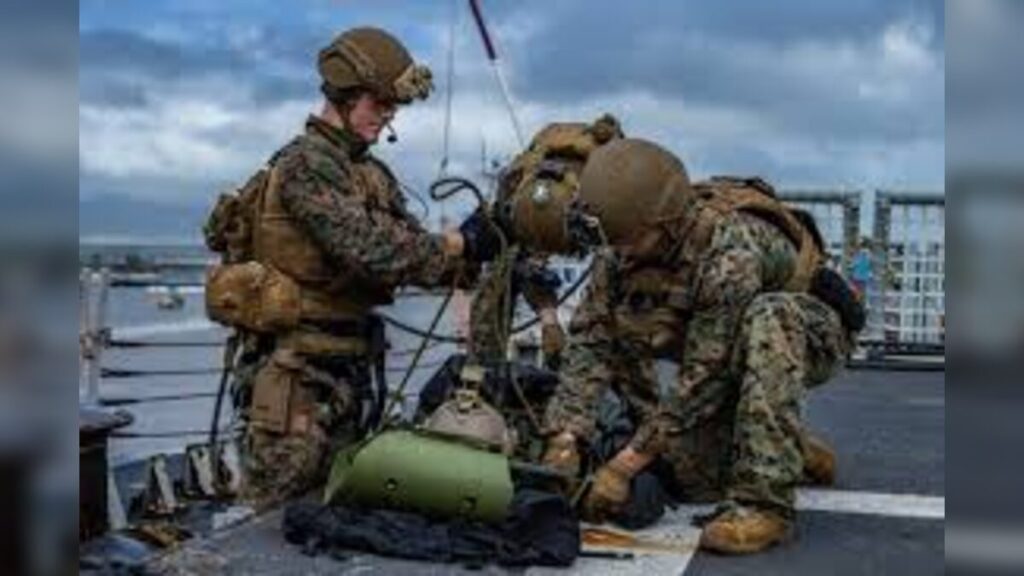
Tensions in the Persian Gulf are heating up as thousands of U.S. Marines are slated to arrive in the Middle East this Friday, coinciding with President Donald Trump’s firm deadline for Iran to reopen the Strait of Hormuz.
Sources cited by the Wall Street Journal report that this deployment is a clear message from Washington: the U.S. is prepared to act if Tehran continues to disrupt global shipping lanes.
The Forces on the Move
The deployment involves two major naval assets: the Japan-based amphibious assault ship USS Tripoli and the amphibious landing dock USS New Orleans.
Together, they will carry roughly 2,200 Marines from the 31st Marine Expeditionary Unit (MEU).
While the ships will enter the U.S. Central Command area on Friday, it could still take several days for the unit to reach the Strait itself.
Marine Expeditionary Units are designed for rapid, flexible responses.
They operate from ships as mobile bases, capable of deploying troops, aircraft, and equipment quickly.
That means they can handle evacuations, raids, or securing strategic locations without needing a large ground footprint—a critical factor in the tense Gulf environment.
Why the Strait Matters
The Strait of Hormuz isn’t just a geographic chokepoint; it’s a lifeline for global energy markets.
Roughly a fifth of the world’s oil passes through these waters.
Iran’s recent harassment of shipping vessels has already rattled global markets, pushed up insurance premiums, and increased energy costs worldwide.
For Americans, that often translates into higher fuel prices at the pump and economic uncertainty.
Trump’s message is clear: “eventually” is not enough.
The administration wants shipping lanes open immediately, and the Marine buildup reinforces that urgency.




While troops are not being sent onto Iranian soil, the show of force widens U.S. options and signals to Tehran that the U.S. is ready to respond to further provocations.
Pressure on Allies
The U.S. isn’t acting alone in concern over the strait.
Many European and Middle Eastern nations rely heavily on these shipping routes for energy imports.
Trump has argued repeatedly that countries benefiting most from the Strait should share the responsibility of protecting it.
The arrival of U.S. forces underscores America’s willingness to act unilaterally if allies are hesitant.
This is also part of a broader diplomatic and strategic message: Iran cannot block global trade or intimidate the West without consequences.
The presence of the 31st MEU ensures that Washington has a rapid-response option in place, keeping pressure on Tehran while maintaining a degree of restraint.
Impact and Consequences
The Marine deployment is likely to affect both regional geopolitics and global markets.
Shipping through the strait may become temporarily more secure, calming insurance and energy price volatility.
But it could also escalate tensions with Iran, increasing the risk of military incidents in the Gulf.
For the U.S., this move demonstrates readiness and resolve, but it also commits resources and heightens the stakes.
Any misstep could spark a wider confrontation, drawing in regional powers and affecting international trade.
What’s Next
In the coming days, all eyes will be on Iran’s response.
If Tehran reopens the strait voluntarily, the crisis may be defused without conflict.
But if provocations continue, the Marines and their amphibious ships are already in position to support rapid action.
Meanwhile, Washington will continue diplomatic pressure, urging allied nations to contribute to the Strait’s security.
Monitoring will also extend to economic signals: energy markets and shipping insurers will track any changes closely, and global oil prices could fluctuate based on perceived risk levels.
Summary
Thousands of U.S. Marines are heading to the Middle East as President Trump sets a hard deadline for Iran to reopen the Strait of Hormuz.
The deployment, involving the USS Tripoli, USS New Orleans, and the 31st MEU, signals U.S. readiness to ensure the strait remains open for international trade.
While not an immediate move against Iran, the buildup raises pressure on Tehran and tests the resolve of global allies reliant on these shipping lanes.
Bulleted Takeaways
- 2,200 Marines from the 31st MEU are arriving in the Middle East this Friday
- Amphibious assault ship USS Tripoli and landing dock USS New Orleans are part of the deployment
- Marines operate from ships as mobile bases, ready for rapid response or evacuation missions
- Deployment coincides with Trump’s deadline for Iran to reopen the Strait of Hormuz
- Iran’s disruption of shipping has spiked global energy costs and insurance rates
- U.S. allies are being urged to help secure the strait, but America is prepared to act alone
- Military presence sends a strategic signal without immediate boots on Iranian soil
- The situation could affect oil markets, regional tensions, and global trade security

