
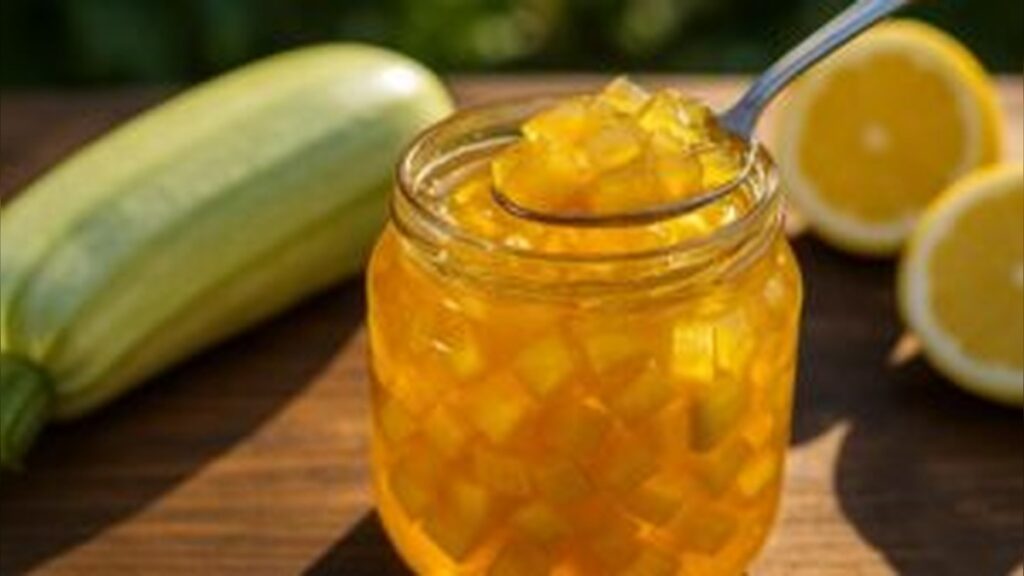
A jar of zucchini preserve can look remarkably similar to canned pineapple, with translucent golden cubes suspended in a thick amber syrup.
The surprising resemblance is intentional.
Young zucchini has a mild flavour and porous flesh that readily absorbs sugar and acidity, allowing it to take on the character of the syrup surrounding it.
With the right technique, an ordinary garden vegetable can be transformed into a sweet preserve with a firm, fruit-like texture.
Why zucchini works so well
Zucchini’s relatively neutral flavour makes it an effective base for this type of preserve.
Its cellular structure allows the vegetable to gradually absorb the concentrated syrup during repeated periods of heating and cooling.
Lemon juice or citric acid is particularly important because it cuts through the sweetness and supplies the sharpness associated with tropical fruit.
Professional chef Lyudmila Kravtsova stresses that patience is essential.
If the zucchini does not have enough time to absorb the syrup, the outside may be flavourful while the centre remains bland.
The ingredients for the preserve
For approximately 2kg of young zucchini, the recipe calls for 1.2kg of sugar, 200ml of water, one teaspoon of citric acid or the juice of one lemon, and one packet of vanilla sugar.
The zucchini should be young, with thin skins and soft, undeveloped seeds.
Older vegetables with tougher, woody flesh are less suitable because they are unlikely to produce the tender, translucent cubes required.
Cutting the vegetable for a fruit-like appearance
Start by peeling the zucchini before cutting it into cubes measuring roughly 2–3cm.
The size is important for both appearance and texture.
Larger pieces can retain a more substantial bite while resembling chunks of preserved fruit.
Once prepared, the zucchini is ready to absorb the syrup.
Building the sweet and acidic syrup
Combine the sugar, water and lemon juice in a saucepan and bring the mixture to a boil.
Allow it to cook for around three to five minutes, giving the sugar enough time to dissolve completely.
The resulting syrup provides the foundation for the transformation, supplying sweetness, acidity and the liquid needed to penetrate the zucchini.
The overnight step makes the difference
Pour the hot syrup over the prepared zucchini, cover the mixture and leave it for approximately eight to 12 hours.
This is one of the most important stages of the process.




During the resting period, the zucchini releases moisture while gradually taking in the concentrated syrup.
Rushing this stage can leave the finished preserve lacking in flavour and consistency.
Why the cooking happens in cycles
Rather than boiling the zucchini continuously, the mixture is heated for about 10–15 minutes before being removed from the heat and allowed to cool for three to four hours.
The heating and cooling cycle is then repeated until the zucchini becomes translucent and the syrup develops the desired consistency.
This slower method helps the cubes retain their shape.
Cooking everything in one prolonged session can soften the zucchini too aggressively, producing a mushy preserve rather than firm, fruit-like pieces.
Adding the final flavour
Vanilla sugar is introduced during the final cooking stage, giving the preserve a more pronounced confectionery aroma.
For an even stronger tropical character, cooks can experiment with additions such as finely grated lemon zest, ginger or pineapple essence.
These ingredients are optional, but they can push the flavour further away from the vegetable’s natural profile.
What each ingredient contributes
| Ingredient | Main function |
|---|---|
| Zucchini | Provides the fruit-like cubes and absorbs the syrup |
| Sugar | Supplies sweetness and contributes to preservation and texture |
| Lemon or citric acid | Balances the sweetness with acidity |
| Vanilla sugar | Adds a dessert-like aroma |
| Water | Forms the initial syrup |
The balance between these ingredients is crucial.
Too little acidity can leave the preserve excessively sweet, while insufficient cooking can result in a thin syrup.
Knowing when the preserve is ready
Appearance provides one of the clearest signs of progress.
The zucchini pieces should become almost transparent, while the syrup should thicken into a rich amber liquid.
If the syrup remains noticeably watery after the planned cooking cycles, another brief boiling session can be used to reduce excess moisture.
The zucchini should still retain its shape rather than collapsing when handled.
Choosing the right additions
Lemon is the traditional acidic component, but lime juice can also be used for a fresher flavour.
The amount should be adjusted according to its acidity and the overall balance of the recipe.
Ginger and citrus zest can add complexity, while pineapple essence can make the resemblance to tropical fruit even more pronounced.
The key is not to overwhelm the delicate zucchini pieces with additional flavourings.
Preparing the jars safely
Once the final cooking stage is complete, the hot preserve should be transferred into properly sterilized jars and sealed using appropriate canning practices.
For long-term storage, clean, intact jars and properly prepared lids are essential.
The original recipe states that hermetically sealed jars can remain stable for up to a year in a cool, dark environment.
However, home-preservation safety depends on the acidity, processing method, sealing conditions and storage environment, so established food-preservation guidance should be followed rather than relying on appearance alone.
A simple way to rescue a thin preserve
If the syrup has not thickened sufficiently, there is no need to abandon the batch.
An additional cooking session can help evaporate some of the excess liquid.
The mixture should be monitored carefully to avoid overcooking the zucchini and damaging the texture.
The goal is a syrup that coats the cubes while leaving them intact.
The secret is patience
The appeal of zucchini jam lies in the unlikely transformation taking place inside the jar.
What begins as a mild, everyday vegetable becomes a glossy, amber preserve with a texture and appearance reminiscent of tropical fruit.
The method is not complicated, but it rewards patience.
Young zucchini, carefully balanced acidity, repeated heating and cooling, and proper preparation all contribute to the final result.
For gardeners facing a surplus of zucchini, the recipe offers an inventive alternative to savoury dishes — and a sweet preserve that can leave diners wondering whether the “pineapple” on their plate really came from a garden vegetable.

