
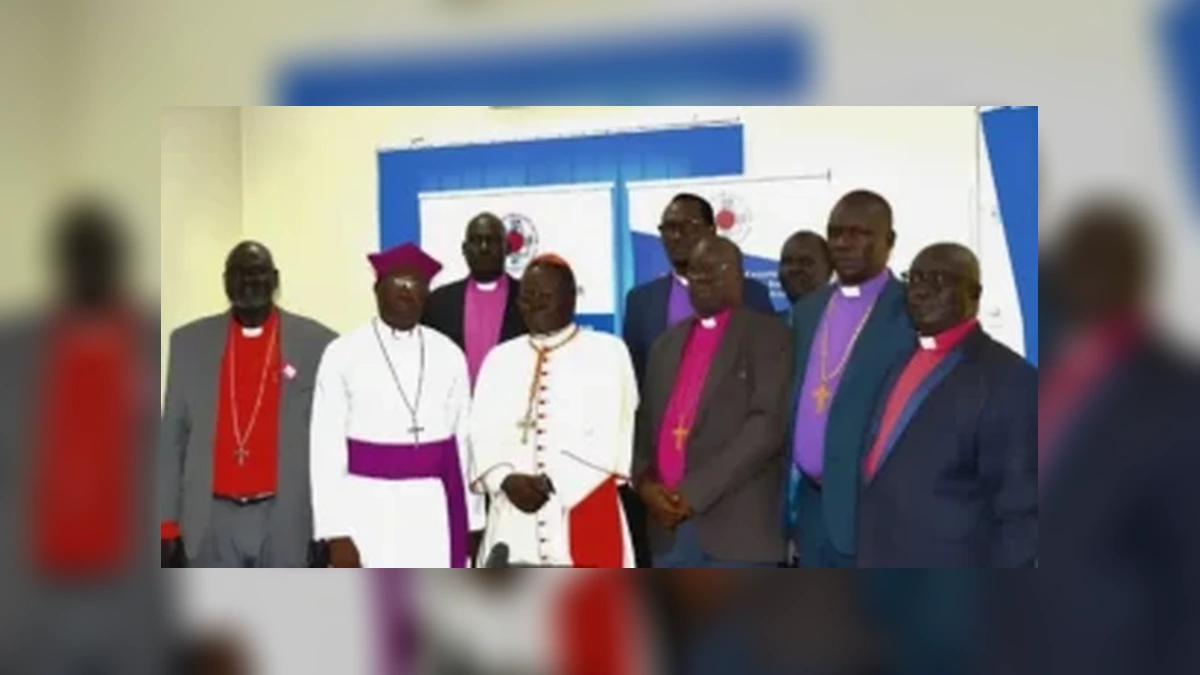
Church leaders in South Sudan have called for an immediate end to fighting and stronger measures to protect civilians as insecurity, killings, abductions and displacement continue to affect communities across the country.
In a statement issued on October 5, members of the South Sudan Council of Churches said the worsening humanitarian and security situation had reached a point where remaining silent was no longer acceptable.
The council includes representatives of the Sudan Catholic Bishops’ Conference.
Calls for Protection of Civilians and Aid Access
The church leaders urged the government, armed groups, traditional authorities and local communities to take immediate steps to stop violence and revenge attacks.
They called for greater security along roads and river transport routes, which are vital for civilians and humanitarian organisations operating in affected areas.
The leaders also demanded safe and unrestricted access for humanitarian agencies so that assistance can reach people displaced or otherwise affected by the violence.
Jonglei and Upper Nile Among Areas Facing Severe Insecurity
The statement highlighted several areas where renewed armed confrontations and the mobilisation of armed youth have contributed to deaths and displacement.
In Upper Nile State, the church leaders specifically identified Nasir and Ulang counties, where they said fighting had also disrupted humanitarian access.
Jonglei State was another major area of concern. The leaders pointed to Nyirol, Uror, Ayod, Akobo, Twic East and Duk, as well as the Pibor Administrative Area, where fighting, intercommunal violence and revenge attacks have affected civilians.
Displacement Has Reached Hundreds of Thousands
The renewed violence comes amid a broader deterioration in South Sudan’s humanitarian situation.
The United Nations High Commissioner for Refugees warned in June that months of fighting in eastern Jonglei had forced hundreds of thousands of people to leave their homes.
UNICEF reported in April that more than 330,000 people had been displaced by fighting and airstrikes as of March. Women and children accounted for the overwhelming majority of those displaced, according to the agency.




The displacement had also spread into neighbouring Lakes and Upper Nile states, increasing pressure on local communities and already stretched essential services.
UN Documents Significant Civilian Casualties
The scale of the violence has also been reflected in United Nations monitoring.
The United Nations Mission in South Sudan documented 206 incidents of conflict-related violence affecting 1,388 civilians between January and March.
A UNMISS report released in June recorded 767 civilian deaths, 457 injuries and 93 abductions during the reporting period. It also documented 71 cases of conflict-related sexual violence.
The figures underline the concerns raised by church leaders over the continued vulnerability of civilians in different parts of the country.
Concerns Extend to Unity and Warrap States
The South Sudan Council of Churches also raised concerns about security around Bentiu in Unity State and in the Ruweng Administrative Area.
According to the leaders, the insecurity is having consequences for displaced and vulnerable populations in those areas.
In Warrap State, they pointed to intercommunal and revenge-related violence in Tonj North and Gogrial East. Similar concerns were raised about the Abyei Administrative Area.
Roads in Equatoria Face Growing Security Risks
The church leaders also warned about insecurity along key roads in the Equatoria region.
They identified the Juba-Mundri, Juba-Torit and Juba-Bor routes as areas where attacks and insecurity are putting civilians and humanitarian operations at risk.
Communities in Yei River County and parts of Western and Eastern Equatoria were also described as continuing to experience the effects of armed insecurity, confrontation and displacement.
Church Calls for Dialogue Instead of Retaliation
Beyond the immediate security concerns, the church leaders appealed for a renewed commitment to reconciliation.
They urged political and community leaders, armed groups and ordinary citizens to reject revenge and retaliation and instead strengthen local peacebuilding mechanisms.
The council called for restraint rather than retaliation, dialogue rather than confrontation, and reconciliation rather than revenge.
The leaders stressed that South Sudan had already endured decades of conflict and said its people should be able to travel without fear, remain in their homes and live without being caught between armed groups and armed youth.
Leaders Appeal for a Different Path
The church leaders urged South Sudanese communities to reject hatred and violence and work collectively towards peace and reconciliation.
They said the country’s future depended on protecting civilians and rebuilding trust among communities rather than allowing cycles of revenge to continue.
The statement ended with a prayer for God to heal what the leaders described as a wounded nation and to give wisdom to those in positions of authority.
They expressed hope that communities throughout South Sudan would ultimately be able to live in peace and dignity.

