
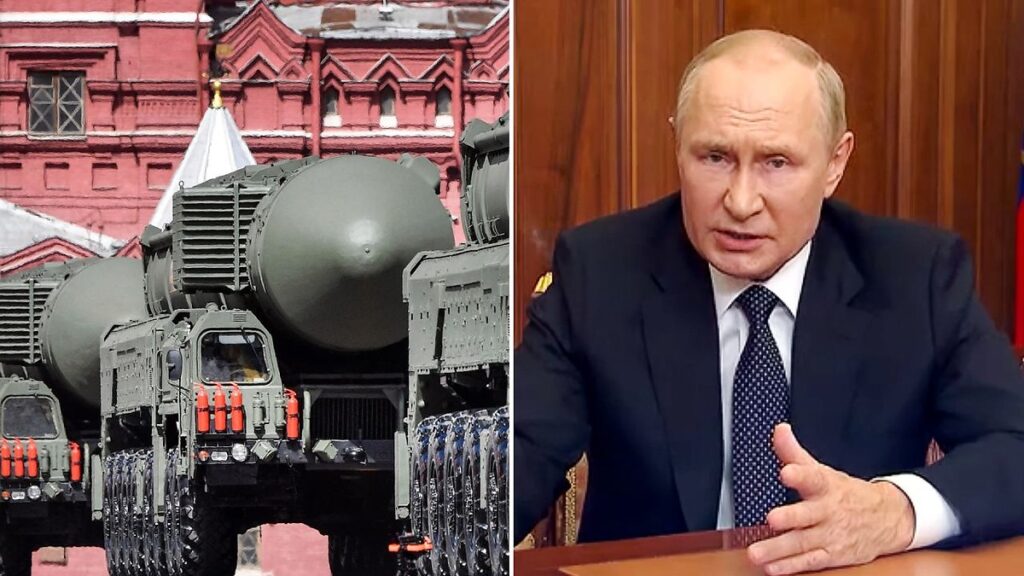
Russia has issued a fresh warning to Britain over its military and political support for Ukraine, raising fears that the increasingly hostile relationship between Moscow and London could enter a more dangerous phase.
A senior Russian figure has suggested that Moscow could consider a range of retaliatory measures, including cyberattacks and what was described as a possible “semi-military” response against British interests.
The warning followed Prime Minister Andy Burnham’s visit to Kyiv and an announcement concerning the production of long-range missiles in Ukraine using British technology.
Kremlin Accuses Britain of Direct Involvement
Moscow has accused Britain of moving beyond indirect support for Ukraine and becoming directly involved in the conflict.
Kremlin spokesman Dmitry Peskov said Britain was “participating in this war” and accused the UK of repeatedly undermining efforts towards a potential peace process.
He also warned that Russian forces would seek to identify locations where missiles and other military equipment are being produced.
The comments represent another escalation in the increasingly bitter rhetoric between Moscow and London since Russia launched its full-scale invasion of Ukraine.
Missile Manufacturing Deal Triggers Russian Anger
The immediate source of the latest dispute is a decision involving the British-French defence company MBDA and the production of long-range missiles.
During his visit to Kyiv, Burnham announced that information relating to British components used in the Scalp missile had been cleared for sharing, potentially allowing Ukraine to manufacture the weapons domestically.
The Scalp is produced using British and French technology and is capable of striking targets deep behind enemy lines.
For Ukraine, domestic production could reduce reliance on foreign deliveries and strengthen its ability to conduct long-range operations.
For Moscow, however, the move represents a significant expansion of Britain’s role in supporting Ukraine.
Former Russian Official Warns of a New Escalation
Andrei Fedorov, a former Russian deputy foreign minister, said the reaction inside Russia had been strongly negative.
Speaking on BBC Newsnight, Fedorov said there was growing political and public pressure on President Vladimir Putin to respond to Britain because Moscow considers British assistance to Ukraine to amount to direct participation in the conflict.
He warned that a future response could go beyond diplomatic statements.
According to Fedorov, possible measures could include cyberattacks launched through unidentified actors, political retaliation and potentially a form of “semi-military” action.
British Defence Industries Could Become Targets
Fedorov specifically raised the possibility that British facilities involved in producing drones or components for weapons supplied to Ukraine could face attacks.
He suggested that companies connected to drone production or equipment associated with the Storm Shadow and Scalp missile programmes could be among the facilities Russia might consider targeting.
The comments were framed as a warning rather than an announcement of an imminent Russian operation, but they have nevertheless added to concerns over the potential expansion of the conflict beyond Ukraine.
Putin Warns That a ‘Pandora’s Box’ Has Been Opened
The Russian response has also been accompanied by warnings attributed to Putin that the latest developments could open a “Pandora’s box”.




The phrase reflects Moscow’s concern that allowing Ukraine to manufacture increasingly sophisticated Western-designed weapons could change the character of the conflict.
Russia has previously warned Britain about the consequences of Ukrainian attacks deep inside Russian territory involving British-supplied equipment.
Moscow has also said that the more directly Britain becomes involved, the greater the price it could ultimately face.
Burnham Rejects Russian Threats
Burnham has rejected the warnings and insisted that Britain will continue supporting Ukraine.
During his first major international speech, delivered in Kyiv in front of St Sophia Cathedral during Ukraine’s 35th anniversary celebrations, he condemned Russia’s threats and praised the Ukrainian resistance.
He argued that Britain had a responsibility to continue supporting Ukraine and compared the country’s struggle to earlier European battles against Nazi Germany.
Burnham said the UK would remain behind Ukraine both during the war and during the reconstruction that follows.
Britain Calls for More Pressure on Russia
Burnham also used his visit to call for stronger international pressure on Moscow.
He argued that the time had come to further restrict Russia’s ability to finance its military campaign, pointing to what he described as pressure on the Russian economy, including falling oil revenues and a large budget deficit.
He backed additional sanctions and urged the US Congress to increase economic pressure on Moscow.
His message was clear: Britain intends to maintain its support for Ukraine despite Russian warnings.
Calls for More Patriot Missiles
During his first meeting with the coalition of nations supporting Ukraine, Burnham also called for the urgent delivery of additional Patriot interceptor missiles.
He argued that Ukraine needs more air-defence capabilities to protect its population from Russian attacks.
The appeal places further pressure on Western allies to maintain weapons supplies at a time when Ukraine continues to require sophisticated military equipment to defend its cities and infrastructure.
Russia and Britain’s Relationship Deteriorates Further
The latest dispute comes amid a broader deterioration in relations between London and Moscow.
Russia has described its relationship with Britain as being at an unprecedentedly low point, while its ambassador to London, Andrey Kelin, was ordered back to Moscow after seven years in the post.
Kelin has accused Britain of choosing confrontation rather than seeking improved relations with Russia.
The diplomatic withdrawal adds another layer to an already tense relationship marked by sanctions, military support for Ukraine, intelligence disputes and increasingly hostile public statements.
Ukraine Welcomes Continued British Support
Ukrainian President Volodymyr Zelensky welcomed Burnham during the visit, with the two leaders publicly demonstrating their continued partnership.
Burnham also visited sites displaying destroyed Russian military vehicles and used the occasion to underline Britain’s commitment to Ukraine.
He said Ukraine had acted as a protector of European security and argued that its resistance should be met with continued support rather than fatigue among its allies.
A Dangerous New Phase?
The latest warnings raise questions about how far Moscow is prepared to go in responding to Britain’s growing military assistance to Ukraine.
Cyber operations, diplomatic retaliation and attacks against defence-related facilities have all been raised as possible forms of pressure, although no evidence presented in the statements establishes that a specific attack on a British factory is imminent.
The central concern is that increasingly direct Western involvement in Ukraine could create additional opportunities for confrontation between Russia and NATO-aligned countries.
What’s Next?
Britain is expected to maintain its military and political backing for Ukraine despite the latest Russian warnings.
The focus will now be on whether Moscow follows its increasingly aggressive rhetoric with concrete action and whether Britain and its allies respond with additional military assistance or sanctions.
Ukraine, meanwhile, continues to seek more advanced air-defence systems, long-range weapons and other military support as it attempts to strengthen its ability to withstand Russian attacks.
Summary
Russia has warned Britain that its expanding support for Ukraine could provoke retaliation, with a former senior Russian official raising the possibility of cyberattacks, political measures and potentially “semi-military” action.
The warnings followed Britain’s decision to facilitate the sharing of information linked to the production of Scalp missiles in Ukraine.
Moscow argues that the move amounts to direct British involvement in the war, while Britain insists it will continue supporting Ukraine until a lasting peace is achieved.
With diplomatic relations already at a historic low, the dispute has intensified concerns that the confrontation between Russia and Britain could move into an even more dangerous phase.

