
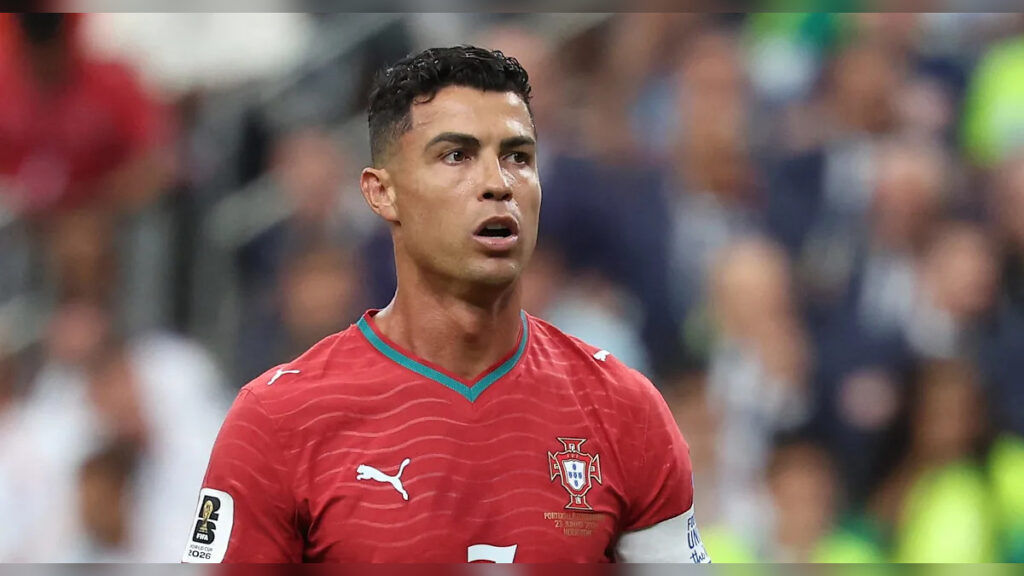
Cristiano Ronaldo has found himself at the centre of another football controversy after appearing to engage with social media content that sharply criticized FIFA‘s conduct during the recent World Cup.
The Portugal captain reportedly liked an Instagram post featuring journalists accusing world football’s governing body of corruption and suggesting the tournament had been influenced in favor of Argentina and Lionel Messi.
Ronaldo’s Social Media Activity Draws Attention
The Portuguese star’s interaction with the post quickly attracted widespread attention online, with many interpreting it as support for claims that FIFA manipulated aspects of the competition.
However, a social media “like” does not necessarily confirm agreement with the opinions expressed.
Ronaldo’s Portugal side exited the tournament in the Round of 16 after losing to eventual champions Spain, while longtime rival Lionel Messi captained Argentina to the World Cup final before suffering a narrow 1-0 defeat after extra time.
Journalists Accused FIFA of Favoring Argentina
The Instagram post that caught Ronaldo’s attention featured comments made by Spanish journalists Pilar Rodrigues Losantos and Ruben Amon during the television program Espejo Publico.
Rodrigues Losantos argued that Argentina had benefited repeatedly from FIFA’s decisions throughout the tournament, claiming the governing body wanted Messi to lift the World Cup.
She suggested Argentina had survived several matches because of officiating decisions and expressed greater concern about FIFA president Gianni Infantino than the Argentine national team itself.
Her colleague Ruben Amon went even further, describing FIFA as an organization that had damaged football by prioritizing commercial interests and turning the sport into an experience increasingly reserved for wealthy fans.
He labeled FIFA “mafia-like” and “shameful,” while insisting that supporters continued to love football despite the governing body’s reputation.
World Cup Decisions Became a Major Talking Point
Throughout the tournament, several controversial refereeing decisions involving Argentina generated debate among fans, pundits and rival teams.
One of the earliest incidents came during Argentina’s group-stage victory over Algeria, when Messi escaped disciplinary action after appearing to catch defender Aissa Mandi with his studs during a challenge.
Although the referee awarded a free kick, VAR did not recommend an on-field review, leaving many questioning why no card was shown.
The decision became one of several moments critics later cited while alleging Argentina had received favorable treatment.



Egypt Vented Fury After Elimination
Argentina’s knockout victory over Egypt also produced heated reactions.
Egypt believed they had been denied a penalty after Mohamed Salah appeared to be clipped inside the penalty area shortly before Argentina scored the decisive goal at the opposite end of the pitch.
The North African side also saw a goal disallowed following a lengthy VAR review for an earlier foul in the attacking sequence.
Following the defeat, Egypt manager Hossam Hassan openly questioned the fairness of the tournament, suggesting commercial interests may have influenced events and accusing football authorities of treating his team unjustly.
Switzerland Questioned Refereeing in Quarter-Final
Switzerland also voiced frustration after their quarter-final defeat to Argentina, with the biggest controversy surrounding Breel Embolo’s dismissal.
Initially, Argentina midfielder Leandro Paredes received a yellow card for a challenge involving Embolo.
After intervention from VAR under the competition’s mistaken identity protocol, referee Joao Pinheiro reviewed the incident and instead concluded that Embolo had simulated contact.
The Swiss striker received a second yellow card and was sent off.
Although the decision complied with tournament regulations, Swiss players and coaching staff argued the dismissal fundamentally altered the match.
Captain Granit Xhaka said the sending-off “killed the game,” while defender Manuel Akanji claimed nearly every important decision favored Argentina.
Midfielder Remo Freuler questioned why VAR had intervened in the situation, and coach Murat Yakin described the sequence as incomprehensible.
Debate Continued Even After the Final
Questions surrounding officiating persisted after Spain defeated Argentina 1-0 in extra time thanks to Ferran Torres’ 106th-minute winner.
Some observers pointed to Nico Williams having a goal ruled out after what they believed was a questionable foul in the buildup.
Others argued that the late sending-off of Argentina midfielder Enzo Fernandez demonstrated that officials were not consistently favoring the South American side, helping counter allegations of systematic bias.
Political Banner Also Attracted Scrutiny
Away from refereeing controversies, Argentina also faced criticism over political messaging displayed during the tournament.
After reaching the final, players celebrated with a banner declaring “Las Malvinas son argentinas,” referring to the disputed Falkland Islands.
FIFA regulations prohibit political slogans and demonstrations inside official competition venues, yet no disciplinary action was announced before the championship match.
The incident drew additional attention after Andrew Giuliani, who headed the White House FIFA task force, defended the players’ freedom of expression by referencing First Amendment principles in the United States.
FIFA Continues to Reject Allegations
Despite persistent accusations from critics, FIFA has consistently denied claims that the World Cup was manipulated to benefit Argentina or Messi.
Nevertheless, debate surrounding officiating standards, VAR decisions and the governing body’s consistency has continued long after the tournament ended.
Ronaldo’s social media activity has now added another high-profile voice to a discussion that remains one of the most contentious legacies of the competition.
