
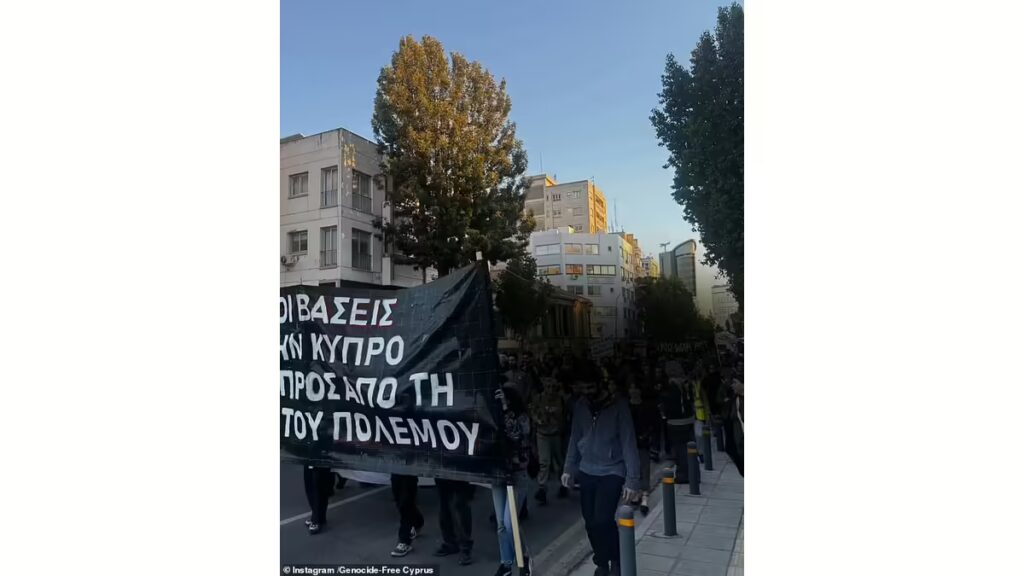
Hundreds of demonstrators filled the streets of Nicosia yesterday, voicing anger over the continued presence of United Kingdom military bases on the island.
The protest was driven by safety fears following a recent drone attack on RAF Akrotiri last Sunday, which caused minimal damage but highlighted the bases’ vulnerability.
Participants marched from a union headquarters to the presidential palace, chanting slogans like “Say it loud, say it clear, British bases out of here” and holding banners that read “Cyprus is Not Your F****** Launchpad.”
Organizers from afoa.cy and the Cyprus Palestine Solidarity Action framed the bases as a threat, warning that their presence drags Cyprus into “imperialist plans” and turns the country into a strategic “launchpad for war.”
Drone Attack Sparks Concern
The protest came just a day after the drone strike on RAF Akrotiri.
Officials confirmed that the attack caused no casualties and only minor damage.
Two additional drones were intercepted less than 12 hours later.
British military sources suggest the strikes were launched from Lebanon by the Iranian-backed militia Hezbollah, underscoring regional tensions.
RAF Akrotiri, part of the UK’s Sovereign Base Areas (SBAs) established under the 1960 treaty granting Cyprus independence, has long been a strategic asset for Western operations.
Recently, Prime Minister Keir Starmer authorized US bombers to use the bases for “defensive” strikes on Iranian missile sites.
However, the presence of American U-2 spy planes and other military activities has made the base a potential target in the escalating Middle East conflict.
Growing International Military Presence
Amid rising tensions, the German frigate FGS Nordrhein-Westfalen arrived at Limassol port yesterday, joining a growing fleet of international naval vessels.
Meanwhile, the UK has reinforced RAF Akrotiri with additional air defence assets, including F-35 fighter jets and Royal Navy Wildcat helicopters.
Despite these measures, the deployment of the Type 45 destroyer HMS Dragon has been delayed due to maintenance and welding issues, which unions have attributed to Ministry of Defence cost-cutting measures and staffing reductions at the Portsmouth naval base.
Local Leaders Question Sovereignty
Cypriot Foreign Minister Constantinos Kombos raised concerns about the long-term control of the bases, calling for dialogue between the UK and Cyprus to clarify their future.



“There are questions. There are issues.
There are concerns,” Kombos told BBC Newsnight, reflecting local unease over sovereignty and the potential risks the bases pose to residents.
Political Fallout in the UK
The UK response has also drawn criticism.
Opposition leader Kemi Badenoch accused Starmer of indecision during the crisis, highlighting the delayed deployment of HMS Dragon to protect RAF Akrotiri.
Speaking at the Conservative Party Spring Conference in Harrogate, North Yorkshire, Badenoch argued that Britain requires strong leadership in times of international conflict and accused the prime minister of “sitting on the fence.”
Impact and Consequences
The events in Cyprus underline multiple tensions:
-
The safety of UK military personnel and Cypriot residents is under scrutiny due to the drone attacks.
-
Anti-UK sentiment is rising locally, putting pressure on the government to reconsider the future of its bases.
-
Delays and cost-cutting in military deployments raise questions about the UK’s readiness to respond to regional conflicts.
-
Politically, Starmer faces criticism both domestically and internationally over perceived indecision in a volatile situation.
What’s Next?
-
The UK and Cyprus may enter negotiations regarding the status and sovereignty of the military bases.
-
Increased international military presence, including additional warships and aircraft, could be expected in Cyprus.
-
Protests and public demonstrations may continue, reflecting local frustration with perceived risks and lack of control over the bases.
-
Political pressure on Starmer’s government may intensify, particularly from opposition parties and media scrutiny.
Summary
Cyprus has become a flashpoint of tension after drone attacks on RAF Akrotiri sparked widespread protests against UK military bases. Hundreds marched in Nicosia, demanding the bases be shut down. While the UK has reinforced the bases with aircraft and naval assets, delays in deployment and local criticism highlight challenges in both security and diplomacy. Political fallout is also underway, with opposition figures accusing the government of indecision.
Bulleted Takeaways
-
Hundreds protested in Nicosia demanding closure of UK military bases following a drone attack.
-
The drone strikes on RAF Akrotiri caused minimal damage but raised security concerns.
-
Anti-UK groups claim the bases drag Cyprus into international conflicts.
-
German and UK naval reinforcements, including F-35s and Wildcat helicopters, have been deployed.
-
Delays in the arrival of HMS Dragon were linked to cost-cutting and maintenance issues.
-
Cypriot leaders question sovereignty over the bases and call for talks with the UK.
-
UK Prime Minister Keir Starmer faces criticism for perceived indecision from political opponents like Kemi Badenoch.

