
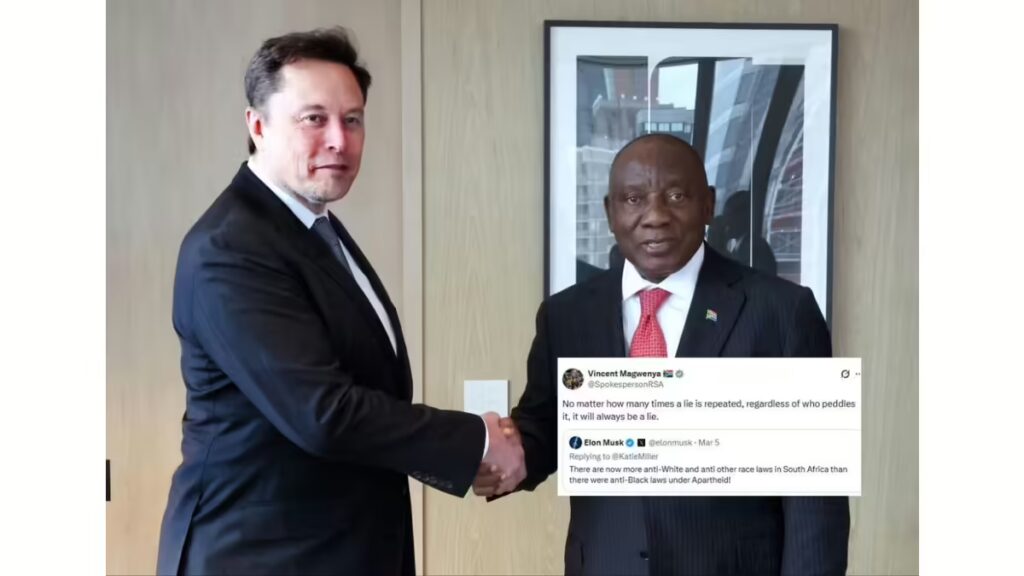
A fresh political debate has erupted after tech billionaire Elon Musk made controversial comments about race-related policies in South Africa.
The remarks quickly drew a sharp response from the office of Cyril Ramaphosa, with the president’s spokesperson dismissing the claims as outright false.
The exchange highlights the ongoing tension between critics of South Africa’s transformation policies and government officials who argue those policies are necessary to address the deep inequalities left behind by apartheid.
How the Dispute Began
The controversy started after President Cyril Ramaphosa spoke in an interview with The New York Times about allegations that white South Africans are being persecuted.
Responding to claims — including those previously echoed by former US president Donald Trump — Ramaphosa firmly rejected the idea that a “white genocide” is taking place in the country.
He argued that such claims are based on misinformation and a misunderstanding of South Africa’s complex history.
According to the president, the narrative ignores the lasting damage caused by apartheid, the system of racial segregation that ruled the country for decades before it ended in 1994.
Ramaphosa insisted there is no state-sanctioned campaign targeting white farmers or confiscating their land.
Elon Musk’s Strong Reaction
Following the interview, Elon Musk reacted on his social media platform X.
Replying to a post criticizing the South African government, Musk wrote that the country now has more laws discriminating against white people and other races than the discriminatory laws that existed against Black South Africans during apartheid.
The comment sparked widespread debate online.
Supporters of Musk argued that some of South Africa’s transformation policies unfairly limit business opportunities for certain groups.
Critics, however, accused the billionaire of misrepresenting the purpose and scope of those policies.
The Role of Black Economic Empowerment
Part of Musk’s frustration may stem from regulations linked to Black Economic Empowerment (BEE), a policy framework designed to correct economic inequality created by apartheid.
BEE encourages companies operating in South Africa to include Black ownership, management representation, and community investment.
These rules have reportedly complicated the entry of Musk’s satellite internet venture, Starlink, into the South African market.
The company must meet certain ownership or partnership requirements to operate locally — something Musk has previously criticized.
Supporters of BEE say such measures are essential to level the economic playing field after decades of systemic exclusion.
Ramaphosa’s Spokesperson Fires Back
The president’s spokesperson, Vincent Magwenya, responded bluntly to Musk’s claims.
Taking to social media, Magwenya said repeating misinformation does not make it true.
He insisted the suggestion that South Africa has racial laws targeting white citizens is incorrect.




Magwenya also pointed out that Musk’s own father, Errol Musk, continues to live comfortably in South Africa — something he believes contradicts claims that the country is hostile to white residents.
Errol Musk’s Perspective
Interestingly, Errol Musk has previously spoken positively about life in the country.
During an appearance on the popular podcast hosted by MacG, he described South Africa as one of the best places to live.
According to him, the country offers excellent food, welcoming people, and a quality lifestyle that he struggles to find elsewhere.
He even contrasted it with life in the United States, which he described as fast-paced and expensive.
A Long-Running Debate About Land and Race
The issue Musk referenced is part of a broader political conversation in South Africa about land ownership and economic justice.
The government has debated land reform for years, including the possibility of expropriation without compensation in certain cases.
The goal is to redistribute land more fairly after apartheid-era policies concentrated ownership among white South Africans.
However, critics worry that aggressive land reform could harm agriculture or discourage investment.
This debate frequently attracts international attention and has been amplified by political figures abroad.
Impact and Consequences
Musk’s remarks add fuel to an already sensitive political discussion.
Several potential consequences could follow:
-
Diplomatic tensions: Comments from influential global figures can affect how international audiences view South Africa.
-
Investment concerns: Negative narratives about the country’s policies could discourage foreign investors.
-
Political polarization: The debate may deepen divisions within South Africa between supporters and critics of transformation policies.
-
Technology rollout delays: Regulatory disagreements could slow the introduction of services like Starlink.
At the same time, the controversy also highlights the global influence Musk wields through his online platform and businesses.
What’s Next?
The debate is unlikely to end soon.
South Africa continues to review its transformation policies and regulatory frameworks, particularly in sectors such as telecommunications and technology.
If companies like Starlink want to operate locally, negotiations or regulatory adjustments may still take place.
Meanwhile, political leaders will likely continue defending the country’s policies internationally, especially when accusations about racial persecution resurface.
Summary
A public dispute has emerged between tech billionaire Elon Musk and the office of South African President Cyril Ramaphosa.
After Ramaphosa rejected claims of “white genocide” in South Africa, Musk responded by alleging that the country now has discriminatory laws against white people.
The president’s spokesperson, Vincent Magwenya, dismissed the comments as false and misleading.
The exchange reflects broader tensions surrounding South Africa’s transformation policies, particularly Black Economic Empowerment and debates over economic equality.
Key Takeaways
-
Elon Musk claimed South Africa has race-based laws that discriminate against white people.
-
President Cyril Ramaphosa rejected claims of “white genocide” and racial persecution.
-
Presidential spokesperson Vincent Magwenya labeled Musk’s remarks as lies.
-
The dispute is partly linked to regulations affecting Musk’s company Starlink.
-
Musk’s father, Errol Musk, has publicly praised living in South Africa.
-
The debate reflects deeper disagreements about post-apartheid policies like Black Economic Empowerment.

