
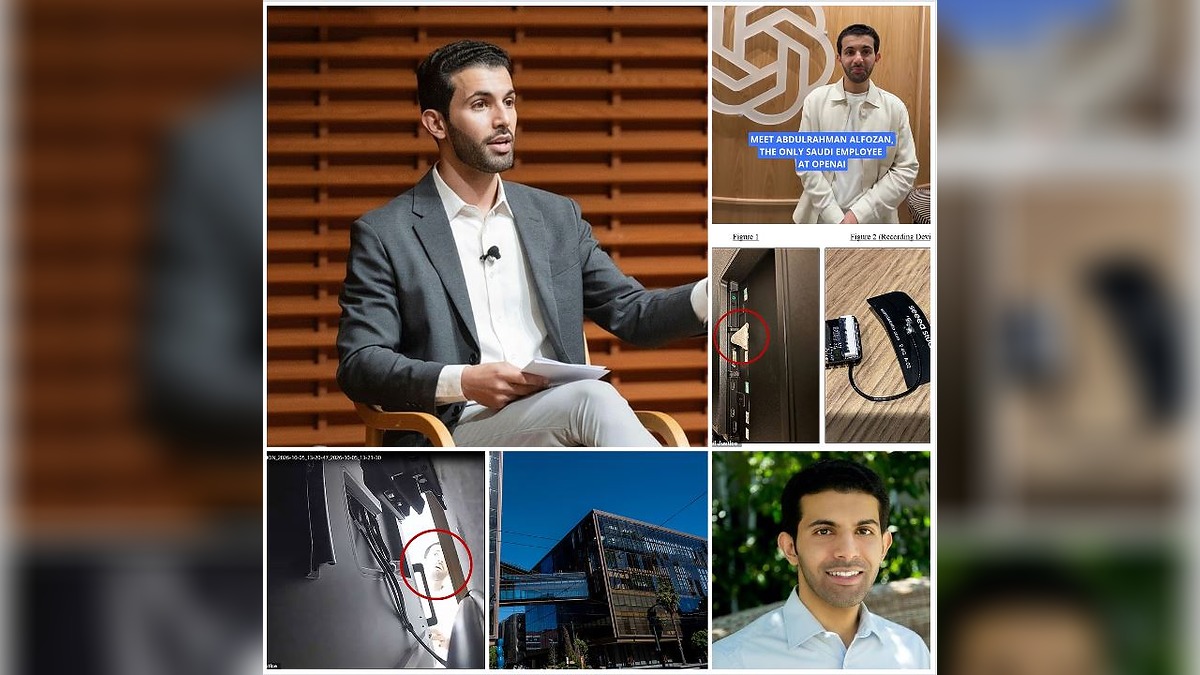
A Saudi national employed as an engineer at OpenAI has been arrested in the United States after prosecutors alleged he planted a concealed recording device in a conference room used by the company’s executives.
Abdulrahman Alfozan, 35, was arrested on Friday and charged with using or attempting to use a device to intercept oral communications, according to the US Department of Justice. Authorities allege that the device was intended to capture conversations involving sensitive company information, although the precise motive behind the alleged operation remains unclear.
The case has attracted national security attention because of OpenAI’s role in the rapidly developing artificial intelligence industry and Washington’s efforts to maintain an advantage over China in advanced AI technology.
US Attorney Craig Missakian said federal authorities were treating the matter as a national security issue.
OpenAI Discovers Recording Device During Security Sweep
The investigation began after OpenAI’s technical surveillance countermeasures team discovered a suspicious device on September 30 during a security inspection at one of the company’s San Francisco offices.
According to the criminal complaint, the device was connected to a USB port at the back of a television in an executive conference room. It had reportedly been concealed in toilet paper and was believed to have been installed around September 28.
The room was regularly used for meetings involving confidential technical, commercial and strategic matters. These discussions could include proprietary research, product development plans and engagements with government representatives.
Prosecutors allege that Alfozan had been captured on surveillance footage near the room on several occasions before the device was discovered, despite lacking authorisation to enter the room or attend meetings there.
The discovery prompted an internal investigation into the device’s origin, its capabilities and whether other recording equipment might have been placed elsewhere in the company’s offices.
Investigators Examine Searches About Recording Devices
The criminal complaint describes a series of online queries that prosecutors say could help explain how the alleged recording operation was planned.
Before the device was found, Alfozan allegedly used a productivity tool to seek information about OpenAI’s buildings, meeting rooms, room capacities and calendars. The queries reportedly also covered the locations of company executives and meetings involving outside partners.
Authorities further allege that a chatbot account associated with Alfozan’s wife shared identifiers with his own account and submitted prompts between September 24 and September 30 concerning the construction, installation, concealment and remote access of a recording device.
The reported queries included questions about building a continuous audio recorder and encrypting an SD card.
According to prosecutors, the account also asked about the specific device that was eventually discovered, including its unique media access control, or MAC, address, on September 27 and 28.
The allegations form part of the evidence investigators are examining. The complaint does not, by itself, establish that every query was made by Alfozan or prove his motive.
Second Recording Device Allegedly Found in Unattended Bag
Investigators say the case developed further on October 5, when Alfozan was allegedly captured on surveillance footage entering the conference room and looking behind the television where the first device had been found.
On the same day, he allegedly left a bag unattended in another room at OpenAI’s headquarters.
According to the complaint, security personnel opened the bag and discovered a wallet and identification belonging to Alfozan, along with a second recording device similar to the first.




OpenAI executives subsequently said they had evidence suggesting that Alfozan intended to place additional devices in sensitive areas to record more meetings.
The company described the device as sophisticated, alleging that it incorporated advanced encryption, audio-monitoring capabilities and a mechanism for transferring data discreetly.
Authorities have not publicly established that the devices successfully captured confidential conversations or that any recordings were passed to another person or organisation.
OpenAI Says There Is No Evidence of Stolen AI Technology
OpenAI said it began restricting Alfozan’s access to company systems and physical spaces after the first device was discovered.
His physical and network access was subsequently suspended, he was placed on leave, and the company secured equipment issued to him.
OpenAI also said it coordinated the timing of his termination with the FBI to avoid interfering with the investigation. He was officially fired on Friday, the day of his arrest.
Despite the seriousness of the allegations, the company said it had found no evidence that Alfozan improperly accessed or extracted model weights, source code or customer data.
The company pledged to continue assisting federal authorities and emphasised that protecting its technology, information and employees was a matter of national importance.
OpenAI also thanked investigators and prosecutors for acting quickly following the discovery.
Engineer Previously Worked at Meta and AI Infrastructure Company
Alfozan joined OpenAI in July 2025 as an engineer on the product team.
Before that, he worked as a founding engineer at Nash, an artificial intelligence infrastructure company focused on logistics, from 2022 until August 2025, according to his LinkedIn profile.
He also worked at Meta as a senior systems engineer between 2017 and 2022. His earlier experience included a role at wireless power startup Reach Labs and internships at Microsoft, SAP in Berlin and Akamai Technologies.
Alfozan earned a master’s degree in data science from the University of California, Berkeley, in 2025 and had previously attended the Massachusetts Institute of Technology.
He had also appeared in a video promoting his experience at OpenAI, in which he was described as the company’s only Saudi employee. Reflecting on his time there, he said one year at the company had felt like five years elsewhere.
His professional background has drawn attention because of the technical expertise associated with his previous positions. However, those qualifications do not independently establish the allegations against him.
FBI and Intelligence Officials Link Case to US AI Security Priorities
The arrest comes as US authorities place growing emphasis on protecting advanced artificial intelligence research and preventing sensitive technology from being compromised.
FBI Director Kash Patel said safeguarding American AI innovation was among the bureau’s highest counterintelligence priorities.
He argued that protecting the sector was essential to the country’s economic strength and national security.
Director of National Intelligence Jay Clayton also highlighted the broader strategic implications, saying the case underscored the importance of the global race to develop what the administration calls “Super Intelligence”.
The officials’ comments reflect Washington’s concern that access to advanced AI systems, research and infrastructure could carry significant economic and national security consequences.
However, the allegations against Alfozan do not establish that the incident was connected to a foreign government or that China, Saudi Arabia or any other state was involved.
Alfozan Faces Court Hearing and Potential Prison Sentence
Alfozan is scheduled to appear in court for a detention hearing on October 19.
If convicted of the charge, he could face up to five years in prison, a fine of $250,000 and three years of supervised release.
The case remains an allegation at this stage, and the prosecution will need to establish the relevant elements of the offence in court.
Investigators are continuing to examine the devices, the reported online queries and the circumstances surrounding their discovery. The central questions include why the equipment was allegedly placed in the conference room, whether any conversations were recorded and whether other sensitive areas were targeted.
For OpenAI, the incident has raised concerns about the security of executive meetings and the protection of confidential research at a time when advanced AI has become a major focus of international competition.
For federal authorities, it is also a reminder of the counterintelligence challenges facing companies whose technology is increasingly viewed as strategically important to the United States.

