
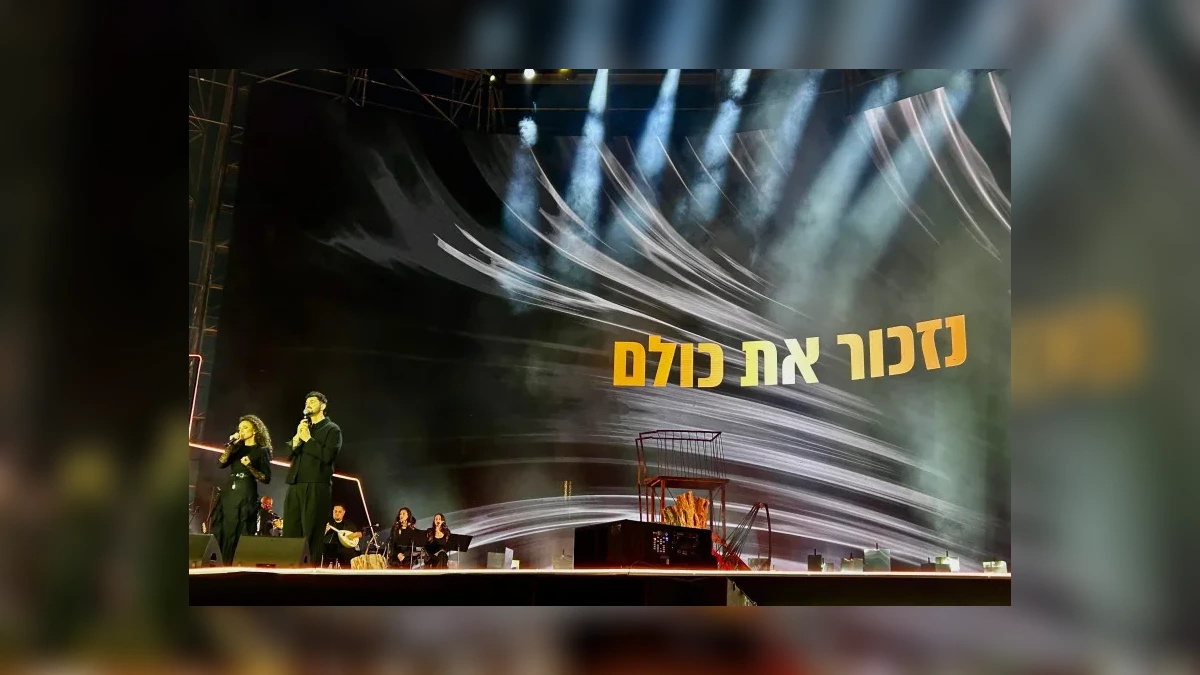
Families of people killed during the October 7 massacre have gathered at Yarkon Park in Tel Aviv for a major memorial ceremony dedicated to those who lost their lives and the communities affected by the attacks.
The ceremony, organised by families of the victims, focused on remembrance, personal stories and the experiences of survivors, relatives and communities that have continued to live with the consequences of the events.
Music Opens the Memorial
Singer Arkadi Duchin opened the ceremony with a performance of “Who Loves You More Than Me,” accompanied by a piano connected to the memory of the Kipnis family.
The instrument was placed in the Kipnis family home in Kibbutz Be’eri, where Eviatar “Teri” Kipnis and Lilach Kipnis were killed. Their caregiver, Paul Vincent Castelvi, was also murdered.
Images of those who were killed and fallen were displayed behind Duchin during the performance.
A Mother Remembers Her Fallen Son
Standing alongside Duchin was Or-Li Niv, whose son, Staff-Sgt. Omri Niv Feierstein, served in the Home Front Command’s Search and Rescue Brigade.
Omri Niv Feierstein was killed in fighting at the Zikim military base.
Niv read the poem “Mothers” by Osnat Eldar as part of the ceremony, adding a personal dimension to the remembrance of the soldiers and civilians killed during the conflict.
Shani Cohen Reflects on What Was Lost
Actress and comedian Shani Cohen also addressed those attending the ceremony, reflecting on the changes experienced by Israeli society since October 7.
She spoke about the loss of innocence and the suffering experienced by people who sought refuge in safe rooms and roadside shelters during the attacks.
Cohen recalled messages sent by people desperately seeking help and described them as part of the record of the final moments experienced by many victims.
She said the ceremony provided an opportunity not only to remember those who were lost, but also to consider what remained with the country after the tragedy.
Eli Sharabi Recalls Acts of Courage
Eli Sharabi spoke about the experiences of children and families who attempted to survive while hiding from attackers.
He recalled children remaining concealed for hours, parents placing themselves between danger and their children, and people sending brief messages to loved ones as they faced life-threatening situations.



Sharabi also remembered neighbors who supported one another, members of local security teams and civilians who intervened to help others.
He paid tribute to those killed during the October 7 war and to people who confronted extreme circumstances while continuing to act with humanity.
A Ceremony Built Around Collective Memory
Sharabi described the event as a ceremony created by and for the people, emphasizing the importance of preserving the memory of what happened.
He called on Israelis to continue telling the stories of those who died and those who helped others during the attacks.
His remarks concluded with a commitment to remember the victims and ensure that their stories are not forgotten.
Memorial Prayer Honors Civilians and Security Forces
A special Yizkor memorial prayer was later recited by Ido Yakir, a member of the local security team in Kibbutz Magen.
Members of the team fought during the October 7 attacks and helped prevent terrorists from entering the kibbutz.
Two members of the team, Ofir Yaron and Avi Fleischer, were killed during the fighting.
Prayer Remembers Those Killed Across the Region
Yakir’s prayer paid tribute to people murdered in their homes, fields and on roads across the western Negev.
It also remembered parents who attempted to protect their children, people attending the music festival who fled from attackers, and those who were abducted.
The prayer included those who died in captivity and those whose bodies were taken away during the attacks.
Tribute to Those Who Rushed to Help
The memorial also honored local security personnel, soldiers stationed at bases near the border, security and rescue workers, and civilians who went toward danger to assist others.
Yakir remembered people from communities along the frontier who became part of the defensive effort, including residents, visitors and strangers who responded to the attacks.
The prayer described the fallen as people whose actions became part of the country’s collective memory.
Survivors and Bereaved Communities Also Remembered
The ceremony did not focus solely on those who were killed.
The memorial prayer also acknowledged survivors, children, people wounded physically and psychologically, orphans, widows and widowers, as well as communities displaced from their homes.
It paid tribute to people working to rebuild damaged communities and to those who remain unable to return because of the trauma associated with the attacks and the loss of loved ones.
A Memorial Amid an Ongoing War
The ceremony concluded with a prayer that the memory of those who died would remain present until Israel could live securely and peacefully.
The gathering brought together remembrance of civilians, soldiers, security personnel and emergency responders, while also recognizing the continuing experiences of survivors and bereaved families.
The ceremony remains part of an ongoing effort by families and communities to preserve the memory of those killed on October 7 and during the war that followed.
This is a developing story.

