
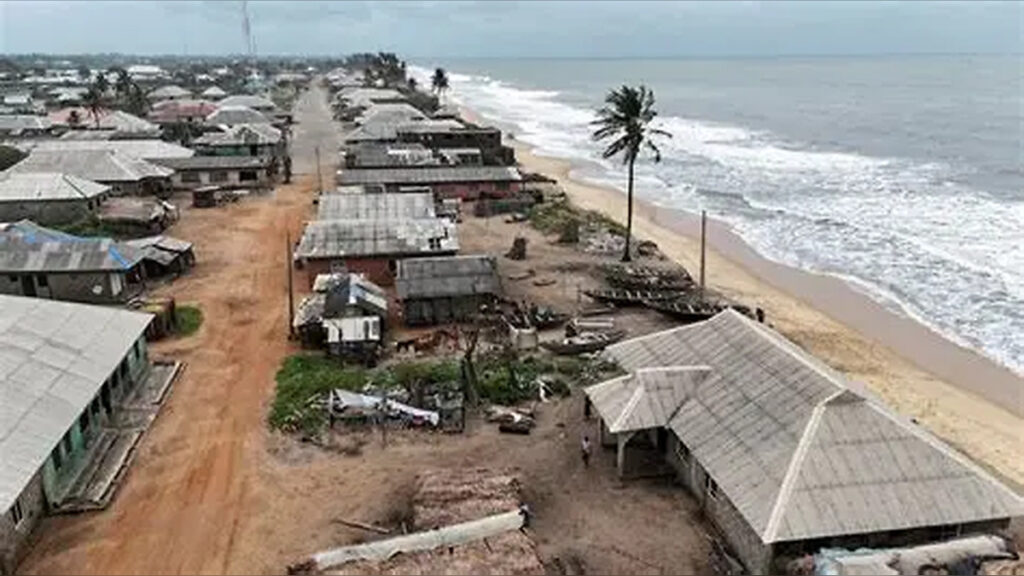
Along the southern Nigerian coastline, a narrow stretch of beach is now scattered with fragments of houses that once stood where the Atlantic Ocean now reaches.
Some structures disappeared years ago, while others were lost only months before.
For residents travelling by boat along the shrinking shoreline, the destruction has become impossible to ignore.
“We are walking on people’s houses,” said 35-year-old fisherman Thompson Akingboye as he moved along the remaining strip of sand.
The ‘Happy Place’ Faces an Uncertain Future
Ayetoro, known locally as “The Happy Place,” is home to roughly 10,000 people.
The settlement was established in 1947 by communist-inspired Christians who envisioned a community built around shared property and communal living.
For decades, Ayetoro developed as a distinctive coastal settlement, but its future is now increasingly threatened by the sea.
As the shoreline retreats, families repeatedly abandon damaged homes, move farther inland and rebuild.
et many find themselves facing the same problem again when the ocean advances.
Shoreline Has Retreated by Metres Each Year
Coastal erosion in Ayetoro has accelerated since the early 2000s and is affecting 19 other communities in the Ilaje district.
A study by spatial planning specialist Barnabas Ogirima James found that Ayetoro’s coastline receded by an average of 15 metres every year between 1987 and 2022.
The changes are occurring against a wider backdrop of rising sea levels along the Gulf of Guinea.
Research published in Scientific Reports in 2024 estimated that sea levels along the west African Gulf of Guinea are rising at about 3.9 millimetres annually, roughly 10.5 percent above the global average.
Climate change is adding pressure to an already vulnerable coastline.
The King Has Watched His Palace Disappear
Few residents have witnessed the transformation more closely than Ayetoro’s traditional ruler, Oluwambe Ojagbohunmi.
Standing outside his palace, the king recalled a photograph taken 14 years ago showing a telecommunications tower surrounded by houses.
The tower remains today, but its surroundings have changed dramatically.
Water now encircles it, while the remains of buildings swallowed by the sea lie nearby.
“My palace once had 100 rooms. Only about a dozen remain,” the king said.
His bedroom has been moved to the section of the palace closest to the ocean.
At night, waves crashing against the walls make sleep difficult.
“This is our land. Where can we go? It’s complicated,” he said.
Storms Are Turning Homes Into Temporary Shelters
The danger becomes particularly severe when storms push the ocean farther inland.
In April, rising sea levels during a storm trapped people inside the palace for an entire week.
For residents who have already lost their homes, such events reinforce the feeling that there is nowhere safe to relocate.
Akingboye said he lost his father’s house to the ocean in 2019.
Almost everything was destroyed, and he managed to save only his university degree certificate.




“I’ve become a refugee in my own community,” he said.
Families Are Forced to Move Again and Again
Repeated displacement has become part of everyday life for many Ayetoro residents.
According to Akingboye, some families have moved more than three times after losing their homes to the advancing water.
Many houses are constructed from wood and corrugated iron sheets, while raised wooden walkways connect parts of the community.
Plastic waste washed inland by the waves now litters streets that are increasingly exposed to the sea.
For residents, moving farther inland is not necessarily a permanent solution.
The ocean continues to advance behind them.
Human Development Is Making the Problem Worse
The environmental crisis is not caused by rising seas alone, according to researchers.
Oluwasegun Babatunde Esan, a landscape architecture researcher at the University of Lagos who collaborates with Harvard University, said development along vulnerable areas is contributing to the problem.
Nigeria’s rapidly expanding population has increased demand for land, leading to the clearing and development of floodplains, swamps and coastal areas that would naturally absorb floodwater and storm surges.
“There is growing demand for land, whether for housing or industrial activities,” Esan said.
He argued that development in such locations needs stronger regulation while recommending natural coastal protection measures, including the restoration and planting of mangroves and coconut palms.
Essential Services Are Also Being Swallowed
The erosion is threatening more than homes.
Ayetoro’s only health centre has already been lost to the waves, leaving healthcare workers to operate in extremely difficult conditions.
Omomiye Oluwaseun, a 26-year-old healthcare worker, said floodwater can sometimes rise to window level while medical staff continue treating patients.
“We help women give birth under these conditions. We have no choice,” she said.
The constant intrusion of seawater is also affecting the community’s water supply and raising concerns about health.
Contaminated Water Fuels Health Concerns
Residents increasingly rely on water affected by seawater intrusion, creating additional risks.
Oluwaseun said people in the community suffer from conditions including high blood pressure and water-borne illnesses such as typhoid and diarrhoea.
She said the sea has contaminated available water sources, but residents continue using the water for cooking because they have few alternatives.
The erosion is therefore becoming both an environmental emergency and a public health challenge.
Children Face Repeated Disruption at School
The effects are also being felt by Ayetoro’s children.
Teacher Sunday Akinjoye said schools have been relocated several times as the coastline advances, mirroring the repeated displacement of families.
Constantly moving homes and schools can create instability for children and interfere with their education.
“Schools have been relocated several times, just like their homes.
It takes a psychological toll on them. Their ability to concentrate on their studies drops drastically,” Akinjoye said.
Government Aid Has Not Solved the Crisis
Government agencies and non-governmental organisations occasionally provide relief materials to Ayetoro, but residents say the assistance has not matched the scale of the problem.
With homes, healthcare facilities and schools all vulnerable to the advancing ocean, residents face a crisis that requires more than temporary relief.
The challenge is particularly difficult because Ayetoro’s population depends on the area for its livelihoods and has deep historical and cultural ties to the settlement.
A Battle Against an Advancing Ocean
Ayetoro’s experience reflects a wider challenge facing communities along Nigeria’s 850-kilometre coastline.
As development expands into vulnerable coastal areas and global sea levels continue to rise, settlements such as Ayetoro face growing exposure to erosion, flooding and saltwater intrusion.
For residents, the consequences are no longer distant warnings about climate change.
They are visible in missing houses, damaged roads, displaced schools and a palace that has lost most of its rooms.
What’s Next?
Researchers and residents say stronger coastal planning, tighter controls on development and investment in natural protective barriers could help reduce the damage.
Mangrove restoration and other nature-based solutions could provide some protection, while improved water supplies, healthcare facilities and relocation planning could help communities cope with unavoidable changes.
But without sustained intervention, Ayetoro’s remaining land will continue to shrink.
Summary
Ayetoro, a historic coastal community in Ondo State known as “The Happy Place,” is rapidly losing ground to the Atlantic Ocean.
Its coastline retreated by an average of 15 metres annually between 1987 and 2022, while rising sea levels and development along vulnerable areas have intensified the community’s exposure to erosion.
Residents have repeatedly rebuilt farther inland after losing their homes, while the destruction has already affected the king’s palace, healthcare services and schools.
For a community founded nearly eight decades ago, the central question is becoming increasingly urgent: how long can Ayetoro survive if the ocean continues to take more of its land each year?

