
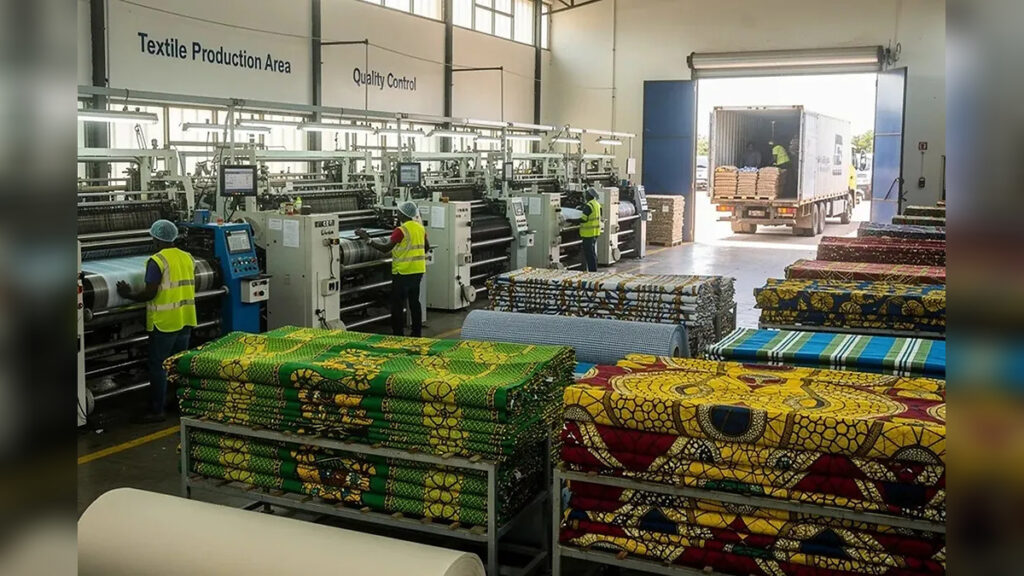
Nigeria’s upper legislative chamber has approved a sweeping resolution urging a total ban on textile imports, in what lawmakers describe as an urgent intervention to revive the country’s once-thriving textile sector and tackle rising unemployment.
The decision followed a heated debate in the Senate on Tuesday, where lawmakers argued that protecting local manufacturers is now essential to restoring industrial productivity and creating jobs for millions of Nigerians.
Lawmakers Push Protectionist Policy After Motion Gains Support
The motion was introduced by Sunday Katung and co-sponsored by several prominent lawmakers, including Natasha Akpoti-Uduaghan, Adams Oshiomhole, Mohammed Monguno, Ibrahim Khalid, and Mustapha Khabeeb.
During deliberations, senators overwhelmingly supported the idea of restricting textile imports, framing it as a necessary step to rebuild domestic production capacity and revive cotton farming across the country.
Following a voice vote, the chamber also urged federal ministries and agencies to collaborate on implementing policies that would strengthen local manufacturing and reduce dependence on foreign fabrics.
Kaduna’s Textile Legacy Recalled as Industry Decline Comes Under Scrutiny
Presenting the motion, Katung highlighted the historical strength of Nigeria’s textile industry, noting that its roots date back to the establishment of the first major textile mill in Kaduna in 1957.
He explained that government policies in the 1960s and 1970s helped the sector expand rapidly, transforming it into one of the country’s largest industrial employers during its peak decades.
By the late 1970s and 1980s, Nigeria reportedly had about 167 textile mills in operation, employing nearly half a million workers.




Kaduna, once a hub of industrial activity, earned the nickname “Textile City” due to its concentration of factories.
Senators Blame Smuggling, Imports, and Policy Gaps for Collapse
As the debate unfolded, several lawmakers pointed to unchecked imports, smuggling, and weak government protection as key factors behind the sector’s collapse.
They argued that the influx of cheap textiles from abroad severely undermined local production, forcing many mills to shut down and leaving thousands unemployed.
Some senators also stressed that inconsistent industrial policies over the years contributed to the steady erosion of Nigeria’s manufacturing base.
Calls for Enforcement, Funding, and Industrial Recovery Strategy
Lawmakers including Jibrin Isah urged the Senate not to allow the resolution to become symbolic, insisting that it must be followed by concrete engagement with relevant ministries.
He called for direct coordination with the Ministry of Industry to design a structured implementation plan capable of sustaining long-term industrial recovery.
Ogoshi Onawo also linked the collapse of the textile sector to broader social challenges, arguing that joblessness among young people has contributed to rising insecurity across the country.
Total Ban Proposal and Economic Revival Measures
Another strong voice in the debate, Adamu Aliero, argued that only a complete ban on textile imports would give local producers the breathing space needed to recover.
He recalled Nigeria’s past dominance in cotton production, noting that weak protection and widespread smuggling had devastated both cotton farmers and textile mills.
The Senate resolution also recommended increased funding for the Bank of Industry, alongside renewed agricultural policies aimed at boosting cotton production and strengthening the supply chain for domestic manufacturers.
Government Urged to Act as Industry Faces Long Road to Recovery
Following adoption of the motion, Deputy Senate President Barau Jibrin described the initiative as critical to Nigeria’s broader economic survival, emphasizing its potential impact on employment and national productivity.
Nigeria’s textile industry, once a major economic pillar employing hundreds of thousands of workers, has suffered decades of decline driven by infrastructure gaps, smuggling, high production costs, and overwhelming foreign competition.
Despite the Senate’s push for drastic protectionist measures, the challenge ahead lies in whether policy enforcement and industrial reforms can reverse years of decline and restore the sector to its former prominence.

