
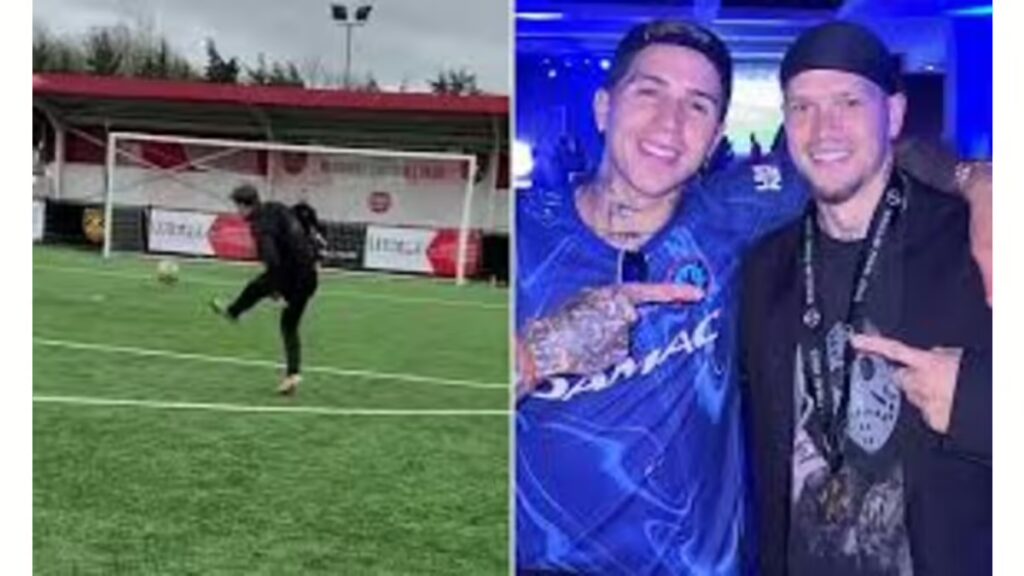
On a chilly morning in west London, there were no roaring crowds or flashing cameras — just the thud of a ball against a post at Honeycroft.
That was where Mykhailo Mudryk resurfaced this week, training with semi-professional side Uxbridge FC.
For a player once unveiled with fanfare at Chelsea FC in an £88million deal, it was a strikingly low-key setting.
Mudryk even shared the moment himself, posting a short Instagram clip to his 1.8 million followers.
In it, he feints past a yellow mannequin, opens his body and curls a left-footed effort that kisses the post before going in.
A training-ground finish — but one loaded with symbolism.
No explanation accompanied the video. Just football.
From Stamford Bridge Spotlight to Uncertain Limbo
Mudryk’s journey since arriving from Shakhtar Donetsk in January 2023 has been anything but smooth.
Signed amid enormous expectation, he was seen as one of Europe’s most electric young wingers — blistering pace, fearless dribbling, and the sort of raw unpredictability that excites supporters.
Yet his last competitive appearance for Chelsea came in a Europa Conference League tie in November 2024.
A month later, he returned a positive test for a banned substance — widely reported to be meldonium — and everything stalled.
By June, the The Football Association had formally charged him.
Since then, silence has largely defined the case.
Mudryk denies wrongdoing. Publicly, he has insisted he never knowingly took any banned substances.
Privately, the process continues behind closed doors.
Training Close to Home, Far From Clarity
Uxbridge’s Honeycroft ground sits roughly 40 minutes from Mudryk’s home in Fulham’s upscale Imperial Wharf development.
It’s practical. Discreet. Away from the daily noise of elite football.
Why Uxbridge? There’s no official word.
But semi-professional facilities offer something invaluable during suspension — routine.
Fitness. A reminder of normality.
For a 25-year-old facing the possibility of a four-year ban, staying sharp matters. Even if the future remains hazy.
The Legal Process That Drags On
Doping cases rarely move quickly. After a provisional suspension, investigations unfold through layers of testing, documentation, and hearings.
In November, Witold Banka, president of the World Anti-Doping Agency, confirmed they are waiting on a disciplinary decision from the English FA.
Only then can WADA decide whether to appeal — either if the punishment is deemed too harsh or too lenient.




That detail is important. Even once a ruling arrives, the saga might not end there.
Under anti-doping regulations, meldonium has been prohibited in competition since 2016.
Several high-profile athletes across different sports have faced sanctions for its presence in samples.
Outcomes vary widely depending on intent, contamination claims, and mitigating factors.
For now, Mudryk waits.
Messages to Fans and Flickers of Hope
While he has mostly kept a low profile, Mudryk has occasionally broken his silence on social media.
Around New Year, he thanked supporters and urged them not to “give up” on him.
His tone was steady, even hopeful. He described the initial notification of a positive sample as a “complete shock.”
He maintained he had done nothing wrong and said he looked forward to returning.
Notably, he was present during Chelsea’s Conference League title celebrations last summer — a reminder that, contractually at least, he remains part of the club’s future until proven otherwise.
Impact and Consequences
The potential consequences are severe.
-
A confirmed doping violation could mean a ban of up to four years.
-
Chelsea would face financial implications, given the scale of their £88m investment.
-
Mudryk’s career trajectory — once pointed sharply upward — would require rebuilding from near zero.
Reputational damage lingers long after suspensions end.
Sponsors grow cautious. Transfer interest cools. Even fan sentiment shifts.
For Chelsea, who have spent aggressively in recent seasons, the situation also raises questions about medical oversight, player education, and risk management in elite sport.
And for Mudryk personally, these are prime career years.
Time lost now cannot easily be recovered.
What’s Next?
The next milestone is the FA’s disciplinary decision.
There is no confirmed timeline.
If cleared, Mudryk could return to full training and competition almost immediately.
If sanctioned, the length and reasoning of any ban will determine whether appeals follow — potentially prolonging uncertainty.
In the meantime, training sessions at Honeycroft suggest he is preparing for the possibility of a comeback.
Football careers are fragile. Redemption stories exist — but they require patience, resilience, and, above all, clarity.
Summary
Mykhailo Mudryk’s appearance at Uxbridge FC training offers a rare glimpse of activity amid an ongoing doping case that has left his Chelsea future hanging in the balance.
Charged by the FA after a positive test for a banned substance in December 2024, the winger continues to deny wrongdoing while awaiting a disciplinary verdict.
With the possibility of a lengthy ban looming, both player and club face a period of uncertainty that could shape the next phase of their respective journeys.
Bulleted Takeaways
-
Mykhailo Mudryk has been training with Uxbridge FC at Honeycroft.
-
He has not played for Chelsea since November 2024.
-
The FA charged him after a positive test for a banned substance reportedly identified as meldonium.
-
Mudryk denies knowingly taking any prohibited substance.
-
A potential ban could last up to four years.
-
WADA may review and potentially appeal the FA’s final decision.
-
The timeline for a ruling remains unclear.
-
Mudryk continues to train privately while awaiting the outcome.

