
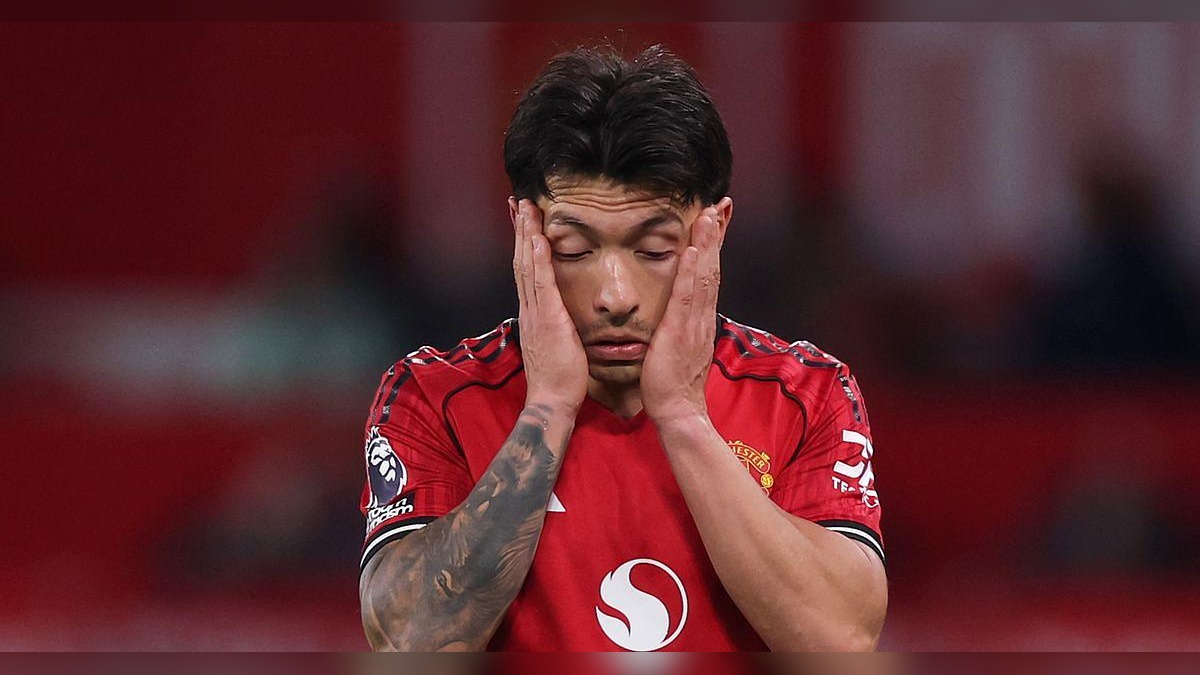
Lisandro Martinez has come under fierce criticism for his conduct and performances at Manchester United, with his latest outburst against the club’s hierarchy highlighting concerns about accountability within the dressing room.
The Argentine defender was unable to prevent Dominic Solanke from scoring Tottenham’s equaliser in the 92nd minute of their Premier League encounter at Old Trafford on Saturday.
The goal denied United a valuable victory, leaving them with one point from a match they had been in a position to win.
The incident proved particularly damaging because of the circumstances surrounding it.
As the ball crossed United’s penalty area, Martinez failed to challenge effectively for the aerial ball.
Rather than jumping to contest it properly, he held on to Solanke’s shirt and appeared to struggle to establish his position.
Solanke subsequently headed the ball into the net, costing United two valuable points.
The defender’s performance has since become a focal point of criticism, particularly after he turned his attention towards the club’s leadership following United’s 2-0 defeat by Atletico Madrid.
Defensive Mistake Contrasts With Martinez’s Criticism of United’s Hierarchy
Martinez reportedly directed an angry outburst towards director of football Jason Wilcox after the defeat in Madrid, expressing frustration over what he perceived as insufficient activity in the summer transfer market.
Although concerns about United’s recruitment have been raised repeatedly, Martinez’s intervention has attracted criticism because of his own performances and the mistakes he has made during the season.
The defender was also responsible for an own goal in United’s draw against Fulham at Craven Cottage last month, adding to questions about his contribution to the team.
Critics argue that Martinez cannot reasonably direct blame towards those responsible for recruitment without first acknowledging his own shortcomings on the pitch.
While the club’s transfer strategy deserves scrutiny, the responsibility for individual performances remains with the players.
United’s problems cannot be attributed exclusively to decisions made in the boardroom when basic defensive errors continue to undermine their results.
Manchester United’s Accountability Problem Extends Beyond One Player
The criticism surrounding Martinez reflects wider concerns about the culture at Old Trafford, where accountability has become a recurring subject of debate.
Successful football clubs require responsibility at every level, from the boardroom and managerial staff to the players representing the team.
When individuals readily accept praise for positive results but resist criticism when performances deteriorate, the environment can become increasingly difficult to manage.
Manchester United have endured repeated disappointments despite changes in leadership, with Erik ten Hag, Ruben Amorim and current manager Michael Carrick all facing challenges in getting the squad to deliver consistently.
The persistence of similar problems under different managers has raised questions about whether the difficulties extend beyond the person in charge of the team.
Martinez, who has spent four years at United and represented Argentina at international level, has been a prominent figure during this period.




However, his overall contribution has been questioned, with critics arguing that his experience should bring greater responsibility and leadership.
Carrick’s Players Face Questions Over Work Rate
United’s performance against Tottenham also intensified concerns about the squad’s work rate.
Carrick recently responded to suggestions that his players were not running enough, arguing that statistical measurements could sometimes give a misleading impression of a team’s performance.
While the manager’s point about statistics has merit, critics who watched the Tottenham match believe the team’s lack of intensity was evident without needing to examine performance data.
United struggled to convince supporters that they were consistently working hard enough, with the players booed at half-time and again at the final whistle.
Such reactions reflected frustration with the performance rather than simply the result.
The late equaliser compounded those concerns, particularly because it followed a defensive lapse that could have been avoided.
For critics, the problem is not merely that United dropped points but that the players appeared unable to maintain the required standards throughout the match.
Martinez’s History of Responding to Criticism Comes Under Scrutiny
Martinez has previously attracted attention for his response to criticism from former United midfielder Paul Scholes.
Last season, the Argentine was reportedly so unhappy with Scholes’ assessment of his performances that a meeting between the pair was discussed.
However, the proposed confrontation never materialised, as Scholes did not receive a phone call from the defender.
The episode has contributed to perceptions that Martinez struggles to accept criticism, particularly when it comes from prominent figures associated with the club.
His latest reported confrontation with Wilcox has renewed that debate, with critics questioning whether the defender is directing too much attention towards others while failing to examine his own performances.
The concern is that public disagreements between players and senior officials can distract from the football itself, forcing the manager to answer additional questions about internal tensions rather than concentrating on performances and results.
Jason Wilcox’s Recruitment Record Faces Its Own Scrutiny
Despite the criticism of Martinez, United’s recruitment strategy remains a legitimate subject of debate.
Wilcox has already faced questions over decisions made since taking up his role, and the club’s difficulties in assembling a balanced squad have not gone unnoticed.
Last season, Wilcox appeared in an internal Manchester United video explaining the principles of successful transfer recruitment.
That presentation has since become an awkward reference point for critics who believe the club has not consistently demonstrated the qualities he outlined.
Nevertheless, Wilcox’s record cannot be judged solely through the mistakes of individual players. Nor can recruitment concerns excuse the failure of those players to perform their duties on the pitch.
The 55-year-old previously played for Blackburn Rovers and Leeds United, winning the Premier League during his playing career.
His experience included competing in an era when pitches were often less reliable and attacking players received less protection from defenders.
That background gives him a practical understanding of the physical demands of football, including the importance of work rate and the standards required within a competitive dressing room.
Manchester United Have Enough Quality to Perform Better
United’s squad has clear limitations, particularly in terms of depth and authority in important positions. However, those weaknesses do not fully explain the team’s inconsistent performances.
The squad possesses enough quality to challenge for a place in the Premier League’s top six and to defeat opponents such as Tottenham.
Yet individual mistakes, inconsistent effort and questions about responsibility have repeatedly undermined those ambitions.
The recurring difficulties across several managerial regimes have strengthened the argument that United’s problems cannot be solved simply by appointing another manager.
Martinez’s comments have placed him at the centre of that debate.
Although his concerns about recruitment may have merit, his own defensive errors and the questions surrounding his response to criticism have weakened his position.
For a club seeking to restore its competitive standing, the issue remains whether players and executives alike are prepared to accept responsibility for their decisions and performances.
