
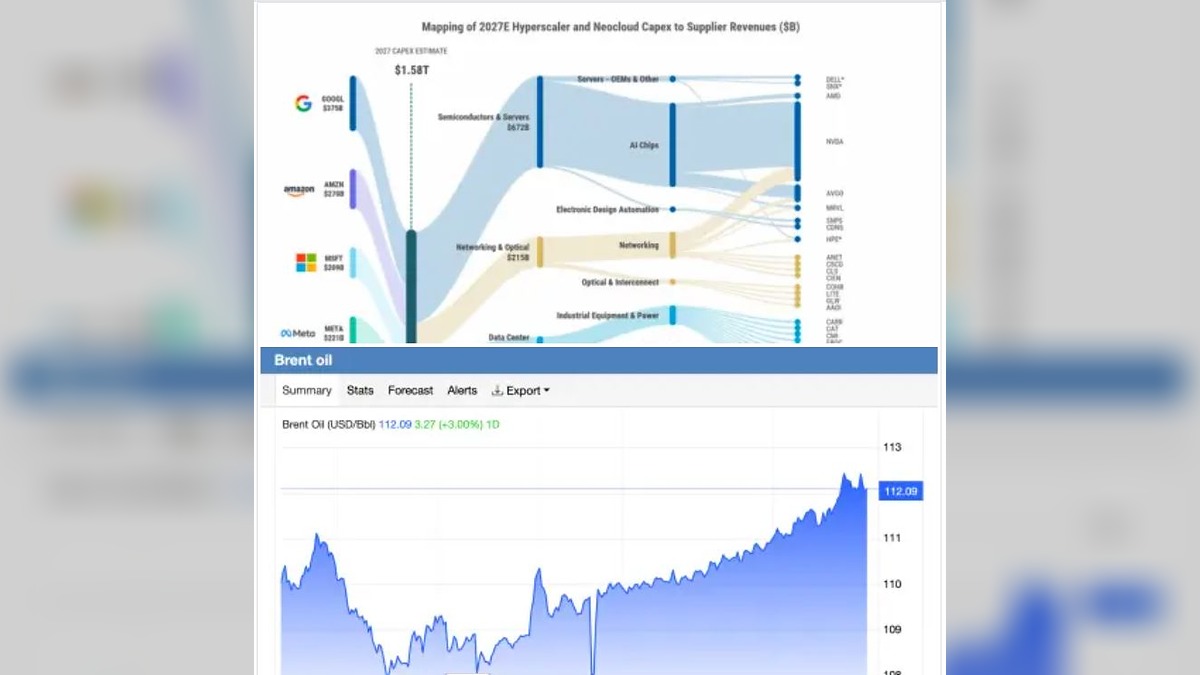
Global stock markets came under heavy selling pressure as escalating tensions involving Iran, Saudi Arabia and the United States unsettled investors, sending major indices lower and pushing oil prices to $112 per barrel.
Before the New York market opened, S&P 500 futures had fallen 1.02%, while futures tracking the technology-heavy Nasdaq dropped 1.82%. The declines followed a 0.58% gain for the S&P 500 in the previous session.
Markets across Asia and Europe also recorded losses as investors assessed the potential economic consequences of further military escalation in the Middle East.
The Iran-backed Houthis carried out additional drone strikes targeting Saudi airports and the Shaybah oil field operated by Saudi Aramco. The United States also ordered its embassy staff in Riyadh to leave.
Meanwhile, Iran continued targeting vessels attempting to navigate the Strait of Hormuz, with four drone attacks reported over the preceding 24 hours.
Reports that Washington and Israel were planning to resume major combat operations against Iran after the US midterm elections added to market concerns.
Brent crude climbed to $112 per barrel as investors responded to the heightened risks surrounding oil supplies.
Asian Markets Bear the Brunt of the Sell-Off
Asian stock markets recorded some of the steepest declines, with investors facing the prospect of more expensive energy imports and potential supply disruptions.
South Korea’s KOSPI fell 3.52%, while Japan’s Nikkei 225 declined 2.65%. India’s Nifty 50 dropped 0.82%, and China’s CSI 300 lost 1.84%.
The CSI 300 is now down 15% since the beginning of the year, placing it in correction territory.
China is also facing the loss of an important source of Iranian oil. According to The Wall Street Journal, supplies carried by Iran’s so-called shadow fleet of tankers before the Strait of Hormuz blockade have been exhausted.
The development adds pressure to an energy-importing region already exposed to rising crude prices and uncertainty over shipping routes.
European Shares Fall as French Bond Yields Reach 24-Year High
European equities also declined during early trading.




The Stoxx 600 fell 0.92%, while the UK’s FTSE 100 was down 0.46% before lunchtime.
France’s government bond market faced additional pressure as the yield on its 10-year bonds reached 5.1%, a level not seen since 2002.
The rise in yields indicated that investors remained concerned about France’s public finances and whether the country had moved beyond its fiscal difficulties.
Bitcoin also declined, falling to $81,922 amid the broader market downturn.
Tesla Shares Drop After Company Cuts Capital Spending Forecast
Tesla shares fell 5.35% in after-hours trading following the company’s third-quarter earnings call.
The electric vehicle manufacturer reduced its capital expenditure forecast for 2026 from $25 billion to $20 billion.
The change raised questions about the pace of Tesla’s planned transition into artificial intelligence and robotics, according to Deutsche Bank analyst Jim Reid.
Reid said the company’s current revenue and earnings were close to expectations, but the lower spending guidance prompted concerns about its future investment plans.
SpaceX Forecast Exceeds Wall Street Expectations
While Tesla shares declined, SpaceX stock rose 8% in the previous session after the rocket and artificial intelligence company reported earnings above expectations.
The company’s revenue guidance also substantially exceeded analysts’ forecasts.
According to a note from Stifel analyst Jonathan Siegmann cited by Fortune, SpaceX projected revenue of between $33 billion and $37 billion for the first quarter of 2027. That range was 57% above analysts’ estimates.
Elon Musk also referred to the possibility of SpaceX generating between $500 billion and $1 trillion in annual revenue by the end of 2027, compared with Wall Street’s estimate of $186 billion.
“The scale of potential estimate revisions is completely unprecedented,” Siegmann wrote.
He added that analysts’ estimates lagged Musk’s stated targets by an amount equivalent to Amazon’s revenue over the previous 12 months, which he put at $776 billion.
Artificial Intelligence Spending Could Reach $1.6 Trillion in 2027
A separate analysis by Morgan Stanley estimated that capital expenditure on artificial intelligence could reach $1.6 trillion in 2027.
The analysis, prepared by Nicholas Lentini and his team, examined how spending by large cloud computing companies and newer cloud infrastructure providers was flowing through the stock market.
Chipmaker Nvidia was identified as the largest beneficiary of the expansion in AI investment.
The Morgan Stanley team estimated that AI-related capital expenditure would drive approximately 25% of S&P 500 sales growth next year.
They also said companies enabling or adopting artificial intelligence broadly accounted for 78% of projected earnings growth.
The estimates highlight the scale of investment expected to support AI infrastructure and related businesses as markets contend with geopolitical uncertainty and changing corporate spending plans.
