
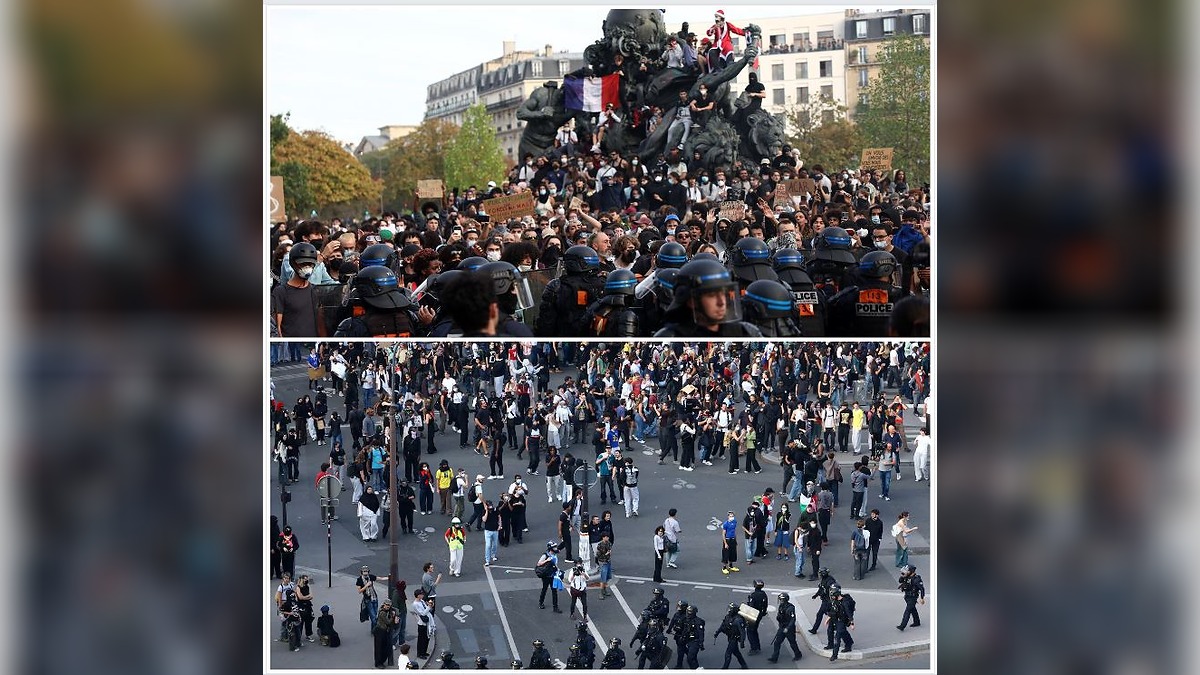
France has been hit by its most serious wave of school protests in decades, with police deploying tear gas as students, teachers and parents took to the streets across the country.
The demonstrations, which began in September in disadvantaged suburbs around Paris, have now spread nationwide, with protesters demanding action over overcrowded classrooms, teacher shortages and deteriorating school buildings.
Prime Minister Sebastien Lecornu described the unrest as the most violent school protest movement seen in decades.
Hundreds Injured as Clashes Intensify
Lecornu’s office said at least 215 teenagers and 85 school staff members had been injured during clashes, describing the casualties as the heaviest toll suffered by the country’s school system in decades.
More than 700 police officers have also reportedly been injured since the unrest began.
The latest demonstrations saw confrontations between protesters and riot police in several cities, with incidents reported in Paris, Strasbourg, Lyon, Rennes, Toulouse, Marseille and Nantes.
Tear Gas and Street Fires in Major Cities
In some locations, protests remained peaceful, while others descended into clashes.
Police used tear gas in several cities as demonstrators reportedly set fires in streets and threw objects at officers.
In Paris, police said around 300 people attempted to confront security forces. Officers reported that most of the wider demonstration remained peaceful, although clashes continued with a smaller group later in the day.
Three shops were also damaged in the capital.
Teenager Loses Hand During Northern France Clash
The protests took a particularly disturbing turn on Monday when a 15-year-old teenager suffered devastating injuries during a confrontation involving riot police in northern France.
Regional newspaper La Voix du Nord reported that the teenager lost his hand and part of his lower arm after picking up a police grenade described as non-lethal.
The incident has intensified criticism from rights groups, student organisations and parents, who accuse authorities of using excessive force against minors.
Protesters Blame Years of Underinvestment
The movement is being driven by complaints about basic conditions inside French schools.
Students have highlighted problems ranging from water leaks and rat infestations to overcrowded classrooms, teacher shortages and ageing buildings in need of urgent repairs.
In Marseille and Nantes, demonstrators carried signs accusing the state of abandoning the national education system.
In Toulouse, parents joined the protests, with some forming a line at the front of a march.
The High School Students Union said more than half of France’s high schools had either been blockaded or were expected to close for the day. Some education authorities have attempted to move lessons online.




Arrests Mount as Government Blames Outside Groups
France’s Interior Ministry said around 6,100 people had been arrested since the protests began, with the overwhelming majority reportedly minors.
The Justice Ministry said more than 1,800 people were being prosecuted for unspecified offences, including 1,483 minors.
The government has argued that the protest movement has, in some locations, been taken over by outsiders and transformed into wider urban violence.
Student groups and their supporters, however, maintain that the unrest reflects genuine frustration over the state of public education.
Political Battle Intensifies Ahead of Election
The protests are unfolding just six months before France heads to the polls to choose a successor to President Emmanuel Macron.
Macron’s government and Marine Le Pen’s National Rally have accused lawmakers and local politicians from the hard-left France Unbowed party of encouraging the unrest.
France Unbowed has rejected those accusations.
Its presidential candidate, Jean-Luc Melenchon, argued that the presence of young people on the streets showed the depth of their dissatisfaction rather than evidence of a politically manufactured movement.
Lecornu Promises Changes to Schools
The government has begun responding to some of the protesters’ demands.
Lecornu has instructed ministers to examine measures including ensuring that absent teachers are replaced, reconsidering the length of the school day and assessing whether longer lunch breaks are necessary.
The government also plans to examine repairs required at ageing school buildings.
Lecornu has ordered ministers to present their initial proposals by the end of October.
But those promises have done little to convince some parents.
Emilie Lhomme, who attended a protest outside the Helene Boucher school in Paris, said government statements would not be enough to change the everyday experiences of children.
France Faces a Difficult Financial Choice
Delivering major improvements to the education system will be challenging as the government struggles with mounting financial pressure.
France is already under pressure to reduce its widening budget deficit, while investors have become increasingly concerned about the country’s debt, weak economic growth and spending levels.
The yield on France’s 10-year government bonds briefly climbed above 5% last week, reaching a level not seen for 24 years.
Higher French borrowing costs have also begun creating wider concerns across the euro area, while the weakening euro has added another challenge for policymakers.
Finance Minister Roland Lescure said Tuesday that there was no need for the European Central Bank to intervene.
Le Pen Seeks to Capitalise on Fiscal Crisis
The country’s financial difficulties are also becoming a major political issue ahead of the presidential election.
Le Pen, whose National Rally is leading the presidential race, has proposed significant reductions in public spending as she seeks to demonstrate fiscal credibility amid growing concerns about France’s debt.
The political debate adds another layer of tension to the education protests, with both the government’s ability to fund reforms and its handling of the demonstrations likely to remain under scrutiny.
Education Performance Adds to Pressure
France’s education system is also facing concerns over student performance.
Data from the PISA 2025 assessment indicates that French students are falling behind their counterparts in other Organisation for Economic Co-operation and Development countries in overall performance.
At the same time, education spending has failed to keep pace with inflation, according to the reported data.
The combination of deteriorating infrastructure, staffing shortages, financial constraints and weak educational outcomes has left the government facing mounting pressure to deliver meaningful changes.
For now, the protests continue to expose a widening divide between French authorities and many young people who say their schools have been neglected for years.

