
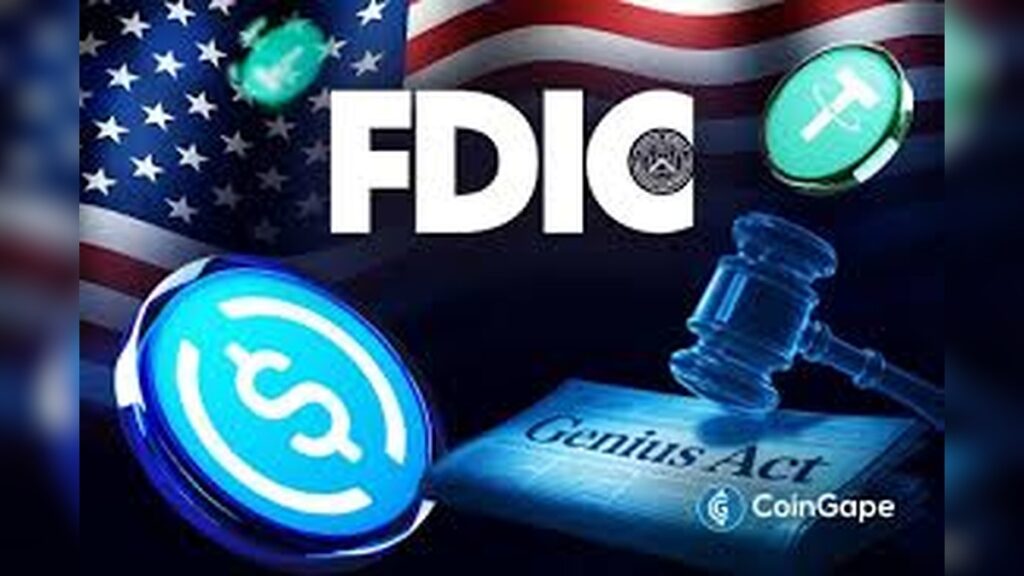
The regulatory spotlight on cryptocurrency in the United States just became even brighter.
As lawmakers and financial agencies continue building a legal framework for digital assets, the Federal Deposit Insurance Corporation has unveiled a proposal that could significantly reshape how stablecoin issuers operate.
The new proposal would require certain stablecoin companies supervised by the FDIC to follow many of the same anti-money laundering and sanctions rules already imposed on banks and other financial institutions.
For the crypto industry, the move signals another major step toward bringing digital finance under the same compliance umbrella as traditional banking.
FDIC Wants Stronger Oversight for Stablecoin Issuers
According to the proposal, FDIC-supervised Permitted Payment Stablecoin Issuers, commonly referred to as PPSIs, would need to comply with strict Anti-Money Laundering and Countering the Financing of Terrorism standards.
That includes following regulations tied to agencies such as:
- Financial Crimes Enforcement Network
- Office of Foreign Assets Control
The proposal would formally categorize these stablecoin issuers as financial institutions under the Bank Secrecy Act, a designation that carries extensive compliance obligations.
In simple terms, crypto firms handling payment stablecoins would be expected to operate much more like regulated banks.
What Stablecoin Companies Would Be Required to Do
If approved, the rule would introduce a broad list of compliance responsibilities for PPSIs.
These companies would need to establish full AML and sanctions programs, including:
- Internal compliance controls
- Dedicated compliance officers
- Employee training systems
- Independent audits and testing
- Customer identification procedures
- Suspicious activity reporting
- Transaction monitoring and blockchain screening tools
The proposal also highlights the growing importance of on-chain monitoring technology, reflecting regulators’ increasing focus on tracking crypto transactions directly on blockchain networks.
For many crypto companies, this would likely require expanded compliance teams and more advanced surveillance infrastructure.
The GENIUS Act Continues to Shape US Stablecoin Policy
The proposal is closely tied to the GENIUS Act, a developing legislative framework focused on regulating payment stablecoins in America.
Under the act, certain banks and savings institutions would be allowed to issue stablecoins through approved subsidiaries. Those subsidiaries would then fall under FDIC supervision.
The agency believes these rules are necessary to reduce financial crime risks while allowing stablecoins to grow within a controlled regulatory environment.
The proposal also follows another FDIC initiative introduced earlier in 2026 that focused on reserve requirements, capital standards, redemption rules, and operational risk management for stablecoin issuers.
Together, the measures show regulators are building a layered oversight system for the digital asset sector.
Why Regulators Are Tightening the Rules
Stablecoins have become one of the most important sectors in crypto because they are widely used for trading, payments, decentralized finance, and cross-border transfers.




Unlike volatile cryptocurrencies such as Bitcoin, stablecoins are usually pegged to assets like the US dollar.
However, regulators have repeatedly warned that without strong oversight, stablecoins could be exploited for money laundering, sanctions evasion, and illicit financial activity.
The collapse of several crypto firms in recent years also intensified pressure on lawmakers to establish clearer rules and stronger safeguards for digital assets.
US regulators increasingly appear determined to prevent the crypto sector from operating outside traditional financial compliance systems.
FDIC Signals Some Flexibility on Enforcement
Interestingly, the FDIC’s proposal does not appear entirely punitive.
The agency suggested that companies demonstrating strong and effective AML/CFT programs would generally avoid enforcement actions unless there was evidence of major or systemic failures.
The proposal would also require coordination between the FDIC and FinCEN before serious enforcement steps are taken against supervised stablecoin issuers.
That detail suggests regulators are trying to balance innovation with oversight rather than completely restricting the industry.
Crypto Industry Faces Another Defining Moment
For many in the digital asset industry, the proposal reflects the next phase of crypto’s evolution.
Early crypto markets often operated with limited oversight and relatively light compliance structures.
But as stablecoins become increasingly connected to mainstream finance, regulators are moving aggressively to close regulatory gaps.
Some industry leaders support clearer rules, arguing they could encourage institutional investment and improve consumer trust.
Others worry that excessive regulation may increase costs for startups and reduce innovation in decentralized finance ecosystems.
Still, the direction of US policy is becoming increasingly clear: stablecoin issuers are expected to meet standards similar to those governing banks.
Impact and Consequences
The proposed framework could have major consequences for the crypto market and financial industry.
If finalized, the rules would likely:
- Increase operational costs for stablecoin issuers
- Push smaller firms out of the market
- Encourage consolidation among larger crypto companies
- Improve regulatory legitimacy for compliant firms
- Strengthen institutional confidence in stablecoins
The proposal may also accelerate the integration of crypto into traditional banking systems, especially if major financial institutions begin issuing their own regulated stablecoins.
At the same time, stricter compliance demands could create tension between regulators and parts of the crypto community that prioritize decentralization and privacy.
What’s Next?
The public comment period for the proposal is expected to remain open until June 9, 2026.
After reviewing industry feedback, regulators are expected to release a final version of the rule later in the year, along with implementation timelines and enforcement guidance.
The FDIC estimates that between five and 30 supervised stablecoin issuers could seek approval during the early years of the framework.
Many of those firms are expected to rely on compliance infrastructure already used by parent banking institutions, which may help reduce additional costs.
Until then, crypto firms, banks, investors, and lawmakers will continue watching closely as the United States shapes one of the most important regulatory frameworks in digital asset history.
Summary
The FDIC has proposed a major new regulatory framework that would require certain stablecoin issuers to comply with strict anti-money laundering and sanctions standards similar to those used in traditional banking.
The rules would classify supervised stablecoin issuers as financial institutions under the Bank Secrecy Act, forcing them to implement detailed compliance systems, customer monitoring procedures, and reporting requirements.
The proposal reflects a broader US effort to integrate crypto into established financial oversight structures while attempting to reduce risks tied to illicit finance and market instability.
Bulleted Takeaways
- The FDIC wants stablecoin issuers to follow stricter AML and sanctions rules
- PPSIs would officially be treated as financial institutions under US law
- Companies would need compliance officers, audits, transaction monitoring, and reporting systems
- The proposal is linked to the developing GENIUS Act stablecoin framework
- Regulators are increasing oversight of the crypto industry after years of rapid growth
- Stablecoin firms with strong compliance programs may avoid major enforcement actions
- Final regulations are expected later in 2026 after the public comment period ends
- SEC in Washington pushes innovation exemption that triggers fierce debate over tokenized stock market fragmentation across United States financial exchanges
- Mike Novogratz battles Mike Belshe over failed Galaxy Digital and BitGo merger dispute in Delaware United States courtroom
- Forces Nakamoto reverse stock split decision as Nasdaq pressure shakes Bitcoin treasury company in United States markets
- US investors drive Hyperliquid ETFs surge as trading volume spikes across American crypto markets
- Glassnode reveals Bitcoin quantum exposure shaking global cryptocurrency markets worldwide
- Zcash forms bullish pattern in global crypto markets as traders in worldwide exchanges eye $1,000 breakout surge
- South Korean funeral company Bumo Sarang records massive crypto ETF losses as regulators scrutinize industry in Seoul financial shock
- Strategy Destroys Market Expectations as Bitcoin Treasury Company Strategy Buys 24869 Bitcoin in Massive United States Acquisition Shock
- Michael Saylor Sparks Massive Bitcoin Selloff Debate As Strategy Defends Its $65 Billion Crypto Treasury In United States
- Jerusalem Victims Families Sue Tether in New York Court Over Frozen 344 Million USDT Crypto Assets Linked to Iran
- Bitcoin Drops Toward $78000 as Traders React to Geopolitical Pressure and Oil Shock in Global Markets
- Nasdaq Welcomes 21Shares Hyperliquid ETF as Crypto Investors Pour Millions Into the New Wall Street Fund in the United States

