
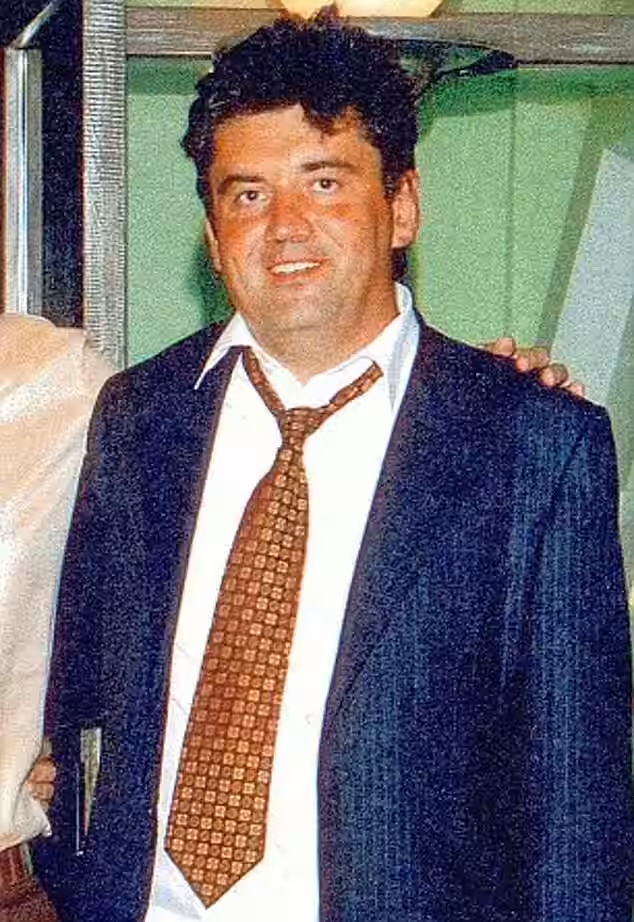
British authorities are under renewed pressure to revisit the mysterious death of Russian businessman and whistleblower Alexander Perepilichny, more than a decade after he collapsed while jogging near his home in Weybridge, Surrey.
Perepilichny, 44 at the time, had helped expose a multimillion-pound fraud involving Russian officials, and many fear he may have been poisoned in a manner similar to that used on Alexei Navalny.
The Circumstances of Perepilichny’s Death
Perepilichny died suddenly in 2012, and an inquest six years later officially ruled his death as natural.
Yet, witnesses reported he suffered severe vomiting before collapsing, raising suspicions of poisoning.
Later analyses revealed traces of a chemical found in the ultra-rare poisonous plant gelsemium elegans in his stomach.
Financial firm Hermitage Capital Management, which Perepilichny had helped, suggested at the time that his death might have been deliberate, pointing to his role in uncovering a $230 million (£142 million) money-laundering scheme connected to Russian officials.
However, the coroner cited a series of investigative failures by Surrey Police, including lost or disregarded evidence and missed CCTV opportunities, which prevented a full accounting of what had happened.
Links to the Navalny Poisoning
The recent international condemnation of Russia over the death of opposition leader Alexei Navalny has intensified scrutiny of Perepilichny’s case.
In February 2024, Navalny, who had been sentenced to 19 years’ imprisonment on contested charges, died in a Siberian penal colony.
Laboratory analysis revealed traces of epibatidine, a potent neurotoxin found naturally on Ecuadorian dart frogs and capable of causing paralysis and respiratory arrest.




Bill Browder, a key figure in the Perepilichny investigations, told reporters he was struck by the parallels between the two deaths.
“We were trying to determine what type of poison was used on Alexander Perepilichny in 2012, and with this new information on the Navalny poisoning, it has many similarities,” he said.
Browder also criticized Surrey Police for quickly closing Perepilichny’s case without preserving crucial evidence.
Surrey Police and Investigative Failures
During the 2018 inquest, it emerged that police had failed to examine CCTV from the area where Perepilichny collapsed and had lost or overlooked important evidence, including the contents of his stomach.
The mishandling of the case has led to calls for the UK authorities to reopen the investigation, particularly in light of the Navalny findings.
International Reactions
The UK, along with Sweden, Germany, the Netherlands, and France, has publicly accused the Russian state of causing Navalny’s death, highlighting the use of the same type of neurotoxin.
Yulia Navalnaya, Navalny’s widow, emphasized that Vladimir Putin must be held accountable and praised Britain and its allies for confirming the likely cause of her husband’s death.
What’s Next?
Experts and campaigners are now pushing for the Perepilichny case to be reopened.
Investigators may seek to reanalyze preserved samples, reconstruct the events leading up to his death, and potentially connect the findings to the methods used in Navalny’s poisoning.
Any renewed investigation could also pressure British authorities to examine historical Russian-linked poisoning cases more broadly.
Summary
Alexander Perepilichny, a Russian whistleblower who exposed a $230 million money-laundering scheme, died suddenly while jogging in Surrey in 2012.
Although initially ruled natural, traces of a poisonous chemical in his stomach and parallels with Alexei Navalny’s 2024 death have prompted calls for the UK to reopen the case.
Investigative lapses by Surrey Police, including lost evidence and unexamined CCTV, contributed to the inconclusive outcome.
Renewed scrutiny could shed light on state-linked poisonings and reexamine Perepilichny’s death in the context of international concerns about Russian political assassinations.

